

Most Cleveland homeowners pay between $7,000 and $20,000 for a professionally installed whole-home standby generator, with some high-demand or complex installs reaching up to $23,000 according to local pricing trends. The metro-adjusted mid-point is around $7,020 for a mid-size unit. That range comes from combining the generator unit itself with the full installation stack. Tri-County Services Electric & Plumbing handles both sides of that equation for Northeast Ohio homeowners, coordinating the electrical and plumbing trades a proper install requires.
A complete installed price typically covers:
- Generator unit (the box itself, sized to your home’s load)
- Automatic transfer switch (ATS) that disconnects you from the grid and switches power automatically
- Natural gas or propane hookup run by a qualified plumber
- Concrete pad or site prep beneath the unit
- Electrical wiring and conduit from the ATS to your panel
- Permits and inspections required by Cleveland and Ohio code
- Startup, commissioning, and load testing
The unit price alone tells you almost nothing. A 13 kW Cummins unit runs around $4,500 MSRP; a 20 kW unit typically costs around $6,000. — but permits, gas piping, and electrical integration routinely add several thousand dollars on top. That gap between sticker price and installed cost is where most homeowners get surprised.
Key Takeaways
A professionally installed whole-home standby generator in Cleveland typically costs $7,000–$20,000 for most projects, but some cases with larger generators or complex installation needs can reach up to $23,000. The installation stack — gas line, ATS, permits, and panel work — drives more of that variance than the generator unit itself.
| Point | Details |
|---|---|
| Cleveland installed cost range | Most projects fall between $7,000 and $20,000, with some higher-complexity installations reaching up to $23,000; metro-adjusted mid-point is around $7,020. |
| Biggest cost driver | Panel upgrades and gas line distance, not the unit price, cause the widest quote swings. |
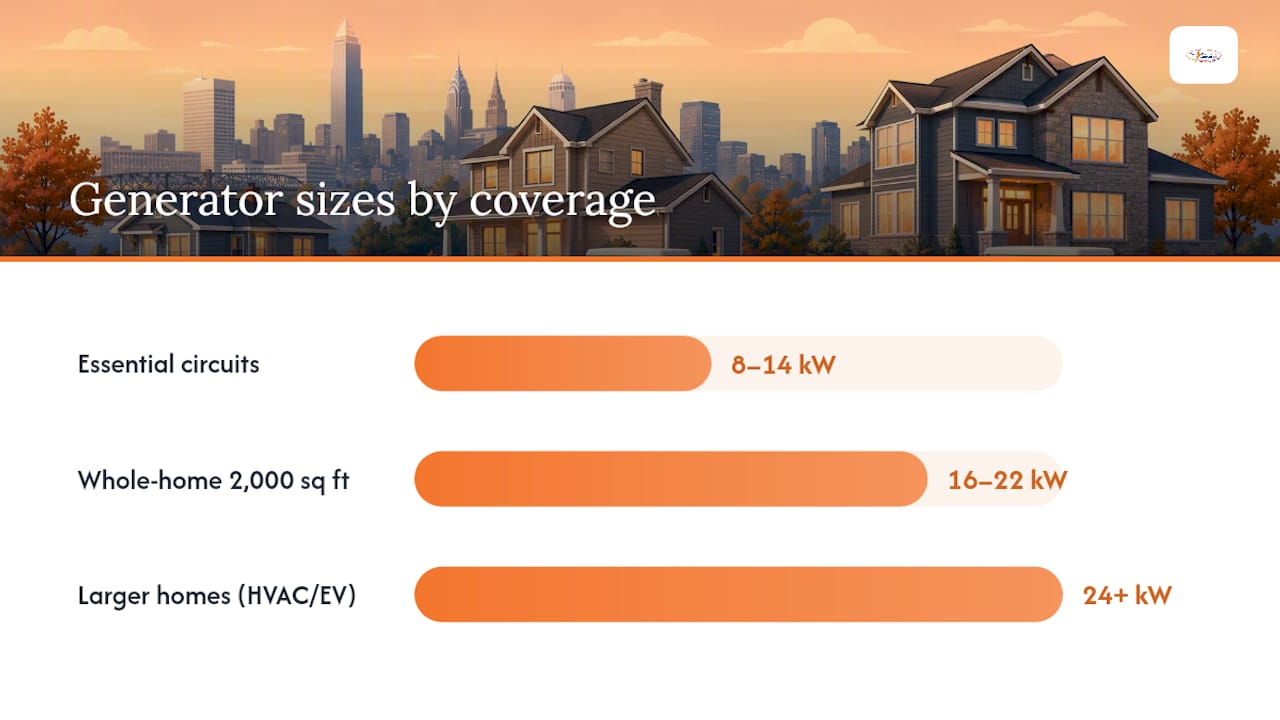
| Sizing approach | Essential circuits need 8–14 kW; whole-home coverage for a 2,000 sq ft home typically needs 16–22 kW. |
| Permit requirement | Cleveland-area installs require electrical and gas permits; utility notification for the ATS is mandatory. |
| Tri-County Services Electric & Plumbing | Handles both electrical and plumbing trades for Cleveland-area generator installs, from permits to commissioning. |
Table of Contents
- What does standby generator cost in Cleveland actually break down to?
- Sample installed budgets for common Cleveland home scenarios
- What variables cause the widest price swings?
- How do electricians size a standby generator for your home?
- What does installation actually involve, and how long does it take?
- What permits and inspections does Cleveland require?
- What are the ongoing costs after installation?
- How do you prepare for an accurate in-home quote?
- Why local expertise matters more than homeowners expect
- Tri-County Services Electric & Plumbing serves Cleveland homeowners from assessment to final inspection
- Sources
- FAQ
What does standby generator cost in Cleveland actually break down to?
Understanding the line items in a quote lets you compare bids fairly and spot what’s missing. Here’s how a typical Cleveland installation breaks down:
Installation work alone commonly runs $3,000–$8,000 on top of the unit cost, which is why whole-home standby systems typically land between $8,000 and $23,000 installed nationally.
The items that vary most by site are the gas line run and the panel condition. A meter 10 feet from the planned generator location is a very different job than a meter requiring 60 feet of new gas pipe through finished landscaping.
Pro Tip: The single most common hidden cost installers find during home visits is an undersized electrical panel. A 100-amp service panel that can’t support a whole-home generator will need a service upgrade before the ATS can be wired in — budget $1,500–$4,000 if your home is older or still running 100-amp service.-amp service.
Sample installed budgets for common Cleveland home scenarios
These four scenarios cover the range most Cleveland homeowners fall into. Assumptions are stated for each so you can adjust to your situation.
The mid-size scenario aligns closely with Cleveland-specific modeling that places many projects between $3,923 and $14,973, with Midwest labor rates generally running below coastal metros. What pushes a project from mid-range to high-end is almost always a combination of panel work and a long or complex gas run — not the generator unit itself.
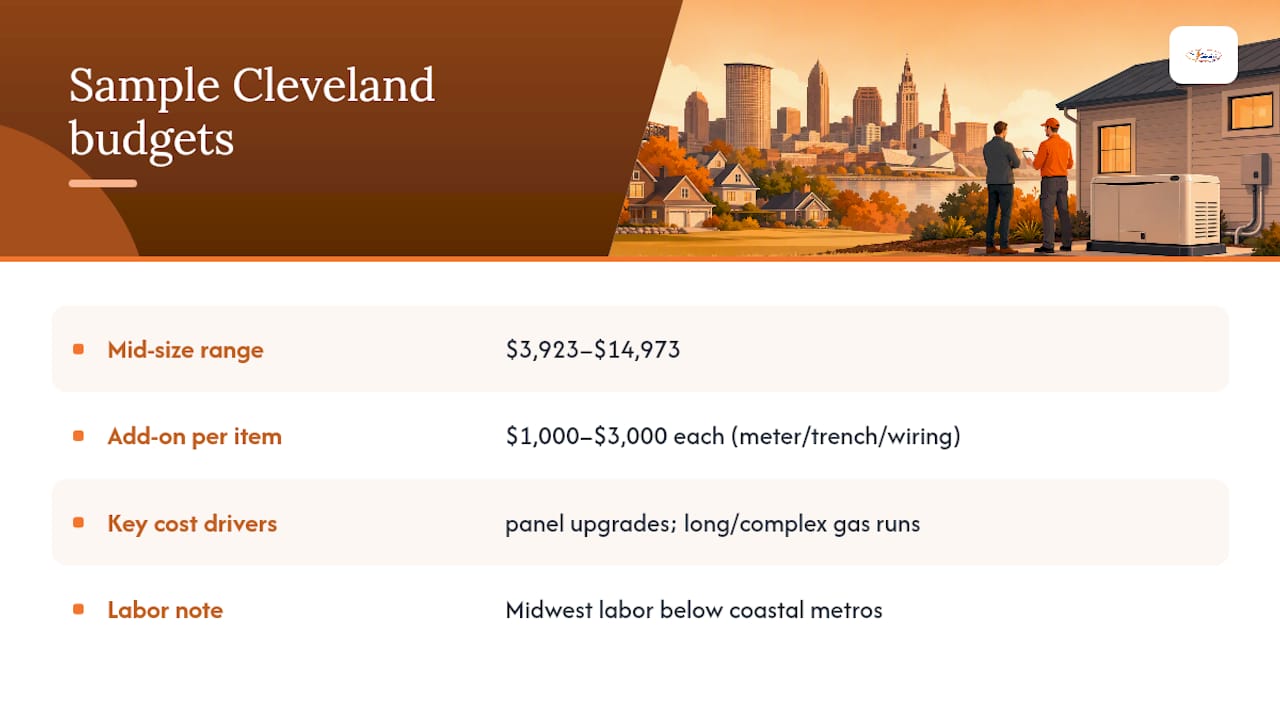
A new meter base, significant trenching through a finished yard, or a home with aluminum wiring can each add $1,000–$3,000 to any scenario above.
What variables cause the widest price swings?
Before a professional comes out for a site visit, knowing which factors drive cost helps you describe your property accurately and avoid quote surprises.
The biggest cost drivers:
- Generator kW size and coverage scope. Essential-circuit coverage (furnace, fridge, lights, sump pump) needs 8–14 kW. Whole-home coverage for a 2,000 sq ft house typically needs 16–22 kW. Larger homes or homes with electric Homes with HVAC, well pumps, or EV chargers typically require a 24 kW or larger generator. kW or more.
- Existing electrical panel capacity. A 200-amp panel in good condition is usually ready. A 100-amp panel, or one with no available breaker spaces, requires upgrade work before the ATS can be installed.
- Fuel type and existing gas infrastructure. Natural gas is the most common choice in Cleveland and the cheapest to run. Propane requires a tank installation and delivery contracts. If your home already has a gas meter, the run to the generator is shorter and cheaper.
- Distance and complexity of the gas line. Every additional foot of pipe, every penetration through a foundation wall, and every obstacle in the path adds labor and material cost.
- Local permit fees and inspection requirements. Cleveland and surrounding municipalities each set their own fee schedules. Some require separate electrical and plumbing permits; others bundle them.
- Site access and landscape conditions. Tight side yards, sloped lots, or finished landscaping that requires restoration all affect the installation crew’s time.
A quick homeowner checklist before your site visit:
- Note your current panel amperage (usually printed on the main breaker)
- Locate your gas meter and measure the approximate distance to where the generator would sit
- Identify any underground utilities, irrigation lines, or buried obstacles in the path
- Check whether your lot has any setback restrictions (HOA rules or municipal codes)
- List the critical loads you want backed up (HVAC, sump pump, medical equipment, refrigerators)
Items that typically require additional trades: the gas line hookup requires a qualified plumber or gas fitter, and the ATS wiring requires a professional electrician. Both trades need to be on-site and coordinated, which affects scheduling and sometimes adds a mobilization cost when they can’t work the same day.
How do electricians size a standby generator for your home?
Sizing isn’t guesswork. A professional starts with a load calculation: adding up the running watts of every circuit you want backed up, then accounting for starting currents. Motors (HVAC compressors, well pumps, sump pumps) draw two to three times their running wattage at startup, and that surge determines the minimum generator capacity.
Key sizing concepts:
- Essential loads vs. whole-home: Essential-circuit coverage protects the circuits you can’t live without. Whole-home coverage means every outlet and appliance runs normally during an outage.
- Nameplate vs. running watts: The nameplate on an appliance shows maximum draw. Running watts are typically lower, but the generator must handle the nameplate surge.
- Starting currents: A 5-ton central air unit can pull 40+ amps at startup. Size the generator for the surge, not just the steady-state load.
| Coverage Level | Generator Size | Typical Home Profile |
|---|---|---|
| Essential circuits | 8–14 kW | Small home, gas heat, critical loads only |
| Medium whole-home | 16–22 kW | 1,500–2,500 sq ft, central AC, standard appliances |
| Large whole-home | 24 kW or more | 2,500–4,000 sq ft, electric HVAC, well pump |
| High-load / commercial-grade | 24 kW or more | Large home, EV charger, pool equipment, workshop |
If you’re planning to add an EV charger or a hot tub in the next few years, size up now. Going from a 20 kW to a 26 kW unit at installation time costs far less than replacing the unit later.
What does installation actually involve, and how long does it take?
A Cleveland standby generator installation typically runs two to four weeks from signed contract to final inspection, though permit lead times can stretch that. Here’s the sequence:
- In-home assessment and sizing (Day 1): The installer measures your panel, locates the gas meter, walks the site, and confirms the kW size and ATS type. This is where the quote gets accurate.
- Permit application (Days 2–7): Electrical and gas permits are pulled from the relevant municipal authority. Cleveland-area permit offices typically process residential permits in three to ten business days, though some suburbs run faster.
- Utility notification (concurrent with permits): Your utility must be notified before an ATS is connected. This is a code requirement, not optional. The installer handles this, but confirm it’s in the scope of work.
- Site prep and pad installation (Day 1 of field work): The concrete pad is poured or a gravel base is set. The generator must sit level on a stable surface.
- Gas line hookup (same day or next): A qualified plumber runs the gas line from the meter to the generator location, installs the shutoff valve, and pressure-tests the line.
- Electrical wiring and ATS installation (same day or next): The electrician installs the ATS, runs conduit from the panel to the transfer switch, and connects the generator’s control wiring.
- Commissioning and load testing (final field day): The installer starts the unit, verifies automatic transfer operation, and runs a load test. This is also when the exercise schedule (typically weekly auto-run) gets programmed.
- Final inspection (Days 1–5 after commissioning): The municipal inspector signs off on both the electrical and gas work. The permit is closed.
What to have ready on installation day:
- Clear access to the electrical panel and meter
- Gas shutoff location identified and accessible
- Utility account number and contact info on hand
- Pets secured and work area clear of obstructions
The whole-home generator installation process involves more coordination than most homeowners expect — two trades, two permit types, and a utility notification, all sequenced correctly.
What permits and inspections does Cleveland require?
Ohio requires permits for both the electrical and gas work on a standby generator installation. Here’s what to expect:
- Electrical permit: Required for the ATS installation and any panel work. Issued by the local building department (City of Cleveland’s Division of Building and Housing for city addresses; individual municipalities for suburbs like Parma, Lakewood, or Euclid).
- Gas/plumbing permit: Required for the new gas line run. Also issued by the local building department or the county.
- Building or zoning permit: Some municipalities require a separate permit for the concrete pad or for placing a permanent structure within setback distances. Check your municipality’s zoning code.
- Final inspection: Both the electrical and gas work must pass inspection before the permit is closed. The inspector checks connections, clearances, and code compliance.
For utility notification, Ohio utilities require that any automatic transfer switch be installed with proper interlocking so the generator cannot back-feed the grid. Your installer submits the ATS specs to the utility as part of the interconnection process. Skipping this step can result in the utility disconnecting your service.
Pro Tip: Pull the permits yourself or confirm your installer is pulling them in their name. A generator installed without permits can create problems when you sell your home — and DIY electrical connections without proper permits carry real safety risks that no homeowner should take on.
What are the ongoing costs after installation?
The generator itself is just the beginning. Plan for these annual costs:
- Annual maintenance service: Most manufacturers recommend a yearly service that includes oil and filter changes, spark plug inspection, battery check, and a load test. Service contracts typically run $150–$400 per year depending on unit size and what’s included.
- Exercise runs: Standby generators run a short weekly self-test automatically. This uses a small amount of fuel but is essential for keeping the engine ready.
- Fuel costs during outages: Natural gas generators draw from your existing utility line, so fuel cost scales with outage length and load. Propane costs more per BTU and requires monitoring tank levels. Diesel units need on-site fuel storage and rotation.
- Extended warranty or service contract: Most units carry a five-year manufacturer warranty. Extended service contracts from the installer add coverage for labor and travel costs after the factory warranty expires.
Natural gas is the most cost-effective fuel for most Cleveland homeowners because it’s piped directly and priced competitively in the Midwest. Propane makes sense when natural gas isn’t available at the property.
Pro Tip: Before signing a purchase agreement, ask the installer specifically about local service response times. A generator that breaks down during a January ice storm is useless if the nearest service tech is four hours away. A local provider with Northeast Ohio coverage can reach you when it matters.
How do you prepare for an accurate in-home quote?
The more information you give an installer before the site visit, the more accurate the first quote will be. Here’s what they’ll measure and inspect:
What installers assess on-site:
- Main panel amperage and available breaker spaces
- Condition of the existing panel and service entrance
- Meter location and distance to the planned generator pad
- Soil type and landscape access for the gas line run
- Required clearances from windows, doors, and gas meters (code-specified)
- Whether a panel upgrade or new meter base is needed
Questions to ask during the assessment:
- What’s included in the written quote, and what’s listed as an allowance or exclusion?
- Who pulls the permits, and is that cost included?
- Which trades are subcontracted, and how does that affect the warranty?
- What’s the response time for warranty service calls?
- Does the quote include commissioning, load testing, and the first annual service?
Two trades are almost always required: a professional electrician for the ATS and panel work, and a qualified plumber or gas fitter for the fuel line. When those two trades are coordinated by a single contractor, scheduling is simpler and accountability is clearer. When they’re separate, you’re managing the timeline yourself.
National cost analyses consistently show that standby unit prices commonly fall in the $4,000–$10,000 band, with installation adding $2,000–$6,000 or more. Getting a written, itemized quote is the only way to know where your specific project lands.
Why local expertise matters more than homeowners expect
Cleveland winters are not forgiving. An ice storm that knocks out power for four days in January is a fundamentally different situation than a summer thunderstorm outage, and the installers who work here regularly know that. They’ve seen what happens to generators that weren’t properly sited for drainage, or ATS units that weren’t rated for the load swings a Northeast Ohio winter creates.
Permit offices in Cuyahoga County and the surrounding municipalities each have their own quirks. Some require a zoning review for the pad; others wave it through. Some inspectors want to see the gas pressure test documentation on-site; others check it at the office. A crew that’s pulled permits in these municipalities dozens of times moves through that process faster and with fewer surprises than an out-of-area contractor learning the local system on your dime.
There’s also the question of what happens after installation. A generator that develops a fault two years from now needs a service tech who can get to your home in hours, not days. Local continuity matters in a way that a national brand’s 800 number simply can’t replicate. Tri-Tri-County Services Electric & Plumbing has extensive experience working in Northeast Ohio since 1975., which means the same people who install your system are the ones who’ll answer the phone when you need service.
Tri-County Services Electric & Plumbing serves Cleveland homeowners from assessment to final inspection
For Cleveland homeowners who want one contractor coordinating the full project, Tri-County Services Electric & Plumbing handles both the electrical and plumbing sides of a standby generator installation. That means the ATS wiring, the panel work, the gas line hookup, and the permit coordination all run through a single point of contact — no juggling separate trades or wondering who’s responsible for what.

Tri-County has been serving Northeast Ohio since 1975. The team knows Cuyahoga County permit offices, local utility notification requirements, and the site conditions that commonly push Cleveland projects over budget. When you schedule an on-site assessment, you get an itemized quote that covers every line item — unit, ATS, gas run, pad, permits, and commissioning — with no surprises buried in the allowances. Contact Tri-County Services Electric & Plumbing to schedule your in-home assessment and get a written quote built around your home’s actual load and site conditions.
Sources
- How Much Does a Generator Cost? Average Price by Type
- Backup Generator Costs in 2026: What to Expect
- Generator Installation Cost in Cleveland, OH (2026) — Free Calculator | HomeCostCalc
- Standby Generator Installation Cost: 2026 Install-Only Breakdown | UseCalcPro
FAQ
What is the average cost to install a standby generator in Cleveland?
Most Cleveland homeowners pay between $7,000 and $20,000 for a professionally installed whole-home standby generator, with a metro-adjusted mid-point around $7,020 for a mid-size unit, according to Cleveland-specific cost modeling.
How much does a generator for a 2,000 sq ft house cost installed?
A 16–20 kW standby generator sized for a 2,000 sq ft Cleveland home typically runs $11,000–$16,000 installed, assuming a 200-amp panel in good condition and a standard gas line run.
Is there a tax credit for a whole-house generator in Ohio?
There is no federal or Ohio state tax credit specifically for whole-home standby generator installations as of 2026. Homeowners should confirm current incentive programs with a tax professional, as rules change and some medical-necessity situations may qualify for deductions.
Why shouldn’t I just hook up a generator myself?
Improper generator connections — including DIY transfer switch wiring — create serious risks of electrocution, fire, and back-feeding the utility grid. The CPSC warns against unsafe temporary wiring practices, and Ohio code requires permitted, inspected installations by qualified professionals for permanent standby systems.
What does Tri-County Services Electric & Plumbing include in a generator installation quote?
Tri-County Services Electric & Plumbing coordinates both the electrical and plumbing trades for Northeast Ohio generator installs, covering ATS installation, panel work, gas line hookup, permit coordination, and commissioning — with itemized quotes so homeowners know exactly what they’re paying for before work begins.