

The fastest fix for an outlet not working: plug a known-good lamp into it, then check for a tripped GFCI (even one in another room), then check the breaker panel. If you smell burning, see scorch marks, hear buzzing, or the breaker keeps tripping after a reset, stop testing and call a professional. A non-contact voltage tester helps confirm what you’re dealing with, but the NFPA is blunt about one thing: heat and arcing mean it’s time for Tri-County Services Electric & Plumbing, not a screwdriver.
TL;DR:
- Most dead outlets are caused by tripped GFCI outlets or a loose circuit breaker, which can often be fixed with simple resets or switches.
- Troubleshooting should include plugging in a known-good device, inspecting nearby GFCIs, and testing breaker panel status before considering wiring faults.
- Heat, burning smells, or arcing signs near an outlet indicate a serious problem requiring immediate professional intervention rather than DIY checks.
- A tripped GFCI in one part of the house can silence outlets across multiple rooms without visible indication, making comprehensive testing essential.
- Continuous outlet failure despite a working breaker often results from loose connections, worn contacts, or heat damage that needs professional diagnosis and repair.
Table of Contents
- Quick Checklist for a Dead Outlet
- Step-by-Step Troubleshooting With Basic Tools
- Why Outlets Fail Even When the Breaker Looks Fine
- Tools and Safety Checks Before You Touch Anything
- When to Call a Professional Electrician
- A Family-Owned Perspective on Electrical Safety
- Get a Professional Diagnosis From Tri-County Services Electric & Plumbing
- Sources
- FAQ
Quick Checklist for a Dead Outlet
Most dead outlets get solved in under five minutes without opening a single panel cover or unscrewing a faceplate. Run through this order before assuming the worst:
- Rule out the device. Plug a lamp, phone charger, or something else you know works into the dead outlet. If it doesn’t power up either, the problem is the outlet or its circuit, not your appliance.
- Hunt for GFCI outlets nearby. Check bathrooms, kitchens, garages, basements, and any exterior outlets. Press the RESET button firmly on each one you find, even if it looks fine.
- Check the breaker panel. Look for a breaker that’s not fully aligned with the others, sometimes called a half-tripped or soft trip.
- Flip nearby wall switches. Some outlets are wired to a switch, so a “dead” outlet might just be switched off.
- Test neighboring outlets. If several outlets in the same room or hallway are also dead, you’re likely dealing with one shared circuit problem rather than a single bad receptacle.
This sequence solves the majority of one outlet not working complaints without any tools, and it tells you a lot about where the real problem lives.
Step-by-Step Troubleshooting With Basic Tools
If the quick checklist didn’t fix things, a couple of inexpensive tools turn guesswork into a real diagnosis. This is where you find out whether you’re dealing with no power to outlet because of the device, the receptacle itself, or something further upstream in the wiring.
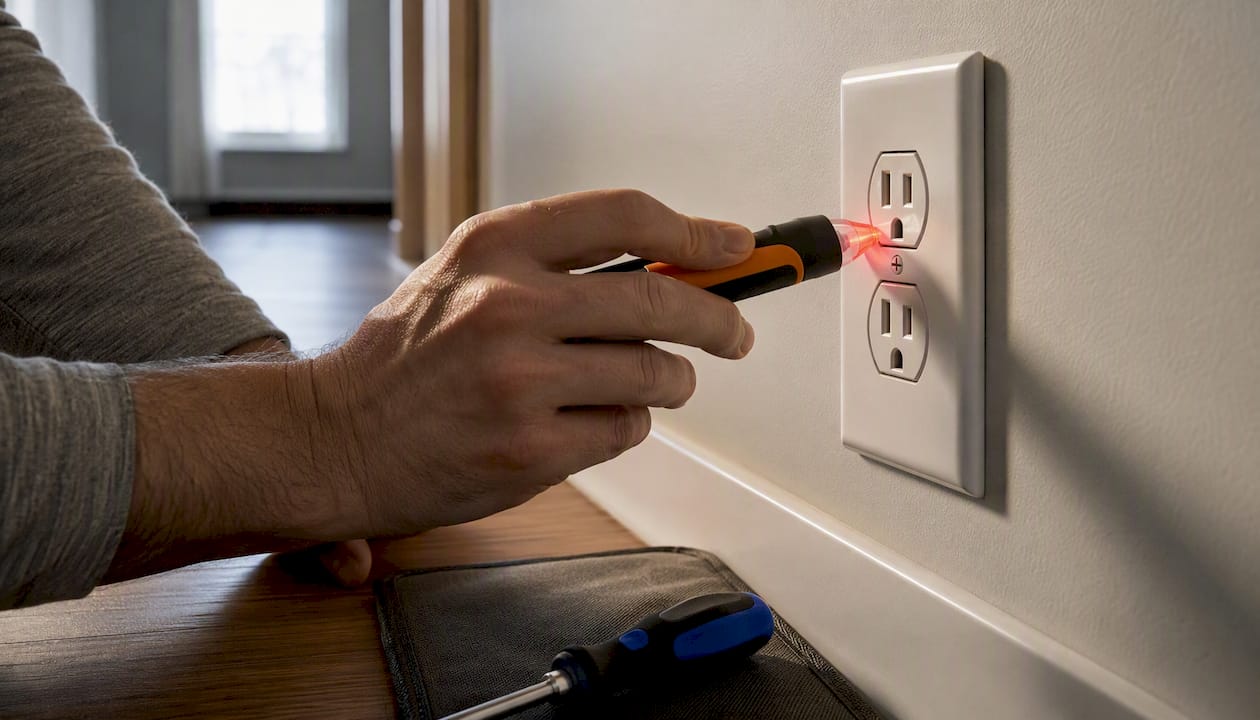
Before trusting any reading from a non-contact voltage tester, validate it first. Touch it to an outlet you know is live. It should signal power. Then touch it to an outlet you know is off (flip that breaker) to confirm it goes quiet. This “Live, Dead, Live” check catches a dead battery or a faulty tester before it sends you down the wrong path, a step Popular Mechanics recommends for exactly this reason.
Once your tester checks out, here’s what to do:
- Use a plug-in outlet tester or multimeter to check hot-to-neutral voltage. A healthy 120-volt outlet should read somewhere around 110 to 125 volts.
- A reading of zero at the dead outlet while neighboring outlets test fine points to an upstream fault, like a loose connection or a failed device earlier in the circuit.
- An outlet tester showing an “open neutral” or “reversed polarity” pattern on its indicator lights means there’s a wiring problem that goes beyond a simple reset.
- Check for GFCI protection you might have missed. A tripped GFCI outlet located elsewhere in the house can silently kill power to outlets in completely different rooms, since one GFCI often protects several downstream receptacles on the same circuit.
- Do a proper breaker hard reset: flip it fully OFF, wait three to five seconds, then push it firmly to ON. A breaker that looks “on” may not have mechanically re-latched after a partial trip, and a half-hearted flip won’t fix that.
- Test the top and bottom halves of the outlet separately, and flip every switch in the room. Some receptacles are half-hot, meaning one plug is always live and the other is controlled by a switch.
Pro Tip: Walk your circuit with the tester in hand instead of testing one outlet at a time. Following the outlet path outlet-by-outlet usually reveals exactly where power stops, and that’s often the first clue to which device actually failed.
If your visual check of the faceplate shows discoloration, a burnt smell around the screws, or a plate that feels warm to the touch, stop right there. That’s not a testing problem anymore. That’s a call-Tri-County-Services-Electric-&-Plumbing problem.
Why Outlets Fail Even When the Breaker Looks Fine
A breaker that hasn’t tripped doesn’t mean the circuit is healthy. Several unrelated issues can leave you with a dead outlet while every breaker in the panel sits calmly in the ON position.
- A distant GFCI killed the chain. GFCI outlets often protect a string of downstream receptacles, sometimes in different rooms entirely. A tripped GFCI in the garage or a bathroom can leave a bedroom outlet dead with zero indication anything’s wrong in that room.
- Loose or backstabbed connections. Outlets wired with the quick “backstab” push-in connections on the back, instead of screw terminals, are more prone to loosening over time. Because outlets are often daisy-chained, a loose connection at one outlet can cut power to every outlet after it in the sequence, making the actual fault look far away from where the symptom shows up.
- Worn internal contacts. Outlets simply wear out after enough plug-ins and removals. The internal spring contacts weaken, and a receptacle that once held a plug snugly starts delivering intermittent or no power at all. Replacement is usually the right call here.
- Heat or surge damage. Discoloration around the slots, a faceplate that’s warm, or plastic that looks slightly melted are signs of a surge event or long-term heat stress. This calls for inspection, not a swap-and-forget fix.
- Older panels with legacy fuses. Homes still running on fuse panels sometimes lose power to a whole circuit because a fuse blew rather than a breaker tripping. If your panel has fuses instead of breakers, that’s worth mentioning to whoever comes out to look at it.
Tools and Safety Checks Before You Touch Anything
Testing an outlet safely comes down to three tools and one habit: verify before you trust.
- Non-contact voltage tester. Cheap, simple, and the fastest way to check for live voltage without touching a wire. Validate it against a known-live and known-dead outlet first.
- Plug-in outlet tester. The small three-light gadget that plugs directly into a receptacle. Different light patterns flag an open ground, an open neutral, or reversed polarity, and most testers come with a legend printed right on the case.
- Multimeter. Reads hot-to-neutral voltage directly, with 110 to 125 volts considered normal for a standard household outlet. If you’re not familiar with multimeter probes and settings, this is a good spot to hand things off to a professional rather than risk a false reading or a shock.
A circuit breaker finder also earns its cost fast in homes with poorly labeled panels. Instead of flipping breakers one at a time and running back and forth to check, the finder locates the exact breaker feeding a specific outlet in seconds.
Before any hands-on work: shut the breaker OFF, confirm it’s dead with your tester, use tools with insulated handles, take off rings and watches, and keep kids and pets clear of the work area. GFCIs exist specifically because wet locations dramatically raise shock risk, which is part of why the CPSC pushes GFCI protection so hard for kitchens, bathrooms, and outdoor circuits.
One more rule, and it overrides everything else on this list: if you notice heat, a burning smell, buzzing, visible arcing, or melted plastic anywhere near the outlet, turn the breaker OFF and call a professional immediately. No test result is worth the risk of pushing further on your own.
When to Call a Professional Electrician
Some signs mean stop testing and pick up the phone right now: a burning smell, a warm or hot wall plate, visible arcing, melted plastic around the slots, or a breaker that trips again the moment you reset it.
Other situations aren’t emergencies but still call for a trained eye rather than more DIY troubleshooting:
- Multiple dead outlets spread across different rooms, not just one circuit
- Power that comes and goes without a clear pattern
- Outlets that failed right after a storm or a power surge
- Any sign of a loose splice or junction further back in the wiring
Tracing hidden junctions, repairing splices, and confirming a panel is up to code all require going past what non-invasive testing can safely tell you. A service visit typically starts with a diagnostic walkthrough, followed by a clear recommendation, whether that’s a straightforward outlet replacement or tracing the circuit back to find where it actually broke.
Pro Tip: Write down which outlets are dead and when the problem started before your service call. That timeline alone often cuts diagnostic time in half.
A Family-Owned Perspective on Electrical Safety
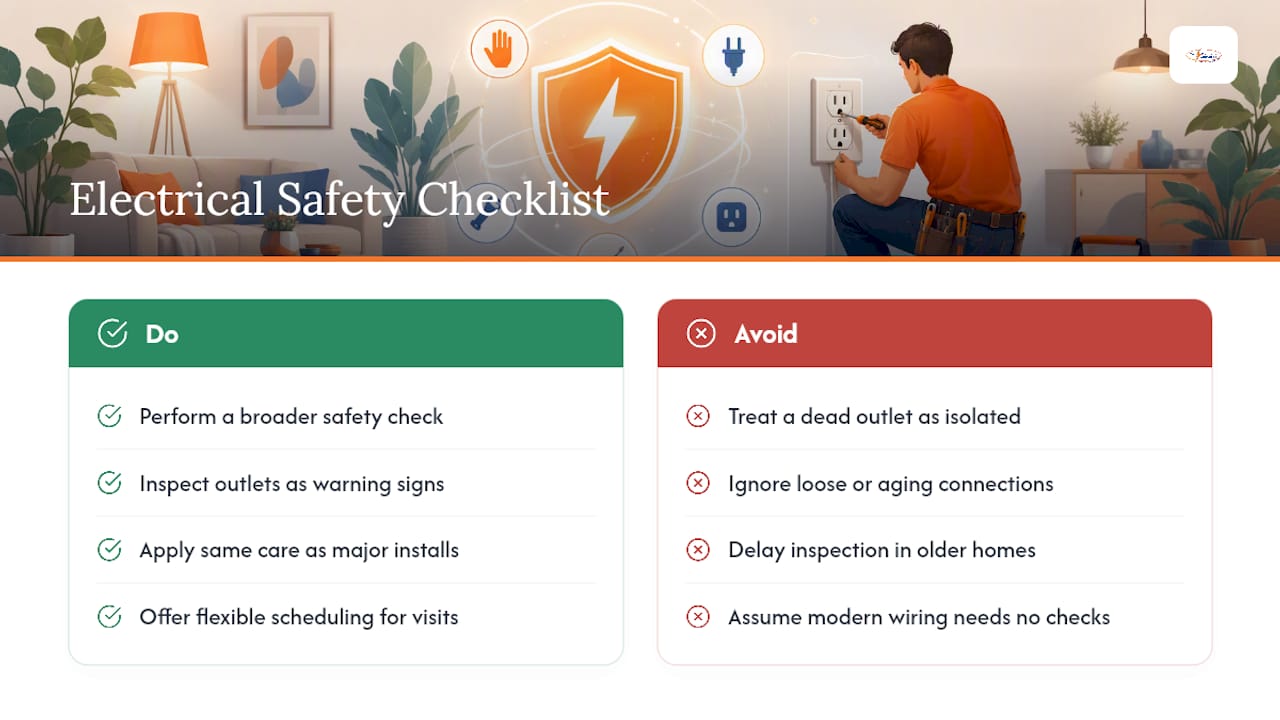
Tri-County Services Electric & Plumbing has worked on homes across Northeast Ohio since 1975, and one pattern shows up constantly: outlet failures rarely stay isolated for long. A loose connection that seems minor today tends to get worse, not better, especially in older homes with decades of wear on the wiring.
That’s why every visit includes a broader safety check, not just a fix for the one outlet that stopped working. Flexible scheduling keeps disruption low, and the same attention to detail that goes into installing an EV charger or a home generator applies to something as ordinary as a dead receptacle. Modern electrical systems have more going on behind the wall than they used to, and outlet problems are often the first visible sign of it.
— Lindsay Paramore
Get a Professional Diagnosis From Tri-County Services Electric & Plumbing
Testing your own outlets buys you time and information, but tracing a loose splice, replacing a worn receptacle, or repairing a panel-level fault is where DIY troubleshooting should hand off to a trained technician. Tri-County Services Electric & Plumbing has been solving exactly these problems across Northeast Ohio since 1975, with technicians who know how to trace a dead circuit back to its actual source instead of just replacing the part that failed most visibly.

Our electrical repair service covers outlet replacement, circuit tracing, and panel diagnostics, all scheduled around your day rather than the other way around. If the fault traces back to the breaker box itself, our circuit and panel repair team handles that too, so you’re not stuck coordinating two separate visits for one connected problem. Call (440) 253-0332 to get a technician out to look at it, or start at Tricountyelectricservice if you’d rather request a visit online first.
Sources
For deeper background on electrical code and shock hazards, the NFPA’s National Electrical Code and CPSC safety guidance are the two most authoritative sources available to homeowners. If your issue turns out to involve a breaker rather than a receptacle, our guide on breaker troubleshooting covers that ground in more depth. And if outlets aren’t the only thing acting up, check our post on lights not working for related quick checks.
- The wall outlet is dead. Now what? — Popular Mechanics
- Outlet Not Working? A Troubleshooting Order That Actually Works | WattSimple
- Electrical outlet not working? – Bob Vila
FAQ
Why is my outlet suddenly not working?
The most common causes are a tripped GFCI (possibly in another room), a half-tripped breaker, a switch controlling the outlet, or a failed device plugged into it. Less commonly, it’s a loose connection or worn-out receptacle that needs replacement.
How do you fix an outlet that doesn’t work?
Start by testing with a known-good device, then reset any GFCI outlets in the house, then hard reset the breaker (OFF, wait a few seconds, then ON). If none of that restores power, the issue is likely wiring-related and needs a professional diagnosis.
How do I know if my outlet is blown?
A blown or failed outlet usually shows no voltage on a plug-in tester even when the breaker is on and other outlets nearby work fine. Visible scorch marks, a loose plug fit, or a warm faceplate are additional signs the receptacle itself has failed.
Why is my outlet not working but the breaker isn’t tripped?
This is almost always a tripped GFCI somewhere else in the house protecting that outlet, or a “soft trip” where the breaker looks ON but hasn’t fully re-latched. Check for GFCIs in bathrooms, garages, and exterior outlets before assuming the wiring itself has failed.