
Outdoor light no electricity is defined as any lighting solution that operates without connection to a conventional electrical outlet or hardwired circuit, relying instead on solar power or battery technology to illuminate outdoor spaces. These systems use weather-resistant LED fixtures to deliver safe, effective light for gardens, pathways, patios, and emergency situations. The two main categories are solar outdoor lighting and battery powered garden lights, each with distinct strengths depending on your yard’s sun exposure and lighting goals. For Cleveland-Akron homeowners dealing with Ohio’s mix of sunny summers and overcast winters, understanding the difference between these options is the first step toward a well-lit yard without a single wire.
What types of outdoor lights operate without electricity?
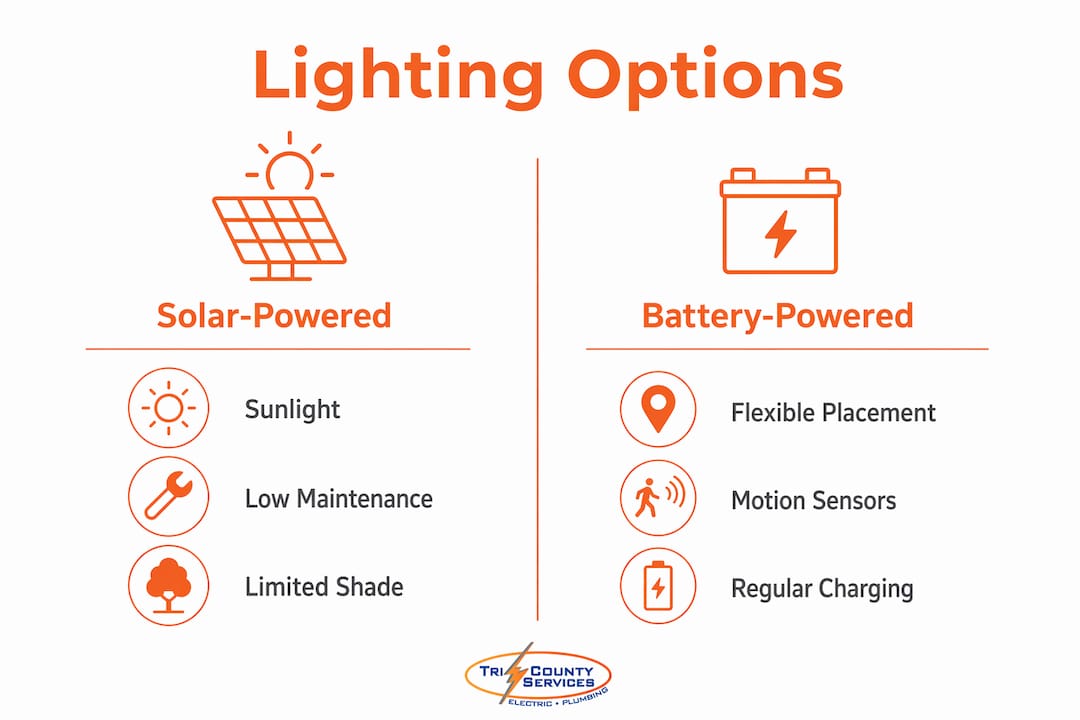
Outdoor lights without electricity fall into two primary categories: solar-powered and battery-powered. Solar lights work by collecting energy through a photovoltaic panel during daylight hours and storing it in an internal rechargeable battery. Battery-powered lights skip the panel entirely and run on replaceable or rechargeable cells, making them the better choice when sunlight is limited or when you need higher brightness.
Solar-powered lights
Solar outdoor lighting is the most popular choice for ambient and pathway use. These fixtures require 8–10 hours of direct sunlight to reach a full charge. That means placement matters enormously. A solar stake light buried under a tree canopy will deliver a fraction of its rated runtime. In Northeast Ohio, where cloud cover is common from October through march, solar lights work best in south-facing, open locations.

Battery-powered lights
Battery powered garden lights give you placement freedom that solar cannot match. You can mount them under eaves, inside covered patios, or in shaded garden corners where a solar panel would be useless. Rechargeable battery-powered wall lights with motion sensor capability are rated IP54 for outdoor durability, meaning they resist dust and water splashing from any direction. That rating makes them a reliable choice for entryways and covered porches.
Comparing the two options
| Feature | Solar-powered | Battery-powered |
|---|---|---|
| Power source | Sunlight via photovoltaic panel | Replaceable or rechargeable batteries |
| Best use | Pathways, ambient garden lighting | High-intensity, shaded, or security lighting |
| Weather rating | Typically IP44 or higher | Often IP54 or higher |
| Maintenance | Panel cleaning every 3–6 months | Battery replacement or recharging |
| Sun dependency | High | None |
IP44 protects against solid objects larger than 1mm and water splashing from any angle. IP54 adds dust resistance on top of that. Indoor-rated lights fail quickly outdoors, so always verify the IP rating before buying.
Pro Tip: Check the IP rating printed on the fixture or packaging before purchasing. Any light rated below IP44 belongs indoors, regardless of how it is marketed.
How to select and maintain outdoor lights without electricity
Choosing the right wireless outdoor lights starts with your yard’s specific conditions, not the product’s marketing claims. Sun exposure, mounting location, and how long you need the light to run each night all determine which system performs best for you.
Placement and solar panel positioning
Solar lights placed in shaded areas may operate at less than 50% of their expected runtime compared to full-sun placement. That is a significant performance drop. Position solar panels where they receive unobstructed southern exposure, and trim any branches that cast afternoon shadows across the panel face.
Battery management
Battery-powered lights require consistent attention to stay reliable. Follow these steps to get the most from your system:
- Use the same battery brand and type throughout each fixture. Mixing battery brands or pairing old cells with new ones causes leakage and shortens the device’s lifespan.
- Activate the built-in timer. Many battery-operated outdoor lights include 6-hour timer cycles that conserve power and extend the time between charges or replacements.
- Recharge before full depletion. Running rechargeable cells completely flat repeatedly degrades their capacity faster than partial cycling.
- Store spare batteries indoors during winter. Cold temperatures reduce battery output. Keeping a charged spare set inside means you can swap quickly on cold Ohio nights.
LED lifespan and usage patterns
LED lights without electricity last significantly longer than incandescent alternatives. LED lifespan can reach 20,000–25,000 hours under normal use. That translates to years of nightly operation before you need to replace the bulb itself. Using dimming or power-saving modes cuts brightness slightly but can double runtime, which is a worthwhile trade for ambient lighting applications.
Pro Tip: Clean solar panels every 3–6 months with a damp cloth. Dust and pollen buildup on the panel surface reduces charging efficiency more than most homeowners expect.
What are effective installation and layering strategies for outdoor lighting without electricity?
The best outdoor lighting designs use multiple fixture types working together rather than relying on a single product. Layering lighting styles for enhanced aesthetics and function is the standard approach used by professional designers, and it applies just as well to solar and battery-powered systems.
Mounting options
- Ground stakes: The simplest installation. Push the stake into soil along a pathway or garden bed. No tools required.
- Wall mounts: Rechargeable wall lights attach with screws to siding, brick, or fencing. They work well for entryways and garage walls where you need directional light.
- Hanging fixtures: String lights and lanterns hang from pergolas, fence posts, or tree branches. These create ambient overhead light without any wiring.
Layering for effect
Combine path lights at ground level with wall-mounted accent lights at mid-height and overhead string lights for a complete outdoor lighting scheme. Path lights guide movement and define edges. Wall lights create pools of focused illumination near doors and steps. String lights add warmth and visual depth across a larger area. Each layer serves a different purpose, and together they eliminate dark zones that a single fixture type would leave behind.
“Solar-powered outdoor lighting has moved well beyond simple pathway stakes. When you layer path lights, wall-mounted accents, and overhead string lights, you create an outdoor space that feels designed rather than just lit. The best results come from treating light as an architectural element, not an afterthought.”
Motion-activated lights add a security layer on top of the aesthetic design. Motion sensor modes can provide up to 15 days of battery life per charge in some models by staying dark until triggered. Place these near entry points, side gates, and dark corners where an always-on light would drain batteries quickly. For homeowners interested in deterring intruders with lighting, motion-activated placement at approach angles is more effective than static ambient lighting alone.
Power-saving modes that include dimming, glowing, and twinkling reduce brightness but double runtime. Use these modes for decorative string lights and garden accents where full brightness is not needed.
What are practical uses and applications of outdoor lights without electricity?
Wireless outdoor lights serve a wider range of situations than most homeowners initially consider. The applications go well beyond decorative garden accents.
- Garden and landscape lighting: Solar stake lights and low-voltage LED spotlights highlight plantings, trees, and garden beds without trenching or wiring. They are the most common application for eco-friendly garden lights.
- Pathway and driveway illumination: Path lights spaced 6–8 feet apart along a walkway provide safe footing after dark. Battery-powered options work in areas where the driveway runs under a carport or tree cover that would block solar charging.
- Patio and deck ambiance: String lights and hanging lanterns create a comfortable outdoor living space without any electrical work. These are the fastest and least expensive way to transform a plain deck.
- Remote and off-grid areas: Detached garages, garden sheds, and back corners of large properties often lack outdoor outlets. Battery-powered lights solve this without running new circuits.
- Emergency lighting: When power outages hit Northeast Ohio during ice storms or severe weather, pre-charged battery-powered lights provide immediate illumination. Solar lighting should not be solely relied on for security where sunlight is inconsistent, which makes battery backups especially valuable during Ohio winters.
For projects that go beyond what solar and battery systems can handle, such as permanent hardwired fixtures, landscape lighting circuits, or whole-property lighting design, Tri-County Services Electric & Plumbing provides professional outdoor lighting installation across the Cleveland-Akron area. Their certified technicians handle the electrical work so you can focus on the design.
For homeowners who want a broader overview of solar landscape options before committing to a system, solar landscape light reviews cover a range of products suited to different yard sizes and budgets.
Key takeaways
Solar and battery-powered LED lights are the most reliable outdoor light no electricity options, and choosing between them depends entirely on your yard’s sun exposure, mounting location, and brightness needs.
| Point | Details |
|---|---|
| Two core categories | Solar-powered suits open, sunny areas; battery-powered works anywhere regardless of sun exposure. |
| IP rating is non-negotiable | Use IP44 or higher for any outdoor fixture to protect against dust and water damage. |
| Placement drives solar performance | Shaded solar lights may deliver less than 50% of rated runtime compared to full-sun placement. |
| Battery management extends life | Use matching battery brands, activate timers, and avoid full depletion to maximize lifespan. |
| Layering creates better results | Combining path, wall, and overhead lights eliminates dark zones and improves both safety and curb appeal. |
What I’ve learned after years of watching homeowners light their yards
By Lindsay Paramore
The most common mistake I see is homeowners buying solar lights based on the brightness claim on the box, then placing them in the shadiest corner of the yard and wondering why they go dark by 9 PM. The physics are simple: no sun, no charge. But the marketing rarely says that clearly.
The second mistake is treating outdoor lighting as a single-product problem. One type of fixture cannot do everything well. A motion-activated wall light handles security. A pathway stake handles navigation. A string light handles ambiance. When you try to make one product do all three jobs, you end up with a yard that is either too bright in one spot or completely dark everywhere else.
My honest recommendation for Cleveland-Akron homeowners is to start with battery-powered lights for any location that gets less than six hours of direct sun daily. Ohio’s cloud cover from fall through early spring makes solar unreliable as a primary source in shaded spots. Use solar where you have genuine southern exposure, and layer in battery-powered motion lights near entry points for security.
If your project involves more than a few fixtures or you want permanent hardwired lighting alongside your wireless options, get a professional involved early. The design conversation is worth more than the installation itself.
— Lindsay Paramore
Outdoor lighting support from Tri-County Services Electric & Plumbing
Solar and battery-powered lights handle a lot, but some outdoor lighting projects call for a professional touch. Tri-County Services Electric & Plumbing has served Northeast Ohio homeowners since 1975, and the team knows how to design outdoor lighting systems that combine wireless fixtures with hardwired solutions for complete, reliable coverage. Whether you need a single exterior outlet added to support a charging station for your battery lights or a full outdoor lighting installation across your property, Tri-County’s technicians work around your schedule and treat your home with care. Contact Tri-County Services Electric & Plumbing to discuss your outdoor lighting project and get a plan that fits your yard and your budget.
FAQ
What is the best outdoor light for areas with no electricity?
Battery-powered LED lights with motion sensors are the most reliable choice for areas with no sun access or electrical outlets. Solar lights work well in open, south-facing locations that receive 8–10 hours of direct sunlight daily.
How long do solar outdoor lights last on a full charge?
Runtime depends on sun exposure during charging. Solar lights placed in full sun can run through the night, while lights in shaded areas may deliver less than 50% of their rated runtime.
What IP rating do outdoor lights need?
Any outdoor light needs a minimum IP44 rating to withstand dust and splashing water. IP54 or higher is better for exposed locations like entryways, driveways, and areas subject to heavy rain.
Do motion-activated lights save battery life?
Motion sensor modes extend battery life significantly by keeping the light off until triggered. Some models deliver up to 15 days of battery life per charge when operating in motion-sensor mode only.
Can solar lights work as security lighting in Northeast Ohio?
Solar lights have limits for security use in areas with inconsistent sunlight, including shaded yards and Ohio winters. Battery-powered motion-activated lights are a more dependable security option during low-sun months.