

To minimize repair disruption, prioritize (1) rapid detection and triage, (2) parts and vendor readiness, and (3) a scripted rapid-response workflow — then schedule any remaining work into planned windows. That sequence is the difference between a 45-minute fix and a two-day outage. OSHA requires worker-protection measures during any maintenance affecting site access, so safety compliance belongs in your workflow from day one, not as an afterthought. Tri-County Services Electric & Plumbing, serving Northeast Ohio since 1975, builds exactly this kind of pre-planned, low-disruption service model for commercial and residential clients.
Three actions to start this week:
- Map your five most critical assets, assign each an Asset Criticality Ranking (ACR), and set inspection intervals based on that ranking.
- Pre-qualify at least one after-hours contractor for electrical and plumbing work, with a documented response-time commitment in writing.
- Create a one-page runbook for your single highest-risk failure scenario, including who gets called, in what order, and where the spare parts are.
The bottom line: Facilities that combine mobile CMMS tools, forward-stocked spares, and scripted runbooks consistently report significant reductions in Mean Time To Repair (MTTR). According to PagerDuty’s MTTR reduction guide, automated diagnostics and runbook execution have cut real-world resolution times from hours to minutes in documented customer cases.
Table of Contents
- How preventive and predictive maintenance keeps repairs from becoming crises
- How automation, IoT, and analytics shorten detection and diagnosis
- How to structure vendor relationships to reduce contractor-caused delays
- Scheduling and stakeholder communication during planned repairs
- Staff training and cross-training to keep operations running during repairs
- Standardize equipment and manage spare parts to speed first-time fixes
- Rapid-response workflows and runbooks that shrink MTTR
- Your 30/90/365-day implementation checklist
- What these strategies mean for electrical and plumbing repairs specifically
- Key Takeaways
- The real reason most disruption-reduction programs stall
- Tri-County Services Electric & Plumbing: built for low-disruption repairs in Northeast Ohio
- Useful sources and further reading
- FAQ
How preventive and predictive maintenance keeps repairs from becoming crises
Most unplanned repairs are not surprises. They are inspections that never happened.
Build a tiered inspection schedule
Start by assigning every asset an ACR score based on three factors: what fails if it goes down, how fast it degrades, and how hard it is to replace. Critical assets (ACR tier 1) get monthly inspections. Important assets (tier 2) get quarterly checks. Low-priority assets (tier 3) get annual reviews or run-to-fail treatment.
Once you have tiers, map the P-F interval — the gap between when a defect becomes detectable and when it causes failure. If a pump bearing gives you a six-week P-F window, a four-week inspection cadence catches it in time. That is the shift from time-based maintenance (TBM) to condition-based maintenance (CBM): you inspect when the asset tells you to, not just on a calendar.
Pilot predictive monitoring in 30 days
- Select two or three tier-1 assets with known failure histories.
- Install low-cost sensors (vibration, temperature, or current draw depending on asset type).
- Set alarm thresholds at 80% of the historical failure value, not at the failure point itself.
- Route alerts to your CMMS so they auto-generate an inspection work order.
- After 30 days, review which alerts led to real findings and adjust thresholds accordingly.
Pro Tip: If a repair comes in as an emergency in the first 30 days of your pilot, document it fully — failure mode, parts used, time to fix — and immediately schedule a planned replacement for the identical component on any other asset of the same type. One emergency, properly documented, can prevent three more.
Research consistently shows that proactive maintenance programs supported by condition monitoring produce significant drops in unplanned downtime. Batching related repairs together amplifies those gains: research on repair batching shows that scheduling multiple related component fixes in a single shutdown can cut total repair costs significantly when fixed overhead costs are high.
How automation, IoT, and analytics shorten detection and diagnosis
The fastest MTTR wins come from eliminating information friction, not from pushing technicians to work faster. A technician who arrives on-site without schematics, part numbers, or failure history will spend the first 40 minutes of every job just getting oriented.
From sensor to work order: a practical stack
| Layer | Tool type | What it does |
|---|---|---|
| Asset | Sensor (vibration, temp, current, flow) | Captures real-time condition data |
| Edge | Local controller or IoT gateway | Filters noise, triggers threshold alerts |
| Platform | Mobile CMMS (e.g., ServiceChannel) | Receives alert, auto-creates work order |
| Technician | Mobile app with QR asset scan | Pulls history, parts list, schematics on-site |
| AI layer | Embedded AI (e.g., Ultimo) | Suggests likely failure cause and fix steps |
ServiceChannel documents how retail facilities using this kind of automation and analytics approach reported major reductions in maintenance disruption and better alignment of work to low-traffic windows. Ultimo’s embedded AI goes further: automatic image description, AI-assisted troubleshooting, and suggested work instructions have driven measurable MTTR reductions in customer deployments.
Quick wins you can deploy in a week:
- Enable auto-work-order creation from sensor alerts in your CMMS.
- Add photo attachments as a required field on every work order closure.
- Print and attach QR asset tags to your top 20 critical assets so technicians pull history instantly on arrival.
- Link your spare parts inventory to open work orders so parts are reserved before the technician leaves the shop.
Oxmaint’s CMMS research reports facilities using mobile-first CMMS workflows with QR scanning and linked inventory saw large reductions in emergency procurement events reported in vendor case descriptions.
How to structure vendor relationships to reduce contractor-caused delays
A contractor who cannot respond until Monday morning is not a vendor relationship — it is a liability. Structure your vendor agreements before you need them.
Contractor vetting checklist:
- Confirmed availability for night and weekend work, in writing.
- Documented average response time for emergency calls (target: under four hours for critical systems).
- Proof of current insurance and relevant certifications.
- Familiarity with your specific asset types (electrical panels, plumbing systems, HVAC).
- Clear communication protocol: who calls whom, what information is shared first, and how updates are relayed.
Contract and SOW items that reduce disruption:
- Define response windows explicitly (e.g., “on-site within two hours for tier-1 assets”).
- Require staging and cleanup plans as part of the scope of work.
- Set scope boundaries so contractors do not expand work without approval, which extends downtime.
- Include a fallback clause naming a secondary vendor if the primary cannot respond.
For complex or multi-contractor jobs, assign a single point of contact on your side and require daily status check-ins. Coordination gaps between trades — an electrician waiting on a plumber, or vice versa — are one of the most common causes of extended downtime. Guidance on reducing appliance and equipment downtime reinforces that scheduling coordination between service providers is as important as the technical work itself.
Build a preferred-vendor roster with at least two qualified contractors per critical trade. The fallback is not a backup plan — it is part of your standard operating procedure.
Scheduling and stakeholder communication during planned repairs
Picking the right window is half the battle. The other half is making sure everyone who needs to know, knows.
How to select low-impact windows:
- Pull 90 days of traffic, sales, or occupancy data and identify your three lowest-activity periods per week.
- Cross-reference with seasonal patterns — a retail facility’s slowest window in January is not the same as July.
- Avoid scheduling disruptive work within 48 hours of a known high-traffic event.
- For multi-day jobs, sequence work so the highest-disruption phase (power shutdowns, water shutoffs) falls on the lowest-traffic day.
Stakeholder communication template (advance notice):
| Audience | Notice lead time | Channel | Key message |
|---|---|---|---|
| Internal operations | 7 days | Email + team meeting | Scope, dates, affected areas, contingency plan |
| Customers / tenants | 3–7 days | Posted notice + email | What is affected, when, and what alternatives exist |
| Emergency services | 48 hours | Direct call | Site access changes, hazard areas |
| Contractors | 14 days | Written SOW | Staging, access, cleanup, scope |
For larger projects involving site access changes, a Transportation Management Plan (TMP) approach scales well beyond road construction. TTI’s research on reducing construction and maintenance disruptions shows that coordinating temporary traffic control, operations, and public information through a single plan reduces impacts and speeds project delivery — a model any facility manager can adapt for major maintenance work.
Staff training and cross-training to keep operations running during repairs
A repair that takes four hours should not shut down your entire operation for four hours. Cross-training is the gap between those two outcomes.
Who to include in cross-training:
- Operations supervisors who need to authorize workarounds and communicate status.
- Floor staff who run equipment or processes adjacent to the repair zone.
- Any role that handles customer-facing tasks that could be affected by partial shutdowns.
A simple runbook for handing off tasks during repairs:
- List the three to five tasks that cannot stop during the repair.
- Name the primary and backup person for each task.
- Document the exact steps, including any safety checks, for each task.
- Include a “done” verification step so the handoff is confirmed, not assumed.
Temporary operational workarounds:
- Alternate routing: redirect workflows or customers around the repair zone.
- Partial capacity operation: identify which systems can run at reduced load without safety risk.
- Manual override procedures: document how to operate critical systems manually if automation is offline.
Before any repair begins, run a five-minute safety briefing with all staff in the affected area. OSHA’s work-zone safety guidance covers worker-protection requirements that apply whenever maintenance affects site access or creates hazards — and those requirements apply to facility maintenance, not just road work. Verify that every workaround has been tested at least once before it is needed in a real repair scenario.
Standardize equipment and manage spare parts to speed first-time fixes
Wait-for-parts is the single most preventable cause of extended downtime. The fix is not ordering faster — it is ordering smarter, before the failure happens.
Deciding what to forward-stock
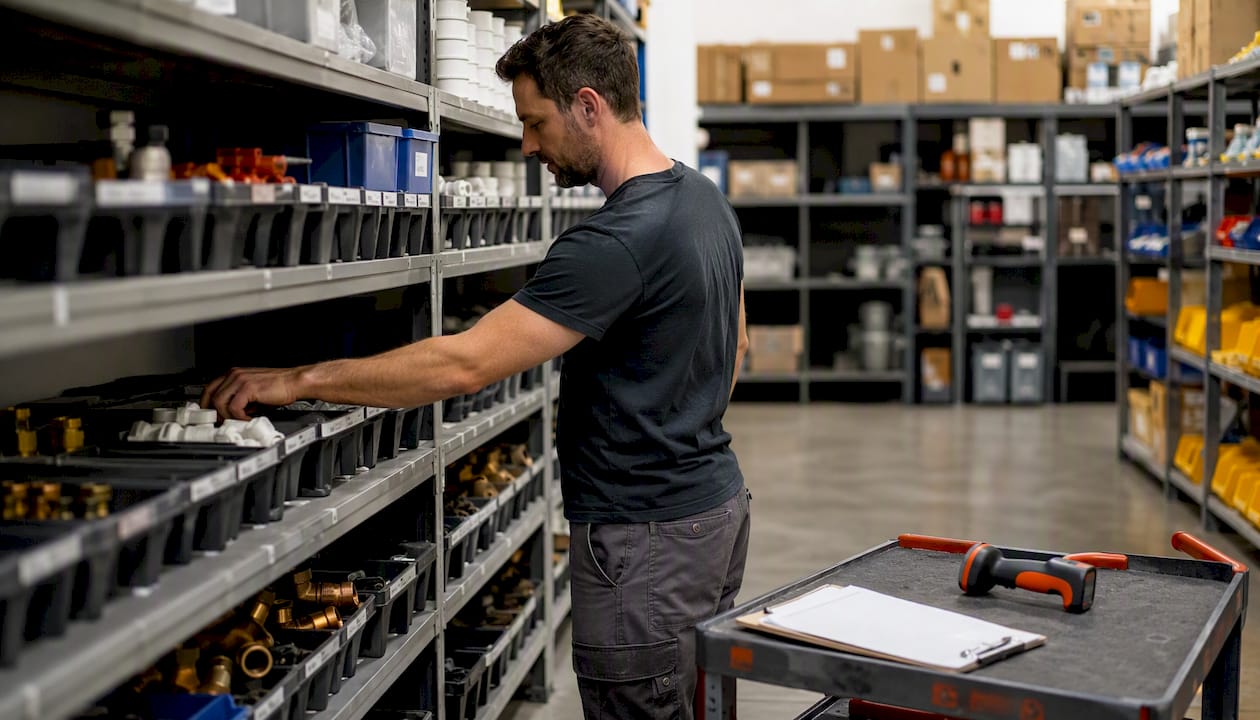
Use a simple three-factor score for each part: criticality of the asset it supports, consumption rate (how often you use it), and supplier lead time. Parts that score high on all three belong in forward stock — kept on-site or in a nearby controlled crib. Parts that score low on all three can be ordered on demand.
Inventory practices that keep accuracy above 95%
| Part category | Trigger level | Suggested location |
|---|---|---|
| Critical electrical (breakers, contactors) | 1 unit on hand | On-site locked cabinet |
| Critical plumbing (valves, seals, pump impellers) | 2 units on hand | On-site mechanical room |
| High-consumption consumables (filters, belts) | 2-week supply | On-site storage |
| Low-criticality, short lead time | 0 (order on demand) | Supplier warehouse |
Link every spare part to the work orders that consume it. When a technician closes a work order and marks a part as used, the system should automatically flag a reorder if stock drops below the trigger level. Cycle counts — counting a subset of inventory weekly rather than doing one annual count — keep accuracy high without shutting down the storeroom. Vendor-managed inventory (VMI) arrangements with your primary electrical or plumbing supplier can eliminate reorder lag entirely for high-velocity parts.
Rapid-response workflows and runbooks that shrink MTTR
The first hour after a failure determines whether the outage lasts 90 minutes or nine hours. That is the Golden Hour. Research from f7i.ai shows that diagnosis and parts logistics — not actual repair time — consume the majority of total downtime. Win those two phases and the wrench time almost takes care of itself.
Runbook template for reactive incidents
| Step | Action | Owner | Verification |
|---|---|---|---|
| 1. Detect | Sensor alert or staff report triggers work order | CMMS / supervisor | Work order number confirmed |
| 2. Notify | Parallel alerts to technician, supervisor, and affected stakeholders | CMMS / supervisor | Acknowledgment logged |
| 3. Diagnose | Technician reviews history, photos, schematics on mobile device | Technician | Root cause documented |
| 4. Stage | Parts pulled from forward stock or ordered emergency | Technician / procurement | Parts confirmed available |
| 5. Repair | Work performed per documented procedure | Technician | Repair steps logged with photos |
| 6. Verify | System tested under load; safety checks completed | Supervisor | Sign-off recorded in CMMS |
| 7. Close | Work order closed with failure mode, parts used, and time logged | Technician | Data available for trend analysis |
Parallelization is the biggest MTTR lever most facilities ignore. While diagnosis is underway, a second person should be pulling parts, notifying stakeholders, and preparing the work area. Those tasks do not need to wait for a confirmed diagnosis — they need to start the moment an alert fires.
Your 30/90/365-day implementation checklist
| Phase | Owner | Tasks | Expected outcome |
|---|---|---|---|
| 30 days | Operations + Maintenance | ACR scoring for all assets; runbook for top 3 failure scenarios; contractor pre-qualification; QR tags on tier-1 assets | Baseline MTTR established; first runbooks live |
| 30 days | Procurement | Forward-stock list drafted; reorder triggers set in CMMS; VMI conversation started with primary supplier | Parts stockout risk reduced for tier-1 assets |
| 90 days | Maintenance + IT | Sensors installed on pilot assets; CMMS auto-work-orders enabled; cross-training modules completed | First predictive alerts generated; FTFR trending up |
| 90 days | Operations | Stakeholder communication templates finalized; scheduling windows documented; TMP-style plan drafted for next major project | Planned work scheduled in low-impact windows |
| 365 days | All owners | Full ACR review; KPI trend analysis; vendor roster updated; pilot results validated; program scaled to remaining assets | MTTR reduction validated; program self-sustaining |
How to run a low-cost pilot: Pick one tier-1 asset, one runbook, and one forward-stocked part. Run the full cycle — detection, response, repair, close-out — and measure every timestamp. If MTTR drops, you have proof of concept. Scale from there, not before.
What these strategies mean for electrical and plumbing repairs specifically
Electrical and plumbing failures have two things in common: they are almost always more disruptive than they look, and they are almost always worse when someone without the right training attempts a fix first.
Common failure modes that drive long downtime:
- Tripped breakers that mask an underlying wiring fault — resetting without diagnosis extends the outage and creates a safety hazard.
- Slow plumbing leaks that go undetected until water damage forces a multi-day repair.
- Panel capacity issues that surface as repeated breaker trips during peak load.
- Corroded or undersized wiring that fails under load, often during the worst possible moment.
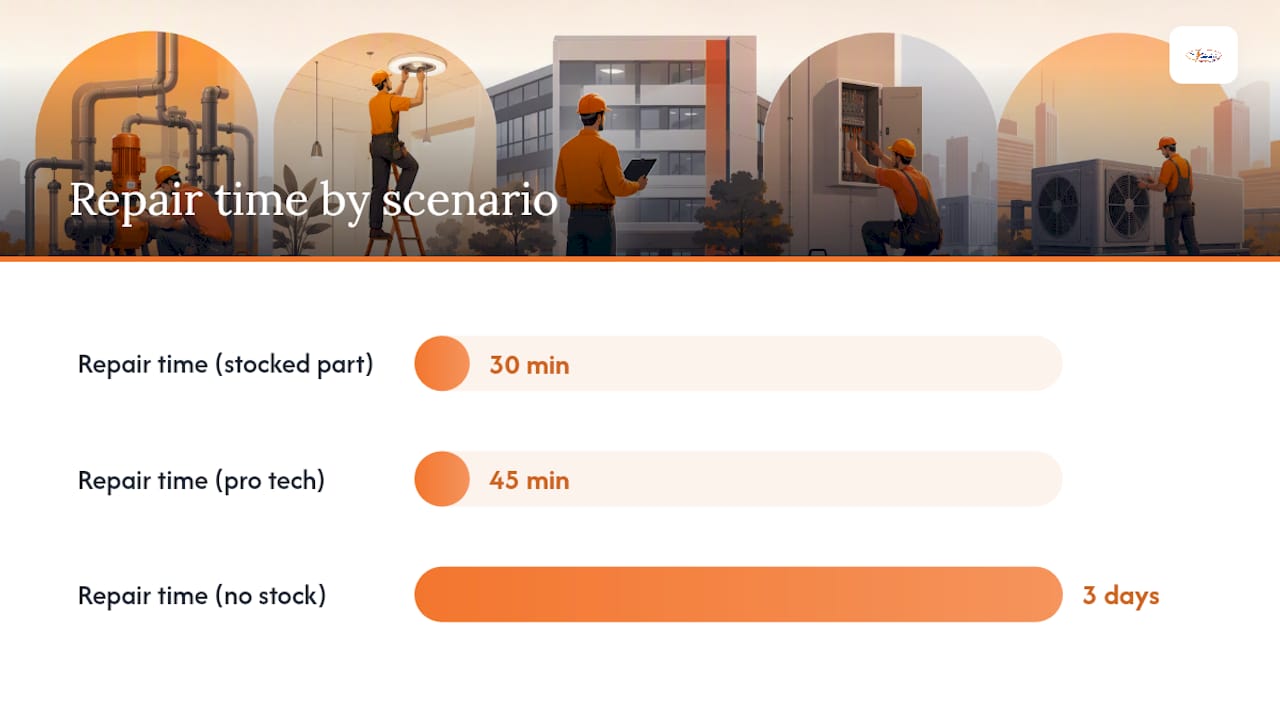
The tactics in this guide — ACR scoring, forward-stocked parts, runbooks, predictive sensors — apply directly to these failure modes. A current-draw sensor on a motor circuit catches the wiring degradation before the breaker trips. A forward-stocked contactor means the repair takes 30 minutes instead of three days waiting for a part.
Pro Tip: For electrical jobs, sequence work circuit by circuit rather than shutting down an entire panel at once. A temporary feed from an adjacent circuit can keep critical loads running while the primary circuit is serviced. For plumbing, isolate at the zone valve level, not the main shutoff, whenever possible. Both approaches cut the scope of disruption without cutting corners on the repair.
Calling a professional for electrical emergency repairs is not just about compliance — it is about not turning a 45-minute fix into a code violation that requires a full panel replacement. Small electrical issues have a way of becoming major hazards when left unaddressed or handled without the right tools. Tri-County Services Electric & Plumbing’s technicians work with commercial and residential facility teams across Northeast Ohio to schedule repairs in planned windows, sequence work to maintain partial operations, and document every job in a way that supports your CMMS records.
Key Takeaways
Facilities that combine rapid detection, forward-stocked parts, and scripted runbooks consistently cut MTTR and convert emergency repairs into planned, low-disruption events.
| Point | Details |
|---|---|
| Start with ACR scoring | Rank every asset by criticality before setting inspection intervals or stocking parts. |
| Win the Golden Hour | Parallel notification and pre-staged parts cut diagnosis and logistics time more than faster wrench work. |
| Forward-stock tier-1 parts | Zero stockouts on critical assets is achievable; link reorder triggers directly to CMMS work orders. |
| Measure MTTR from day one | Automated timestamping in your CMMS is the only reliable way to track improvement over 30/90/365-day windows. |
| Call Tri-County Services Electric & Plumbing first | For electrical and plumbing repairs in Northeast Ohio, professional service prevents code violations and extends the repair window you planned for. |
The real reason most disruption-reduction programs stall
Most facility teams understand the tactics. The gap is almost never knowledge — it is sequencing. Teams try to automate before they have clean data, stock parts before they know which ones matter, and roll out CMMS platforms before anyone has written a single runbook. The result is a system that generates alerts nobody acts on and an inventory room full of parts for assets that were replaced two years ago.
The facilities that actually reduce repair downtime start smaller than feels comfortable. One asset. One runbook. One forward-stocked part. They measure that cycle, prove the result, and then scale. The 30/90/365 checklist in this guide is built around that sequence deliberately.
There is also a trap on the automation side worth naming: over-alerting. When every sensor threshold is set too tight, technicians start ignoring alerts because 80% of them are false positives. The alarm that actually matters gets buried. Set thresholds conservatively at first — 80% of historical failure values — and tighten them only after you have 60 days of real data. Embedded AI tools like those in Ultimo help here by filtering noise and surfacing the alerts most likely to represent real failures, but they compound with good data. Feed them garbage and they return garbage.
The other common mistake is treating vendor pre-qualification as a one-time task. Contractors change their availability, their staff, and their response commitments. Review your preferred-vendor roster every six months, not just when a contractor fails you.
Pilot before you scale. Every time.
Tri-County Services Electric & Plumbing: built for low-disruption repairs in Northeast Ohio
Unplanned electrical or plumbing failures do not wait for business hours, and neither does Tri-County Services Electric & Plumbing. For commercial and residential clients across Northeast Ohio, Tri-County provides the kind of pre-planned, professionally executed service that fits directly into the disruption-reduction framework this guide describes: after-hours scheduling, circuit-by-circuit sequencing for electrical work, zone-level isolation for plumbing, and full job documentation that integrates with your facility records.

Commercial electrical services include panel upgrades, circuit repairs, emergency response, and planned replacement work — all scheduled to minimize impact on your operations. For residential property managers, electrical repair service covers everything from wiring faults to full panel work, with technicians who document every job and respect the property. Tri-County also handles plumbing, EV charger installations, whole-home surge protection, and security camera installation — so one call covers multiple trades.
Do not attempt electrical or plumbing repairs without a professional. The code compliance risk alone can turn a minor fix into a major project. Schedule a service visit with Tri-County Services Electric & Plumbing and get a planned, low-disruption repair on the calendar.
Useful sources and further reading
- Reducing construction and maintenance disruptions — TTI
- osha.gov
- How to Reduce MTTR – 2026 Guide | PagerDuty
- 5 Ways to Minimize Maintenance Disruption on Retail Operations — ServiceChannel
- Minimising downtime during repairs: How to win the Golden Hour of maintenance — f7i.ai
- Reduce MTTR: Proven Ways to Speed Up Maintenance Repairs — Oxmaint
- How embedded AI reduces MTTR — Ultimo
- AAAI paper on batching repairs
FAQ
What is the fastest way to reduce repair downtime?
The fastest gains come from eliminating information and parts friction in the first hour after failure. A mobile CMMS with linked spare parts inventory and pre-written runbooks consistently cuts MTTR faster than any other single change.
What are the 3 P’s of maintenance?
The 3 P’s are typically defined as Preventive, Predictive, and Proactive maintenance — three overlapping strategies that shift repairs from reactive to planned, reducing unplanned downtime over time.
What is the difference between TBM and CBM in maintenance?
Time-based maintenance (TBM) schedules inspections on a fixed calendar interval regardless of asset condition. Condition-based maintenance (CBM) triggers inspections based on real sensor data, so you act when the asset actually needs attention rather than on a schedule that may be too early or too late.
How do you reduce downtime in maintenance?
Combine rapid detection (sensors and auto-alerts), forward-stocked parts for critical assets, parallel notification workflows, and scripted runbooks. Facilities that apply all four consistently report MTTR reductions from hours to minutes for common failure types.
What is the 80/20 rule in maintenance?
In maintenance, the 80/20 rule holds that roughly 80% of downtime comes from 20% of assets or failure modes. Identifying and prioritizing those high-impact assets — through ACR scoring — is where disruption-reduction programs deliver the most return for the least effort.