

TL;DR:
- Most Cleveland-Akron homeowners opt for professionally installed standby generators to ensure reliable, automatic power during outages. Smaller portable units are suitable for modest needs but require manual effort and proper setup. Proper assessment, professional installation, and maintenance are essential for safe and effective backup power solutions.
For most Cleveland-Akron homeowners, the right generator for a power outage is a standby unit sized for whole-home power needs, professionally installed with an automatic transfer switch. If your budget is tighter or your needs are modest, a smaller portable generator can handle the essentials. The five local providers below cover both paths.
What are the best generators for power outages in Cleveland-Akron?
Power interruptions in the U.S. amounted to several hours in 2022, with local events pushing outages even longer in Northeast Ohio, and Northeast Ohio’s ice storms and summer thunderstorms push that number higher locally. Choosing the right provider matters as much as choosing the right unit.
| Provider | Services | Generator Brands | Certifications | Financing | Rating |
|---|---|---|---|---|---|
| Tri-County Electric Service, Inc. | Standby & portable wiring, panel upgrades, transfer switch installation | Multiple brands, portable & standby | Professional electricians, family-owned since 1975 | Not publicly listed | 4.9★ (928 reviews) |
| Generator One LLC | Installation, repair, maintenance | Generac | Certified technicians, authorized Generac dealer | Plans from $284.95 | 4.7★ (343 reviews) |
| Buckeye Power Sales | Sales, installation, service, rental, planned maintenance | Industrial, marine, residential lines | Factory-trained field technicians | Not publicly listed | 4.8★ (39 reviews) |
| Backup Power Solutions | Installation, repair, maintenance, site consultation | Generac, Cummins, Briggs & Stratton | Certified technicians, authorized dealer | Financing available | 4.7★ (35 reviews) |
| ARP Electric & Power Systems | Standby & portable sales, repair, electrical services | Residential, commercial, portable | Locally owned since 1996 | Not publicly listed | 4.8★ (11 reviews) |
Generator One LLC is the strongest pick for homeowners who want a Generac standby unit with a 12-year warranty and structured maintenance plans priced at $284.95, $334.95, or $599.95. Buckeye Power Sales has served the Cleveland area since 1947 with factory-trained technicians and the widest equipment range, including marine and towable units. Backup Power Solutions is a nationwide provider worth considering if you want authorized dealer support for Generac, Cummins, or Briggs & Stratton with financing built in. ARP Electric & Power Systems has operated locally since 1996 and handles both generator sales and broader electrical repairs under one roof. Tri-County Electric Service, Inc. is the go-to for homeowners who need generator wiring paired with a full panel upgrade or electrical repair, drawing on nearly five decades of Northeast Ohio service.
Standby vs. portable generators: which type fits your home?
Standby generators are permanently mounted outside your home, connect directly to your electrical panel, and start automatically within seconds when the grid goes down. You do not touch a switch. They run on natural gas or propane, so fuel logistics are minimal.
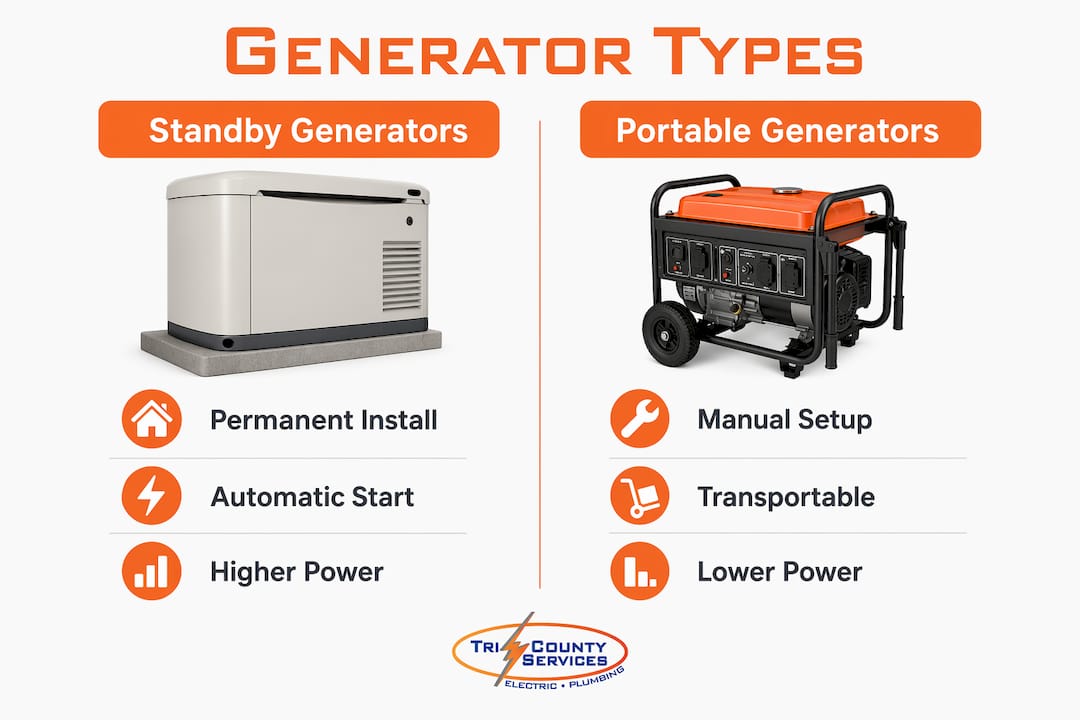
Portable generators cost less upfront but require you to drag them outside, add fuel, and start them manually. Without a professionally installed transfer switch, they can only power devices through extension cords. Backfeeding power through a male-to-male cord is a lethal hazard and a code violation.
Standby pros and cons:
- Automatic start, no manual effort during a storm
- Powers hardwired systems (HVAC, well pump, water heater)
- Higher upfront cost and requires professional installation
- Natural gas supply is effectively unlimited
Portable pros and cons:
- Lower purchase price, easier to store
- Requires manual setup and fuel management
- Gasoline storage is volatile and short-term; propane is safer but needs tank management
- Cannot power hardwired circuits without a transfer switch
Who actually needs a standby generator?
A standby unit makes the most sense when outages at your address are frequent, long, or both. Northeast Ohio ice storms routinely cause power outages lasting multiple days, which exceeds the runtime capacity of most portable units on a single fuel tank.
You should strongly consider a standby generator if any of these apply:
- Someone in your home depends on electrically powered medical equipment
- You have a sump pump protecting a finished basement
- Your HVAC system is the primary heat source in winter
- You work from home and cannot afford extended downtime
- You travel regularly and need automatic protection when you are away
Budget is the honest limiting factor. Standby units have higher purchase and installation costs, but for critical scenarios, portable generators may not provide sufficient backup.
How to assess your home’s electrical needs before buying
Start by listing every device you would run during an outage, then add up the wattages. Power needs break into three tiers: 3,000–5,000 watts for essentials like the refrigerator, lights, and a few outlets; 6,000–8,000 watts if you add HVAC and multiple appliances; 10,000 watts or more for whole-home coverage.
Pay attention to starting wattage, as some appliances draw significantly more power when they first start compared to their running wattage. Your generator needs to handle that spike without tripping.
Assessment checklist:
- List all appliances you need during an outage with their running wattages
- Add a buffer to your total wattage requirement to accommodate startup power surges.
- Identify any 240-volt appliances (HVAC, dryer, well pump) that need a transfer switch
- Confirm whether natural gas is available at your address or if propane is the fuel path
- Have a professional electrician review your panel capacity before installation
What does standby generator installation actually involve?
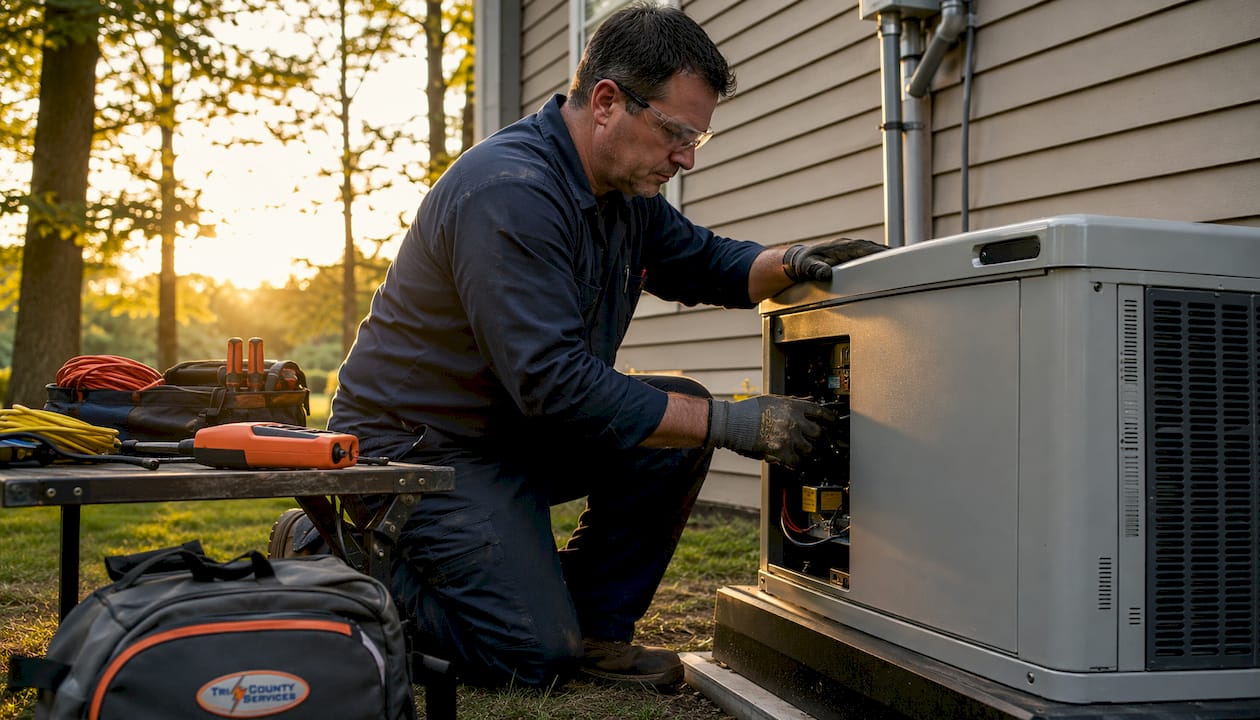
Professional standby generator installation follows a defined sequence, and skipping any step creates safety or code problems.
- Site assessment: A technician evaluates placement, clearance from windows and doors, and fuel line access.
- Permitting: Most Ohio municipalities require a permit before work begins. Your installer pulls it.
- Concrete pad: The generator sits on a level pad, similar in footprint to a central AC unit.
- Transfer switch installation: This is the critical electrical step. It connects the generator to your panel and prevents backfeed to the grid.
- Fuel line connection: Natural gas lines tap into your existing supply. Propane requires a tank sized to your expected runtime.
- Load testing: The technician runs the system under load before signing off.
Never attempt the transfer switch or fuel line steps yourself. The wiring work requires a professional electrician, and the gas connection requires a certified plumber or gas fitter.
Generator maintenance tasks every homeowner should know
Standby generators must be exercised regularly to start reliably when you need them. Most units run a self-test weekly, but that does not replace scheduled service.
Maintenance checklist:
- Oil and filter change every 100–200 hours of operation or annually
- Air filter inspection and replacement as needed
- Spark plug check each season
- Battery test (the starter battery can fail silently)
- Weekly exercise run confirmation, either automatic or manual
- CO detector test in your home before each storm season
- Annual professional inspection covering all mechanical and electrical components
Pro Tip: Schedule your annual generator service in early fall, before the first ice storm hits. Technicians are far easier to book in September than in January when half of Akron is calling at once.
How long can you run a generator during an outage?
Standby generators running on natural gas can operate continuously for days, since the fuel supply does not run out. Propane-fueled standby units’ runtime depends on tank size and usage; portable gasoline generators typically run several hours per tank depending on load and model.
Never run any generator indoors or in an attached garage. Carbon monoxide builds to deadly levels within minutes in enclosed spaces. Place portable units at least 20 feet from your home with the exhaust directed away from windows and doors.
Why professional installation is non-negotiable
Improper generator wiring is one of the most common causes of electrocution and house fires during outages. Transfer switch installation requires a professional electrician who understands load calculations, panel capacity, and local code requirements. A DIY attempt that backfeeds power to the grid can kill a utility worker restoring service on your street.
Beyond safety, professional installation protects your investment. Most generator warranties require certified installation. An improperly wired unit voids coverage and can fail inspection, creating problems when you sell your home.
Tri-County Services Electric & Plumbing has handled generator wiring and panel upgrades across Northeast Ohio since 1975. Their technicians assess your panel, pull permits, install the transfer switch, and test the full system before leaving.
How long does generator installation take?
A straightforward standby generator installation typically takes 1–3 days from permit approval to final testing. That timeline assumes the concrete pad is ready, the fuel line is accessible, and no panel upgrade is needed. Add 1–2 days if your panel requires an upgrade to handle the generator load. Permit processing varies by municipality; some Ohio cities turn permits around in 24 hours, others take a week. Plan for 2–3 weeks from first call to a fully operational system.
Using your generator during Cleveland-area winter storms
Ice storms are Northeast Ohio’s most punishing outage scenario. Temperatures drop, roads close, and outages can stretch for days. A few winter-specific points:
Keep the generator’s air intake and exhaust clear of snow and ice accumulation. Standby units are weatherproofed, but a heavy ice buildup can block airflow. For propane users, cold temperatures reduce tank pressure; a regulator rated for low-temperature operation prevents startup failures below 20°F. If you rely on a portable unit, store gasoline with a fuel stabilizer and rotate it every 30 days. Stale gas is the number one reason portable generators fail to start during an actual emergency.
Does a generator add value to your home?
A permanently installed standby generator adds measurable resale value, particularly in markets like Cleveland-Akron where buyers have experienced extended outages firsthand. Real estate professionals generally cite a standby generator as a selling point comparable to a finished basement or updated HVAC. The exact value added depends on the unit’s size, brand, and condition at the time of sale, but it consistently shows up as a line item in buyer negotiations.
Homeowner insurance and installation costs
Most homeowner insurance policies cover a permanently installed standby generator as a structural fixture, meaning it is protected against fire, theft, and storm damage under your dwelling coverage. Confirm this with your insurer before installation, as some policies require a rider. Installation costs range from roughly $2,000 to $20,000 or more depending on unit size, fuel line complexity, and whether a panel upgrade is needed. The generator unit itself runs $3,400 to nearly $7,000 for whole-home standby models.
What does a complete generator setup cost?
The honest answer is that total costs vary widely. A portable generator with a professionally installed transfer switch runs $1,500–$4,000 all in. A whole-home standby system, including the unit, installation, concrete pad, and transfer switch, typically falls in the $8,000–$20,000 range. Ongoing costs include annual maintenance service and fuel. Natural gas adds minimal ongoing cost since it draws from your existing line. Propane requires periodic tank refills. Generac offers financing options; their published example shows complete backup systems installed for $116 per month on a structured payment plan.
How to choose a local generator provider
Credentials and specialization matter more than proximity. Ask every provider these questions before signing anything:
- Are your technicians certified to install transfer switches and work on gas lines?
- Do you pull permits, or does the homeowner?
- What generator brands do you carry, and are you an authorized dealer?
- What does your maintenance plan include, and what does it cost?
- Can you provide references from installations in my zip code?
Red flags to watch for: a provider who quotes a price without a site visit, anyone who suggests skipping the permit to save time, and any installer who cannot explain the transfer switch installation process in plain terms.
For backup power options beyond traditional generators, battery backup systems are worth comparing, particularly for homeowners with solar panels already installed.
Tri-County Services Electric & Plumbing serves Northeast Ohio homeowners

Tri-County Services Electric & Plumbing is a family-owned Northeast Ohio electrical and plumbing company that has been wiring homes since 1975. For homeowners who want generator installation handled as part of a broader electrical project, including panel upgrades, circuit repairs, or whole-home surge protection, Tri-County handles all of it under one roof without subcontracting the electrical work.
The difference from a generator-only dealer is straightforward: Tri-County’s technicians assess your panel, identify any capacity issues before installation day, and handle the transfer switch wiring themselves. No coordination between separate contractors, no gaps in accountability. They also offer generator installations with flexible scheduling designed to minimize disruption to your household.
Call (440) 325-0136 or visit tricountyelectricservice.com to schedule a consultation.
Key Takeaways
A standby generator with a professionally installed transfer switch is the most reliable home power outage solution for Northeast Ohio homeowners facing multi-day winter outages.
| Point | Details |
|---|---|
| Size your generator correctly | 3,000–5,000 watts covers essentials; 6,000–8,000 watts handles HVAC and multiple appliances; 10,000+ watts handles whole-home coverage. |
| Standby beats portable for critical needs | Standby units start automatically within seconds and run on natural gas or propane without manual refueling. |
| Professional installation is required | Transfer switch wiring and gas line connections must be done by a certified professional, not a DIYer. |
| Total costs vary widely | A whole-home standby system typically runs $8,000–$20,000 installed; portable setups with a transfer switch start around $1,500. |
| Tri-County Services Electric & Plumbing | Handles generator wiring, transfer switch installation, and panel upgrades across Northeast Ohio since 1975. |
FAQ
What size generator do I need for a home power outage?
A generator producing 3,000–5,000 watts keeps essential appliances running during an outage; 6,000–8,000 watts covers HVAC and multiple appliances, while 10,000 watts or more is needed for whole-home coverage including HVAC and a well pump.
Will a generator work during a power outage?
Yes. A standby generator with an automatic transfer switch restores power within seconds of an outage. A portable generator works too, but requires manual startup and a professionally installed transfer switch to power hardwired circuits safely.
What is the best portable generator for power outages?
Popular Mechanics rates dual or tri-fuel portable generators among the top options for home backup use in 2026, with enough output for several critical circuits.
How long should I run my generator during a power outage?
Natural gas standby generators can run continuously for days. Propane units’ runtime depends on tank size. Portable gasoline generators typically run several hours per tank and should never operate indoors or within 20 feet of your home.