

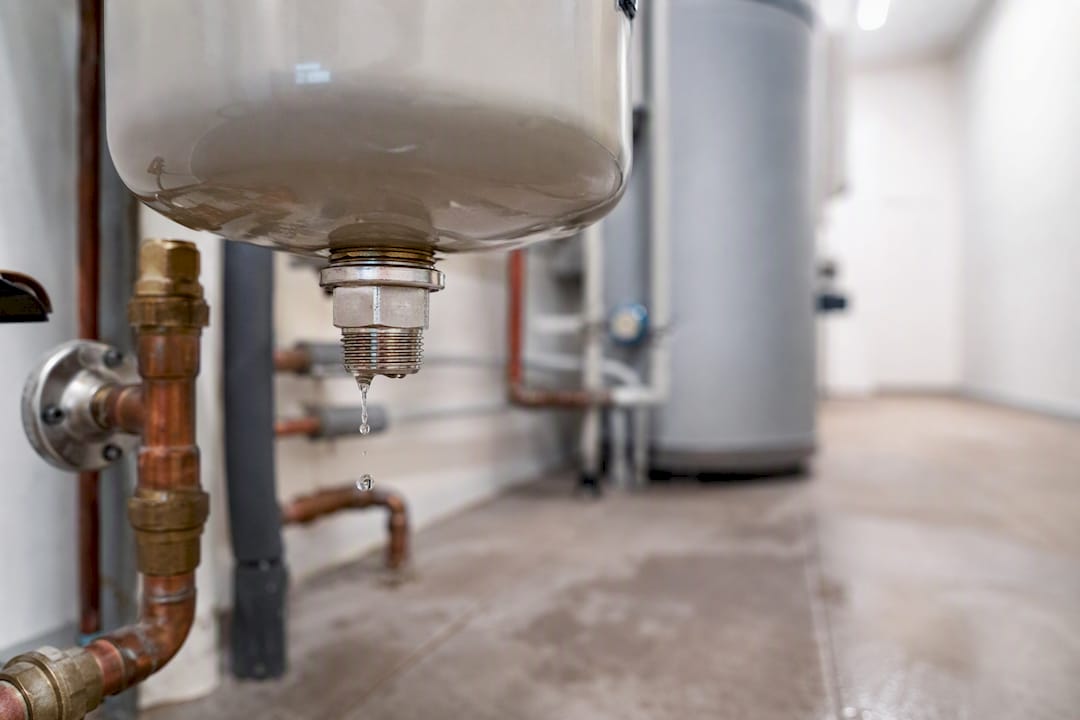
If your expansion tank is leaking and water is actively pooling, touching an electrical panel, or coming out of the T&P relief valve in a steady stream, stop what you’re doing and call for professional help right now. Those are not DIY situations. If instead you’re looking at a small drip or a damp spot near the fitting on top of your water heater, you have time to shut off the cold water supply feeding the tank, relieve pressure at a hot tap, and run a couple of quick, safe checks before deciding whether this is a $10 fix or a full replacement.
Three things cause almost every leaking expansion tank: a failed Schrader (air) valve, a loose threaded connection where the tank meets the tee fitting, or a ruptured internal bladder. The first two are often DIY-friendly for a comfortable homeowner. The third is not fixable at all. A leaking expansion tank puts extra strain on the water heater’s T&P relief valve, so the longer it sits, the more likely you are dealing with a second problem on top of the first.
- Emergency, call now: pooling water, water near outlets or panels, continuous T&P discharge.
- Safe to inspect first: slow drip, dry surroundings, no sign of active flooding.
Pro Tip: Before you touch anything, snap a photo of the leak and the tank’s data label. If you end up calling a professional, that photo alone can cut diagnostic time in half.
A waterlogged expansion tank can add 40 to 50 pounds of extra weight to the piping it hangs from, which is one reason a “small” leak can turn into a cracked fitting faster than people expect.
Key Takeaways
A leaking expansion tank is either a five-minute valve fix or a full replacement, and the difference always comes down to whether water has entered the air chamber.
| Point | Details |
|---|---|
| Check the valve first | Press the Schrader valve pin briefly; air alone means the bladder is intact, water means replacement is needed. |
| Use the tap test | A thuddy sound and extra weight signal a waterlogged tank that can’t be repaired. |
| Small leaks are often cheap fixes | A worn valve core typically costs only a few dollars in parts and minutes of labor to replace. |
| Never patch a ruptured bladder | Pressurized tanks can’t be safely patched once water enters the air chamber. |
| Call before water reaches electrical components | Tri-County Services Electric & Plumbing offers same-day diagnosis and repair for expansion tank leaks at (440) 253-0332. |
Table of Contents
- What Causes an Expansion Tank to Leak?
- Is It Safe to Try Fixing an Expansion Tank Leak Yourself?
- When Does an Expansion Tank Need Full Replacement?
- When Should You Call a Professional Immediately?
- Why We Recommend a Professional Look at Every Leaking Expansion Tank
- Get Your Leaking Expansion Tank Fixed Fast
- Where to Learn More About Expansion Tank Diagnosis
- Sources
- FAQ
What Causes an Expansion Tank to Leak?
The location of the leak tells you almost everything about what’s wrong, so start by finding it before you start guessing at a fix. Expansion tanks sit on top of, or beside, your water heater, connected by a tee fitting with a short pipe. Water never leaks through the tank shell itself under normal conditions. It shows up in one of three places: the threaded connection, the air valve on top, or seeping out around the tank body because the bladder has failed and water has migrated into the air chamber.
1. Check the threaded connection first. Look for wetness, white or greenish mineral crust, or rust streaks where the tank screws into the tee. A loose or corroded fitting is often the easiest cause to confirm and, in some cases, the easiest to correct with basic hand tools.
2. Test the Schrader valve. This is the small metal valve cap on top of the tank, identical in shape to the valve stem on a car tire. Remove the cap and press the pin briefly with a fingernail or small tool.
- If only air escapes, the bladder is intact and you’re likely dealing with a valve or air-charge issue.
- If water spurts out, the internal bladder has ruptured and the tank needs to be replaced, not repaired.
- For a slow, hard-to-see leak, dab soapy water over the valve stem. Bubbles forming confirm a leaking valve core rather than a bladder failure.
3. Run the tap and weight test. With the tank depressurized, knock on the outside with your knuckle. A healthy tank sounds hollow on the air side and thuddy on the water side; if it sounds thuddy everywhere and feels unusually heavy for its size, water has taken over the air chamber. That’s a waterlogged tank, and no amount of re-pressurizing fixes it.
4. Watch the T&P relief valve on the water heater itself. If it’s been dripping or discharging on and off, that’s frequently a downstream symptom of a failing or waterlogged expansion tank rather than a separate problem. A tank that can no longer absorb pressure surges pushes that pressure somewhere else, and the relief valve is where it usually goes.
Air naturally diffuses through a bladder membrane over time, at a rate reported at roughly 1 PSI per year in field observations, which is why even a tank with no visible leak can slowly lose pre-charge and start acting waterlogged years before it ever drips.
Note the tank’s age (check the label or your water heater install date) and take a couple of clear photos of the valve, the fitting, and any wet areas. That information is exactly what a technician needs before they even arrive, and it often shortens an emergency call significantly.
Is It Safe to Try Fixing an Expansion Tank Leak Yourself?
Here’s where we’re going to be direct with you: attempting a repair on a pressurized water system next to a gas or electric water heater carries real risk, and we’d rather you understand why a professional call often makes more sense than a wrench and a YouTube video. That said, if you’ve confirmed the leak is small, isolated to the valve, and nowhere near electrical wiring, there are a few safety-first steps worth knowing, mostly so you understand what a technician is doing when they arrive.
Before touching anything:
- Shut off the cold water supply valve feeding the water heater and expansion tank.
- Open a nearby hot water faucet to relieve residual pressure in the lines.
- Only approach the breaker panel if the surrounding area is completely dry. Water and live electrical panels do not mix, and this is one of the fastest ways a minor plumbing issue becomes a serious injury.
Tools a professional typically uses for this kind of diagnosis:
- A valve core removal tool
- A standard tire pressure gauge
- A small pump or compressor to reset air charge
- A pipe wrench and PTFE tape for the threaded connection
- A digital camera or phone for documenting corrosion and wear
Replacing a worn Schrader valve core is often a low-cost fix that a technician can complete in minutes once the system is depressurized, and it commonly resolves slow air-side leaks without touching the tank itself. The process involves removing the old core, installing a replacement rated for the system’s temperature range, and re-pressurizing to match your home’s static water pressure, generally in the 50 to 60 PSI range for many municipal supplies, then rechecking after a day or two to confirm the tank holds air.
Pro Tip: A tank that holds pressure for 48 hours after a valve-core swap is usually good for years. One that loses pressure again within a day almost always has a bladder problem, not a valve problem.
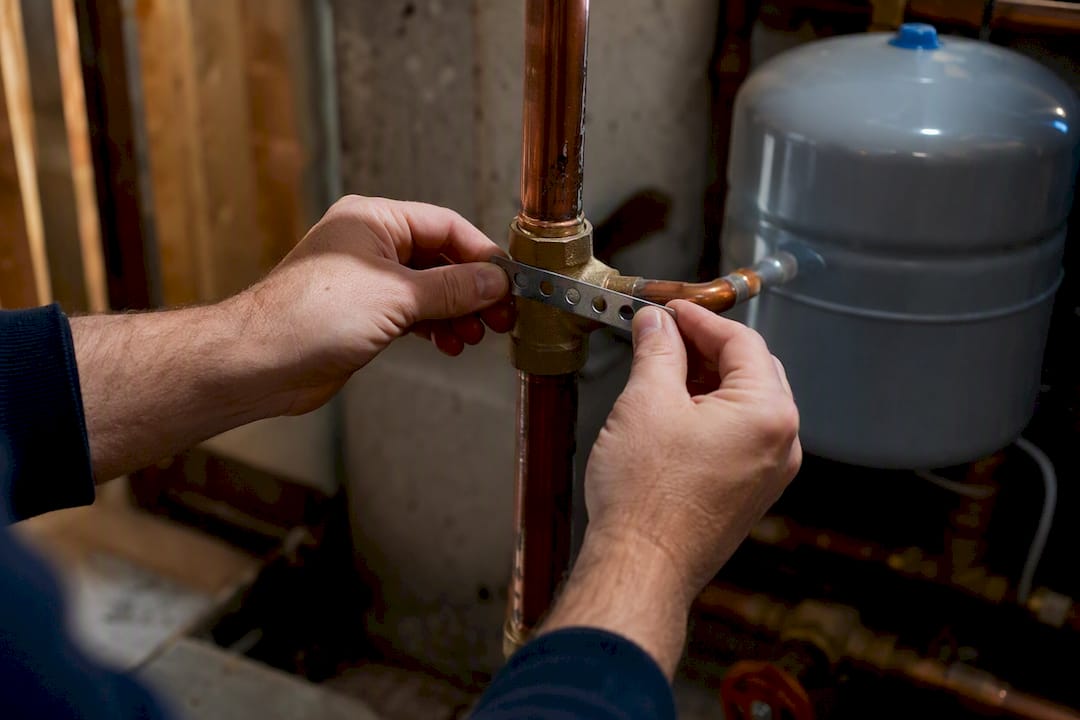
Loose threaded connections need careful handling too. Overtightening cracks fittings; undertightening leaves a leak path. A technician will also check whether the tank’s own weight has started pulling on the tee fitting, since an unsupported tank can stress the joint over months even if the original installation was fine. Bracing the tank properly, and confirming the piping isn’t carrying weight it wasn’t designed for, is part of doing this correctly rather than just tightening a fitting and hoping.
This is exactly the kind of job where calling ahead of time beats troubleshooting solo. Tri-County Services Electric & Plumbing’s plumbing team handles valve core swaps, re-pressurization, and connection repairs on a routine basis and can tell you over the phone whether your symptoms sound like a five-minute fix or something bigger.
When Does an Expansion Tank Need Full Replacement?
A ruptured bladder cannot be repaired. Once water has entered the air chamber, the vessel is compromised in a way that no seal, patch, or tightened fitting corrects, because the tank is a pressurized container and any external patch is unreliable under that pressure. Attempting to patch it isn’t just ineffective, it’s unsafe.
Signs that point to replacement rather than repair:
- Water spurts (not just mist or dampness) from the Schrader valve when tested.
- The tank sounds thuddy throughout and feels noticeably heavier than a healthy tank of the same size.
- Corrosion has visibly eaten into the tank shell or fitting threads.
- The T&P relief valve keeps discharging even after the valve core has been replaced.
How replacement typically works:
The water supply and, where relevant, power to the water heater get shut off, the lines get drained down to the tank level, and the old tank unscrews from the tee fitting. The threads get inspected and cleaned before anything new goes on. A new tank’s air pre-charge, often set at the factory to 20 or 40 PSI, gets adjusted with a gauge to match your home’s static water pressure before installation, since a mismatch between pre-charge and household pressure is one of the more common reasons a brand-new tank seems to underperform right out of the box. Once installed, the system gets tested for holding pressure and checked for leaks at the fitting.
Parts for a standard residential expansion tank tend to run in the range of a modest weekend project cost, with professional labor added on top depending on access and whether any piping needs support or modification. Most jobs are completed in a single visit, often within an hour or two once a technician is on site, assuming there’s no additional water heater damage to address.
When Should You Call a Professional Immediately?
Some symptoms don’t leave room for a wait-and-see approach. Call for emergency service if you notice any of the following:
- Water pooling and spreading rather than staying contained to a small drip.
- Water contacting or dripping toward an electrical panel, outlet, or wiring.
- The T&P relief valve discharging continuously rather than intermittently.
- A leak you can’t visually isolate to the valve or the fitting.
When you call, give the dispatcher a clear picture of what’s happening: the tank’s approximate location, a description of the leak, whether water is anywhere near electrical components or gas lines, the tank’s age if you know it, and any recent plumbing work done on the system. Photos help enormously if you can send them ahead of the visit.
A technician arriving on a call like this will typically check the shutoff valve position first, confirm there’s no active electrical hazard, then move to testing the Schrader valve and inspecting the threaded connection before deciding on repair versus replacement. While you wait, keep the area clear, place towels or a bucket under active drips, and avoid running hot water unless a professional has told you it’s safe to do so.
Why We Recommend a Professional Look at Every Leaking Expansion Tank
We’ve inspected enough failed expansion tanks across Northeast Ohio to say this plainly: the tanks that turn into expensive repairs are almost always the ones where a homeowner tried three or four fixes before calling anyone. A slow drip from a valve core is genuinely minor. But water and pressurized systems sitting a few feet from household wiring is not a situation where guessing is a good strategy, and that’s the core of why our technicians treat every expansion tank inspection as a full system check rather than a single-point fix.
Our approach on a typical expansion tank service visit includes testing the Schrader valve, checking pre-charge against your home’s static pressure, inspecting the threaded connection and surrounding piping for stress, and looking at the water heater’s T&P valve for related wear. Most valve core replacements and re-pressurizing jobs get completed the same day. When a tank needs full replacement, we walk you through sizing and pre-charge before anything gets installed, so you’re not paying twice for a tank that’s mismatched to your system.
If you’re staring at a wet spot on your water heater right now, skip the guesswork and call (440) 253-0332. We’ll help you figure out over the phone whether this is urgent.
Get Your Leaking Expansion Tank Fixed Fast
Tri-County Services Electric & Plumbing is the direct alternative to spending a weekend troubleshooting a pressurized tank yourself, our technicians diagnose and resolve most expansion tank leaks in a single visit, often the same day you call.

Our plumbing team handles the full range of what a leaking expansion tank might need: Schrader valve core replacement, re-pressurizing to match your home’s static water pressure, threaded connection repair, or a complete expansion tank and water heater replacement when the bladder has failed. Emergency calls involving active pooling or water near electrical components get priority scheduling; standard drips and slow leaks can usually be scheduled within your week. When you call, have the tank’s approximate age, a description of the leak, and a couple of photos ready. It speeds up dispatch and lets our technician arrive with the right parts already on the truck.
Call (440) 253-0332 now to get a technician scheduled, or request service online to lock in a visit that fits your day.
Where to Learn More About Expansion Tank Diagnosis
For deeper technical background beyond this guide, InspectApedia’s expansion tank repair library covers diagnostic methods in detail, and RapidRepair.blog’s step-by-step guide walks through valve-core replacement procedures. For the mechanics behind why these tanks exist at all, this overview of thermal expansion in plumbing systems explains the pressure dynamics driving the whole system.
Sources
FAQ
What should I do if my expansion tank is leaking?
Shut off the cold water supply to the water heater, relieve pressure at a hot faucet, and check whether the leak is coming from the valve, the fitting, or the tank body itself. If water is pooling or anywhere near electrical components, skip the diagnostics and call a professional immediately.
How much does it cost to replace an expansion tank?
Parts for a standard residential tank fall in a modest range, with professional labor added depending on access and whether piping needs support. Most replacements are completed in a single visit, often within an hour or two.
How can I tell if my expansion tank’s bladder is leaking?
Press the Schrader valve pin briefly: if only air comes out, the bladder is intact, but if water spurts out, the bladder has ruptured and the tank needs replacement. A tank that sounds thuddy when tapped and feels unusually heavy is also showing classic signs of a waterlogged, failed bladder.
Can I keep using my water heater with a leaking expansion tank?
You can typically keep running hot water for a short period if the leak is small and away from electrical components, but the longer a failing tank sits, the more strain it puts on the water heater’s T&P relief valve. Getting it inspected quickly prevents a minor leak from turning into a bigger repair.