

Hire a professional installer and schedule an on-site assessment with an electrical load calculation before you buy anything. That single step protects you from overspending on an oversized unit, ensures your home’s wiring meets code, and gives you a written scope of work to compare bids fairly. When you’re vetting contractors, three things should appear on every quote or company page before you go further:
- An itemized written estimate covering the generator, transfer switch, fuel hookup, pad, permits, and labor
- Confirmation that the contractor pulls permits and handles inspections
- A stated warranty and maintenance plan for post-install support
Tri-County Services Electric & Plumbing serves Northeast Ohio homeowners with on-site assessments, professional load calculations, and full turnkey installation. Request a written quote before committing to any purchase.
Key Takeaways
Hiring the right professional installer, getting a load calculation, and demanding a permit-ready written estimate are the three steps that separate a smooth installation from an expensive mistake.
| Point | Details |
|---|---|
| Get a load calculation first | Size your generator on actual circuit loads, not square footage, to avoid overpaying. |
| Demand an itemized written estimate | Every line item (unit, ATS, pad, fuel hookup, permits, labor) should be named in writing. |
| Confirm permits and insurance | Your contractor should pull permits and carry liability and workers’ comp coverage. |
| Typical installed cost for a standard 12–14 kW system is $8,500–$14,600; whole-house installs may be higher depending on system size and complexity. | |
| Tri-County Services Electric & Plumbing | Northeast Ohio homeowners can book an on-site assessment and written quote directly. |
Table of Contents
- How much does whole-house generator installation cost?
- How do you size a generator and what should be on the quote?
- What happens on installation day?
- What questions should you ask before signing a contract?
- Why Tri-County Services Electric & Plumbing is a strong local choice
- Professional installation is worth more than the paperwork suggests
- Ready to schedule your on-site generator assessment?
- Useful sources and further reading
- FAQ
How much does whole-house generator installation cost?
Most homeowners pay somewhere between $8,000 and $16,000 for a fully installed whole-house standby generator, including equipment and installation. That range covers a standard 12–22 kW natural gas unit for a typical single-family home. Here’s how a mid-range 12–14 kW installation typically breaks down:
| Line Item | Typical Range |
|---|---|
| Labor | $2,000–$4,000 |
| Total installed | $8,500–$14,600 |
Source: Well Built Florida cost breakdown
The main price drivers are generator size (kW), distance from the unit to your main panel, fuel type, site prep complexity, and local labor rates. A propane system adds tank rental or purchase costs. A long trench run to the gas meter adds labor. If your panel needs an upgrade before the ATS can be installed, budget for that separately.
Watch for hidden fees: some quotes exclude permit fees, utility coordination charges, or the concrete pad. Always ask whether the estimate is all-in.
Financing is available through many installers and manufacturers. Tri-County Services Electric & Plumbing offers whole-home generator financing starting at $199/month for qualifying homeowners in Northeast Ohio.
Timeline: from signed contract to final inspection, expect 2–6 weeks. Permit lead times alone can run 1–3 weeks depending on your municipality. Gas-line coordination with your utility adds scheduling complexity. The physical installation day for a standard system typically runs 6–10 hours for a crew of two or three.
How do you size a generator and what should be on the quote?
Size is determined by a professional electrical load calculation, not by your home’s square footage. A load calculation adds up the wattage of every circuit you want the generator to cover, accounts for motor start-up surges (HVAC is the big one), and identifies the minimum kW rating you actually need.
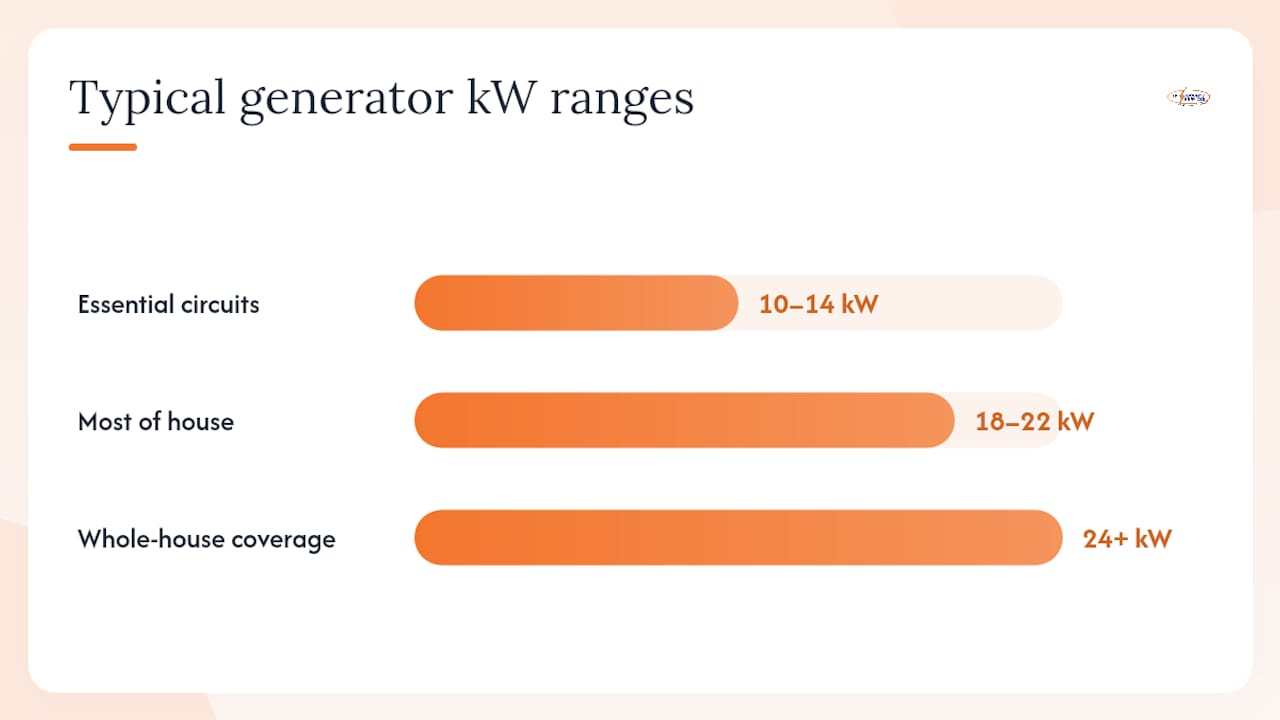
Common kW ranges and what they typically cover:
- 10–14 kW: Essential circuits — HVAC, refrigerator, lights, outlets, sump pump
- 18–22 kW: Most of the house, including electric range or dryer
- 24+ kW: Whole-house coverage including large HVAC systems or electric vehicle charging
Fuel options each come with trade-offs:
- Natural gas connects to your existing utility line, never runs out, and costs less per hour to operate. It requires utility coordination and isn’t available in all areas.
- Propane works anywhere, but requires an on-site tank and periodic refills. Runtime depends on tank size.
- Diesel is common for commercial applications; less typical for residential standby use.
A complete quote should list every component: generator unit, automatic transfer switch, concrete pad or gravel base, fuel-line work, ATS wiring, and outage simulation testing.
Pro Tip: If a full whole-house system exceeds your budget, ask about a critical-circuit-only configuration. Powering your HVAC, refrigerator, sump pump, and a few outlets costs significantly less than whole-house coverage and handles most outage scenarios.
What happens on installation day?
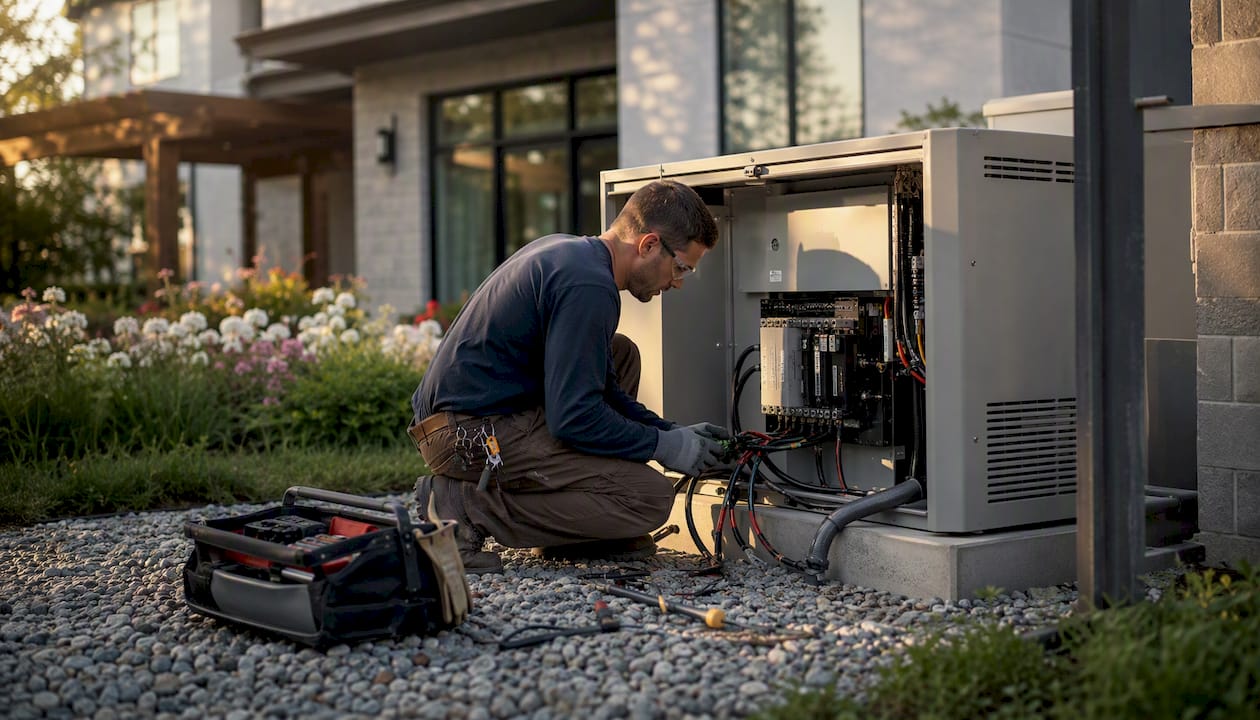
A professional installation follows a predictable sequence. Here’s what to expect:
- Crew arrives and protects the work area (drop cloths, equipment staging)
- Site prep and pad placement (concrete pour or gravel base, leveled and set)
- Generator unit is set on the pad and secured
- Trench is dug for fuel line and conduit runs to the panel
- Fuel line is connected (gas utility or propane tank hookup)
- ATS is mounted and wired to the main electrical panel
- Generator is wired to the ATS and all connections are inspected
- Utility coordination completed if required
- Outage simulation is run to confirm transfer switch operation and load capacity
- Homeowner walkthrough covering controls, maintenance schedule, and warranty paperwork
Expect a crew of two to three technicians and roughly 6–10 hours on-site for a standard installation. You’ll need to clear access to the panel, confirm utility locates are marked, and plan for a brief power interruption during ATS connection.
Before the crew leaves, you should receive:
- Written outage simulation results
- A user demonstration of manual and automatic controls
- Warranty documentation (unit and labor)
- A recommended maintenance schedule
What questions should you ask before signing a contract?
These questions separate professional installers from the ones you want to avoid:
- “Can I see an itemized written estimate with every line item named?”
- “Who pulls the permits, and are permit fees included in this quote?”
- “Can you provide references from two recent installations in my area?”
- “What does the labor warranty cover, and for how long?”
- “Does your quote include outage simulation testing?”
- “Who performs the load calculation, and can I see the results?”
- “Who handles the gas-line coordination with the utility?”
- “What’s the realistic completion date from signed contract to final inspection?”
- “Do you offer an annual maintenance or service contract?”
Acceptable answers: the company pulls permits itself, provides a written load calculation, includes outage simulation, and lists permit fees as a separate line item. Vague answers on any of these points are worth pressing on before you pay a deposit.
Why Tri-County Services Electric & Plumbing is a strong local choice
Tri-County Services Electric & Plumbing has served Northeast Ohio homeowners since 1975 as a family-owned electrical and plumbing contractor. For generator installation, the company offers:
- On-site assessment and professional electrical load calculation
- Full turnkey installation: pad, fuel-line coordination, ATS wiring, panel work, and permits
- Outage simulation testing before sign-off
- Written warranty and maintenance plan options
- Post-install generator repair and service for ongoing support
Tri-County publishes detailed regional guidance on whole-home generator installation and maintains a dedicated generator services page where homeowners can review service details and request a consultation.
Pro Tip: Before your consultation, write down which appliances and systems you absolutely cannot lose during an outage. Bring that list to the site visit. It gives the technician a concrete starting point for the load calculation and helps you decide between critical-circuit and whole-house coverage.
Professional installation is worth more than the paperwork suggests
Most homeowners focus on the generator price tag and treat the installation as a line item to minimize. That’s the wrong frame. The installation is where the safety, warranty validity, and long-term reliability of the entire system get determined.
An undersized generator that trips under load during a winter storm is worse than no generator at all. An oversized one burns more fuel every time it runs and costs thousands more upfront for capacity you’ll never use. Neither outcome shows up in a square-footage estimate. Both are preventable with a proper load calculation.
Permits matter for the same reason. An unpermitted installation voids most manufacturer warranties, can complicate a homeowner’s insurance claim after an outage-related loss, and creates a disclosure problem when you sell the house. The permit fee is the cheapest line item on the quote. Skipping it to save $400 is a poor trade.
The right installer handles all of this without being asked. That’s the actual differentiator between top generator installation services and the ones you’ll regret hiring.
Ready to schedule your on-site generator assessment?
Tri-County Services Electric & Plumbing handles the full process for Northeast Ohio homeowners, from the first site visit through final inspection and outage simulation. You get a professional load calculation, an itemized written quote, permit handling, and a maintenance plan, all from a team that has been doing this work in the region since 1975.

Skipping the professional assessment is the most common mistake homeowners make before a generator purchase. It leads to wrong-sized equipment, surprise costs, and installations that don’t pass inspection. Call (440) 325-0136 or visit the Tri-County generator page to schedule your on-site assessment and get a written quote.
Useful sources and further reading
- Backup Generator Installation | Generac Power Systems
- Generator Installation Cost: Price Ranges, Components, and Ways to Save 2026 – Well Built Florida
For exact permit requirements and inspection timelines, contact your local building department directly. Manufacturer installation manuals and your gas utility’s service guidelines are the authoritative sources for fuel-line specifications.
FAQ
What is the average cost to have a generator installed?
Most whole-house standby generator installations run $8,000–$16,000 fully installed, covering the unit, transfer switch, pad, fuel hookup, permits, and labor for a standard 12–22 kW system.
How much does a generator for a 2,000 sq ft house cost installed?
A 2,000 sq ft home typically needs a 12–14 kW system, which falls in the $8,500–$14,600 installed range. The exact figure depends on fuel type, distance to the panel, and local permit costs.
Does Home Depot install generators?
Home Depot offers generator installation through third-party installers rather than in-house crews. Service continuity, warranty support, and permit handling can vary significantly compared with a local specialist contractor who manages the full project.
What is the best home generator company for Northeast Ohio?
Tri-County Services Electric & Plumbing is a strong local option, offering on-site assessments, professional load calculations, full turnkey installation, permit handling, and post-install maintenance for homeowners across Northeast Ohio.