

A two-prong outlet is not illegal, and it does not mean your house is about to catch fire. It does mean that outlet has no path to carry a fault away from you. The safe fix is not swapping in a three-prong outlet. It is having a professional check what is behind the wall and choose the right upgrade for each circuit. At Tri-County Services Electric & Plumbing, a family-owned Northeast Ohio company serving homes since 1975, this is one of the most common questions older-home owners bring us. You can reach our office at (440) 253-0332.
TL;DR
- A two-prong outlet has only hot and neutral connections. It has no ground, so a fault has nowhere safe to go.
- Most older outlets are not required to be replaced, but anything you change must meet today’s rules.
- Putting a three-prong outlet on an ungrounded circuit makes it look protected when it is not.
- The code allows three safe upgrades: a non-grounding outlet, a GFCI outlet, or a grounded outlet behind GFCI protection. Rewiring gives a true ground.
- Call a professional before touching the outlet. We can be reached at (440) 253-0332.
Table of Contents
- What a two-prong outlet actually is
- What grounding does
- Are two-prong outlets safe, and are they illegal?
- Why swapping in a three-prong outlet is the wrong move
- What about plug-in adapters?
- The three safe ways to upgrade a two-prong outlet
- The upgrade that gives you a true ground: rewiring the circuit
- Where to start in an older house
- Why this is a job for a professional
- What to expect when we visit
- Upgrade your outlets with Tri-County Services Electric & Plumbing
- Our perspective
- FAQ
- Sources
What a two-prong outlet actually is
A two-prong outlet has two vertical slots and no round hole underneath. It is fed by a two-wire circuit: a hot conductor and a neutral conductor, with no separate equipment grounding conductor. The Electrical Safety Foundation International (ESFI) explains that two-pronged receptacles were installed before 1962, and grounding-type receptacles were first required for all 15- and 20-amp outlets in the 1971 NEC. The NEC is the National Electrical Code, the model rulebook most U.S. jurisdictions adopt and update every three years.
If your home was built in the 1950s or 1960s, or even later with an older section of wiring, you probably have some of these. In Northeast Ohio, with so many mid-century homes in Cleveland, Akron, and Canton suburbs, they are very common. You may also hear them called ungrounded or non-grounding receptacles.
What grounding does
The ground wire is a safety path. It runs back to the grounding bus in your main panel and normally carries no electricity at all. If a wire frays or comes loose and touches metal, the ground gives that stray current a route to the panel so the breaker trips. Fine Homebuilding describes the hazard: without a ground, a damaged wire can electrify anything metallic, from a lamp base to a blender to a pipe, creating an electrocution risk.
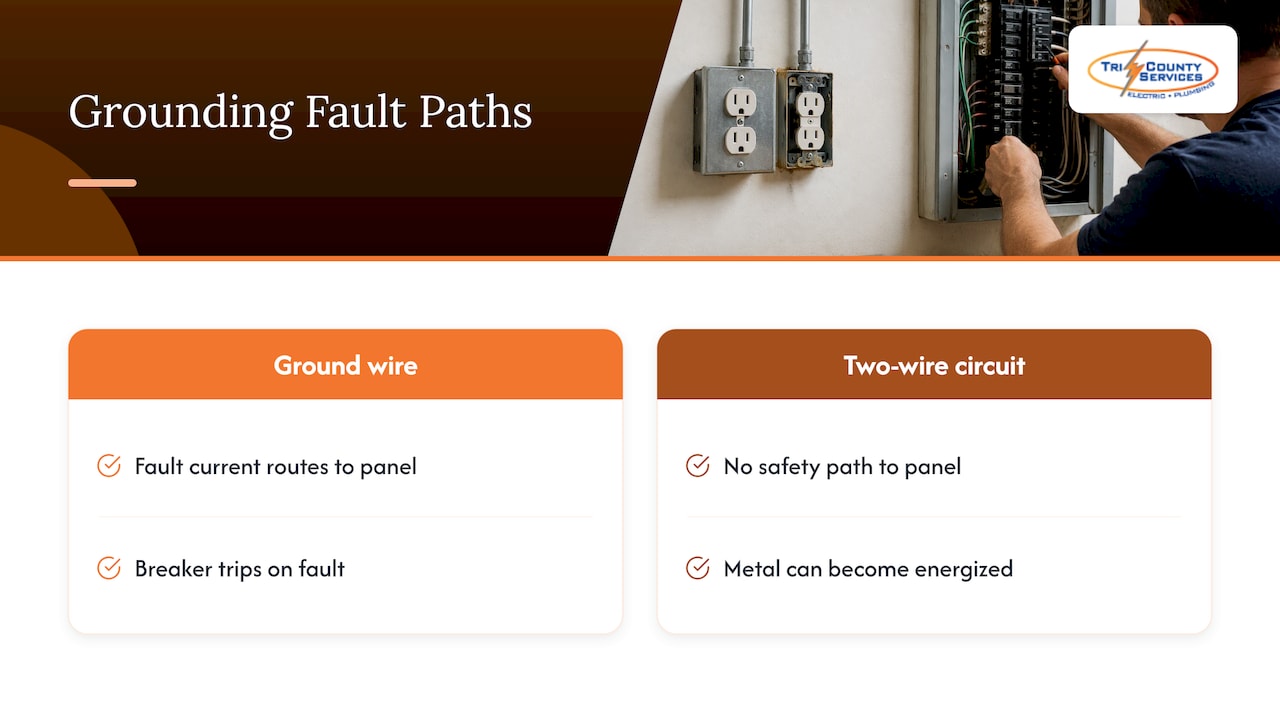
That is why grounding matters most for things with metal housings and for things you hold while standing near water: power tools, kitchen appliances, lamps, and anything in a bathroom, kitchen, basement, or garage.
Are two-prong outlets safe, and are they illegal?
Two questions, two answers.
Illegal? Generally no. The NEC does not apply retroactively, so homeowners are not obligated to replace existing non-grounding receptacles. Local rules can differ, which is one more reason to talk to a professional who works in your area every day. Even housing inspection guidance such as San Diego County’s treats ungrounded two-prong outlets in pre-1975 housing as acceptable, though it cautions against replacing them with three-prong outlets unless a ground wire is connected or GFCI protection is in place.
Safe? Safe enough for small devices that do not depend on a ground. InterNACHI, the home inspectors’ association, notes that many small two-prong appliances, like alarm clocks and coffee makers, are unaffected by a lack of grounding. The concern is the three-prong devices you want to plug in: computers, TVs, refrigerators, power tools, and anything with a grounded plug.
If you are buying an older house, treat two-prong outlets as a cost to plan for, not a reason to walk away. A professional walkthrough tells you which circuits are two-wire, which have a ground, and what an upgrade would involve.

Why swapping in a three-prong outlet is the wrong move
This is the most important point in this article. It seems logical: your plug has three prongs, so install a three-slot outlet. But the third slot only works if a ground wire is connected to it. On a two-wire circuit there is none.
InterNACHI warns that replacing a two-slot receptacle with a three-slot one without rewiring is potentially more dangerous than using an adapter, because the outlet appears grounded when it is not. The next owner, or you in five years, may never learn it is ungrounded. InspectApedia makes the same point: if no ground path exists, installing a grounding receptacle on that circuit is improper and unsafe.
The same applies to shortcuts people try, such as connecting the outlet to a metal water pipe or a ground rod. InterNACHI cautions that homeowners and unqualified people should not modify a building’s electrical components, and that misguided attempts to ground receptacles to a water line or ground rod may be dangerous. Pipes in your home can be replaced with plastic, interrupted by repairs, or corroded, which breaks the connection without anyone noticing. A circuit that looks fixed but is not is the worst outcome, and it is the reason we start with a professional assessment.
What about plug-in adapters?
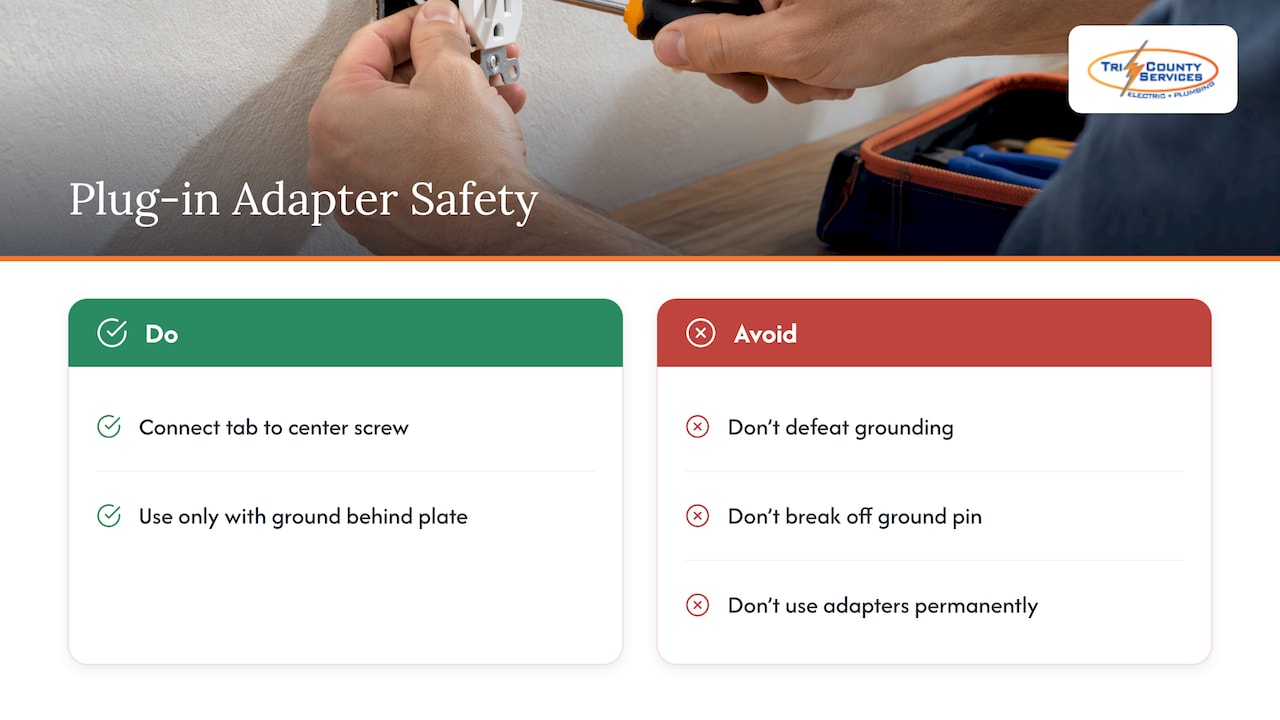
Three-to-two prong adapters are cheap and everywhere, and they are tempting. The U.S. Consumer Product Safety Commission’s Home Electrical Safety Checklist is clear on how they must be treated: the adapter’s grounding wire or tab must always be connected to the center screw on the outlet cover, and the grounding feature must never be defeated or the ground pin broken off.
To understand why grounding features are never to be bypassed, this explanation of temporary adapters and grounding precautions shows how seriously adapter use is treated when power is being routed through different connectors.
There is a second problem. Wirecutter reports that an expert quoted there does not recommend adapters as a permanent solution: they stick out from the wall, get bumped and disconnected, and can cause arcing and sparks. And even a correctly attached adapter only grounds anything if there is a ground behind the cover plate. On a two-wire circuit, there is not.
The three safe ways to upgrade a two-prong outlet
When there is no equipment grounding conductor in the outlet box, the NEC section for replacement receptacles, 406.4(D)(2), gives three choices. EC&M, a trade publication for electrical professionals, summarizes them.
| Option | What it is | Best for |
|---|---|---|
| Non-grounding receptacle | A new two-slot outlet in good condition | Lamps, clocks, small devices in low-risk rooms |
| GFCI receptacle | A ground-fault circuit interrupter outlet, labeled “No Equipment Ground” | Kitchens, baths, laundry, garages, basements, outdoors |
| Grounding-type receptacle with GFCI protection upstream | A three-slot outlet fed through a GFCI outlet or breaker, labeled “GFCI Protected” and “No Equipment Ground” | Places where you need to plug in three-prong cords |
A GFCI, or ground-fault circuit interrupter, senses current leaking where it should not and cuts power. ESFI says GFCIs can shut off power in as little as 1/40 of a second. That protects people even without a ground wire. This Old House points out that an ungrounded GFCI still protects people, tools, and appliances from ground faults, though it cannot shield sensitive electronics such as computers from stray-current interference.
Two details are easy to miss. First, those labels must be on the outlet and visible once the cover plate is on. Second, replacement receptacles also have to meet the rest of 406.4(D), including tamper-resistant devices where required and weather-resistant devices outdoors. Getting these right is a code matter, not a guess, and it is part of what a professional handles.
For how GFCI protection applies in bathrooms specifically, see our guide to bathroom GFCI requirements under the 2026 NEC.
The upgrade that gives you a true ground: rewiring the circuit
A GFCI makes an outlet safer. It does not create a ground. If you want real three-prong grounding for a home office, a workshop, or a media center, the circuit needs a ground conductor. That means running new cable, or in some homes, rewiring the circuit run by run. It involves opening walls or working through attics and basements, which is why scheduling and care for your home matter. Our team uses a flexible service schedule designed to minimize disruption, and our technicians respect your home while they work.
Sometimes a whole-house approach makes more sense than outlet by outlet. If your panel is old, or your home has several two-wire circuits, a panel upgrade combined with new circuits can be more efficient than piecemeal fixes. Our electrical panel upgrade service is one place to start that conversation.
Where to start in an older house
You do not need to do everything at once. A practical order:
- Wet areas first. Kitchens, bathrooms, laundry rooms, garages, basements, and outdoor outlets are where a fault and water or damp concrete can meet a person. GFCI protection here is the highest-value step.
- Outlets that power things with three-prong plugs. Refrigerators, computers, TVs, window air conditioners, and power tools are the reasons homeowners come to us. These are candidates for true grounding.
- Any outlet that is warm, loose, buzzing, or scorched. That is a repair issue, not an upgrade issue, and it should be looked at promptly. If a power failure or burning smell is happening right now, our guide on when to call 911, your utility, or an electrician can help you decide.
- Everything else. Bedroom and living room outlets that only run lamps and chargers can often wait while you plan a larger project.
Two-prong outlets also tend to come with other age-related issues. Our article on common electrical problems in older homes lists what we look for, and our guide to signs of old wiring and when to replace it will help you spot them.
Why this is a job for a professional
The task looks small: remove two screws, move three wires. But the decision behind it is not small. The right choice depends on what is in the box, what the cable is, whether there is a ground nearby, what the circuit feeds, and what the code requires where you live.
This Old House lists the situations where calling a professional is warranted: whole-house upgrades or rewiring, signs of electrical damage or wear, uncertainty about the home’s electrical system, and aluminum wiring. All four show up regularly in older houses. Aluminum branch wiring in particular needs specially rated devices and connectors, and standard outlets are not made for it.
Because an outlet that looks right but is not wired right is the real hazard, getting the diagnosis first matters more than the device you buy. If you are not sure what is behind your walls, our piece on how to know if your home wiring is safe explains what an assessment covers.
What to expect when we visit
Our approach is simple. A technician tests the outlets, opens the boxes where needed, and identifies which circuits are two-wire and which already have a ground. You then get clear, upfront pricing before work begins. For diagnosing a problem, our electrical troubleshooting service is listed at $300 to $500 as a one-off. Other work, such as a panel upgrade, dedicated circuits, or surge protection, is quoted for the job, and you can see the services on the same pricing page.
For the whole house, a common plan is: GFCI protection in the wet areas, grounded circuits where you run valuable equipment, and a rewiring schedule you can spread across several years. A surge protection layer at the panel is also worth discussing if you are putting computers and electronics on upgraded circuits.
Upgrade your outlets with Tri-County Services Electric & Plumbing
We have served Northeast Ohio since 1975, and we are a family-owned business with certified technicians. If you have two-prong outlets and want to know what to do about them, we can look at your circuits and give you a plan that fits your home and budget. Our electrical repair service covers outlet and circuit work, and our pricing guide shows what we offer.

Call our office at (440) 253-0332 to schedule a visit.
Our perspective
Every week, homeowners ask us whether they can just replace a two-prong outlet with a three-prong one. The honest answer is that the plug is the least of it. What matters is what is behind the wall.
We believe an outlet should tell the truth. A three-slot outlet that is not grounded says something that is not so, and that false message stays in the house long after the person who installed it moves on. That is why we start with an assessment and not a part. Once we know what the circuit has, we can recommend GFCI protection, a new grounded circuit, or a larger plan that includes the panel.
Our flexible scheduling is designed to keep the disruption low, and our technicians treat your home the way we would want ours treated. Before work starts, we give you clear, upfront pricing. If you have two-prong outlets and want a straight answer, call us at (440) 253-0332.
Lindsay Paramore
FAQ
Is it okay to have two-prong outlets?
Yes, in many homes they are acceptable, since the code does not require existing ones to be replaced. They are best for low-risk devices. For wet areas and valuable electronics, a professional upgrade gives you protection that an old outlet cannot.
Can I still buy two-prong outlets?
Yes. InspectApedia notes the older two-slot style can still be bought new. The code allows a new non-grounding outlet as a replacement on an ungrounded circuit, but a GFCI outlet is usually the better choice, and a professional can tell you which fits each location.
Can I convert a two-prong outlet to a three-prong outlet?
Only safely if the circuit gets a real ground or GFCI protection with the required labels. Swapping the outlet alone creates a false sense of safety. Our team assesses each circuit and recommends the right path.
What are two-prong outlets called?
They are often called ungrounded, non-grounding, or two-slot receptacles. Electricians and inspectors may also refer to them as two-wire outlets, because the circuit has only hot and neutral conductors.
Does a three-prong outlet always mean the circuit is grounded?
No. A three-slot outlet can be installed on a circuit with no ground, which is exactly why each outlet needs to be tested. A professional can confirm which ones are truly grounded.
Sources
- Outlets: The Ins and Outs, ESFI
- Should I Upgrade Ungrounded Outlets? Fine Homebuilding
- How to Ground an Outlet That’s Ungrounded, Family Handyman
- Inspections: Outlets, San Diego County
- Ungrounded Electrical Receptacles, InterNACHI
- Electrical Receptacle Types, InspectApedia
- Home Electrical Safety Checklist, CPSC
- Common Electrical Safety Problems, Wirecutter
- NEC Requirements for Receptacles, EC&M
- A Comprehensive Guide to Replacing Two-Prong Receptacles, This Old House