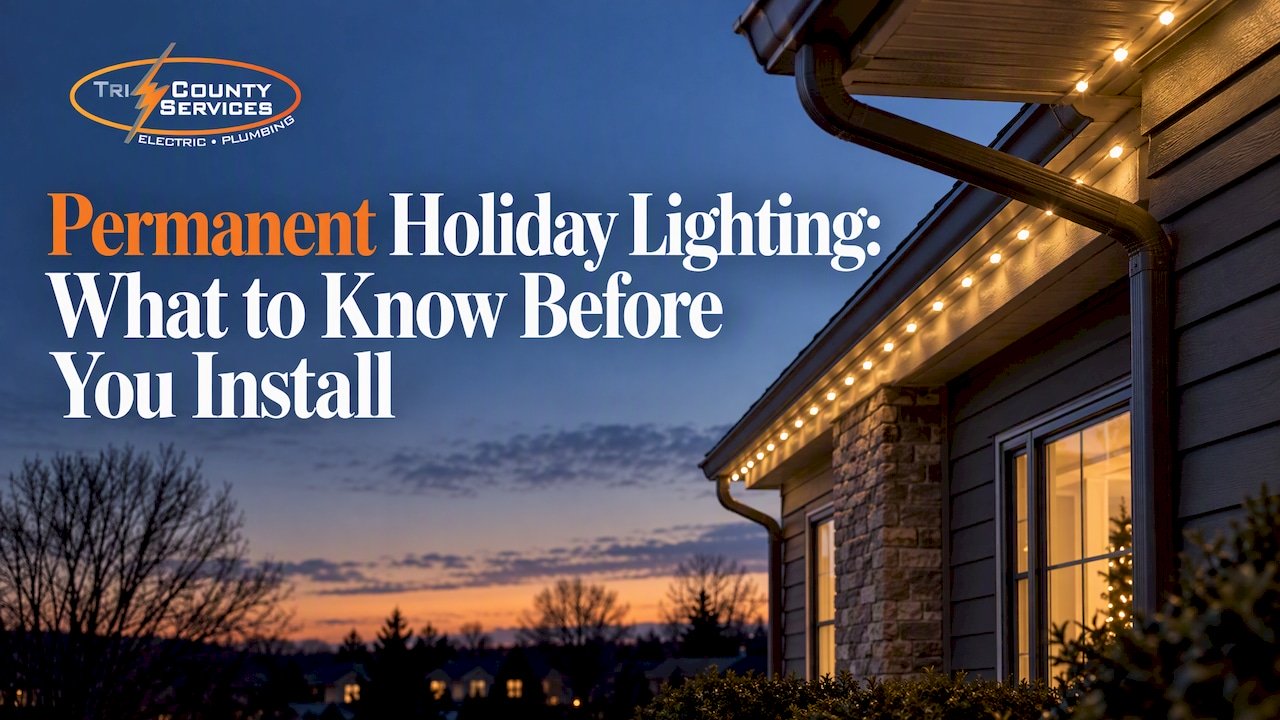


Permanent holiday lighting is a fixed exterior lighting system, usually a weatherproof track or channel along your roofline, that can glow warm white every evening and switch to red and green in December. It is not a strand of Christmas lights left up all year. The difference matters for safety, for code and for how long the system lasts. Here in Northeast Ohio, with lake-effect snow, freeze-thaw swings and ice on every eave, it matters even more.
This guide explains how permanent lighting differs from seasonal strings, what the electrical code says, what drives the cost and what a safe installation includes. We are Tri-County Services Electric & Plumbing, and we have worked on Northeast Ohio homes since 1975. If you want a professional to look at your home’s exterior power before you commit to a system, call our office at (440) 253-0332.
TL;DR
- Permanent holiday lighting is part of your home’s fixed electrical system. Treat it that way, not as a decoration.
- Ordinary seasonal strings are not made for year-round use. The National Electrical Code limits temporary holiday lighting to 90 days, and permanent exposure needs products certified for all-year use.
- Outdoor power should run through GFCI protection on a properly installed circuit, ideally one dedicated to the lighting.
- Most of the cost and most of the risk sit in the wiring, the power supply and the ladder work, not in the lights.
- Call (440) 253-0332 and we will assess your exterior power before any lights go up.
Table of Contents
- What permanent holiday lighting actually is
- Why seasonal string lights are not the same thing
- What the code and safety agencies expect
- Where the power comes from: the part most people skip
- Safety at the roofline
- Is it worth it? Cost and energy
- Questions to ask before you hire anyone
- Our perspective: treat it as electrical work first
- How Tri-County Services Electric & Plumbing can help
- A simple plan for this season
- FAQ
- Sources
What permanent holiday lighting actually is
A typical permanent system has four parts: a mounting track or channel fastened to the fascia, soffit or trim; small LED nodes that sit in the track; a power supply (a low-voltage driver) that converts household current; and a controller, usually app-based, that sets color, brightness and schedule.
The appeal is easy to see. You stop climbing a ladder in November, you stop untangling strands and you can use the same lights for game days, Halloween, Thanksgiving and every night in between.
What the marketing rarely mentions is that the system is a permanent electrical installation. It draws power from a circuit in your house, it sits outside in rain, ice and UV, and it will be there for years. That puts it in a different category from anything you plug in for the season.
Why seasonal string lights are not the same thing
Standard holiday strings are built and tested for temporary use. Per UL Solutions, most seasonal strings are covered by UL 588, and the weather-resistance and durability ratings needed for permanent exposure to UV, moisture and temperature swings come from a separate supplement (Supplement SD). UL also points out that string lights certified for all-year use are different products from ordinary lighting strings.
The code draws the same line. The NEC treats temporary holiday lighting as limited to 90 days, while fixed exterior lighting falls under installation rules for permanent luminaires. Leaving a standard strand up through the year can run afoul of those rules and, in practice, puts a product outside the conditions it was tested for.
A few real-world consequences of that mismatch:
- Insulation breaks down. Sun and cold make ordinary cord brittle, and cracked insulation is a shock and fire path.
- Connections fail. Moisture gets into plugs and splices that were never meant to stay outside for twelve months.
- Wind and weight take a toll. Cords stapled or hung off gutters and shingles move constantly, and chafing leads to shorts.
The same thinking applies to where lights are mounted. As the IAEI’s code column on holiday lighting explains, trees and shrubs are not a stable platform for electrical equipment, which is part of why temporary displays are time-limited. Growth and movement damage wiring over time.
What the code and safety agencies expect
Three points come up on nearly every exterior lighting job.
GFCI protection
The Consumer Product Safety Commission advises plugging outdoor decorations into ground-fault circuit interrupter outlets, which cut power when a ground fault occurs to help prevent shock. For a permanent system, that protection should be built into the circuit, not improvised with a plug-in adapter. If your exterior outlets are older, they may not have it. Our guide to how a GFCI outlet is installed shows what the device does, though replacing or adding protection on an exterior circuit is a job for an electrician.
Exterior-rated equipment
Boxes, connectors, cable and drivers on the outside of your home must be rated for wet locations and sunlight. According to UL Standards & Engagement, holiday lights can become fire hazards when they are installed improperly, damaged, plugged into overloaded outlets or built without meeting safety standards. Look for the UL mark and, for permanent products, certification specifically for all-year use.
No extension-cord shortcuts
A cord run from an indoor outlet through a window, under a door or along the ground is fine for a week in December. It is not an electrical supply for a system that stays up for years. The same source warns against hiding cords under rugs or furniture, and against using vegetation to support conductors.
If you are unsure whether your existing exterior wiring is in good shape, start with a look at the basics in how to tell if your home wiring is safe.
Where the power comes from: the part most people skip
Sellers focus on the lights. The electrician’s questions are about the supply.
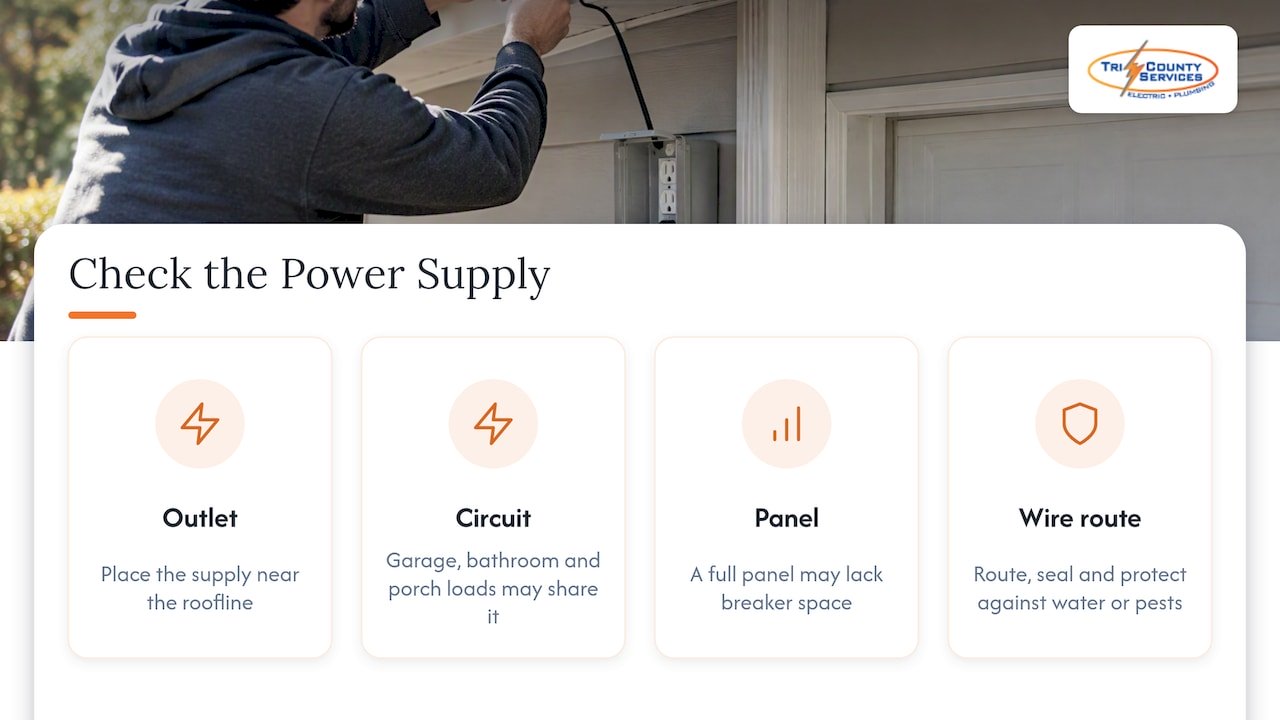
Is there an exterior outlet in the right place? Systems need a power supply near the roofline or a feed to one. Many homes have a single front porch receptacle that is already shared with other loads.
What else is on that circuit? Garage outlets, bathroom receptacles and porch lights often share a circuit. Adding a lighting load to a circuit that already trips in winter is a recipe for nuisance outages.
Is the panel up to it? A full or aging panel may have no room for another breaker. If yours is crowded, our electrical panel upgrade service is the place to start before adding loads.
Where will the wire run? Cable that crosses from the attic or basement to the exterior has to be routed, sealed and protected so it does not become a path for water or pests.
The cleanest answer is usually a dedicated circuit with GFCI protection feeding a weatherproof outlet or junction point close to the power supply. That is wiring work, and it belongs in the hands of a professional who can test it and stand behind it.
Safety at the roofline
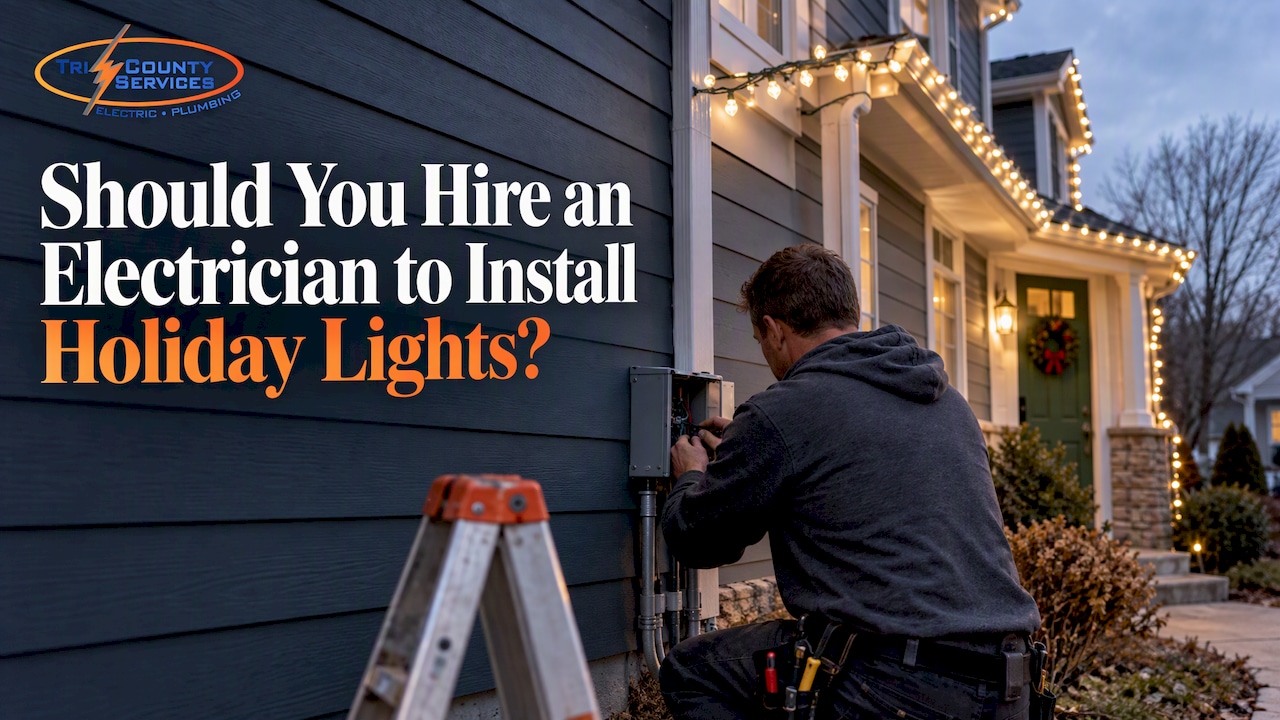
Roofline work means ladders, wet shingles, gutters full of leaves and, in Northeast Ohio, ice. Falls from ladders are the quiet danger of anything holiday related, and electrical contact makes it worse. Service drops and the weatherhead are often within arm’s reach of the eaves.
This is a good reason to hand the job to people who do it daily. We cover that angle in why holiday lighting is a job to leave to the pros, and our holiday outdoor lighting tips go over what to consider before any lights go up.
Before anyone mounts track to a fascia, the surface behind it should be sound. Rotted trim holds nothing, and fasteners driven into damaged areas invite leaks. A roof inspection checklist for homeowners helps you spot soft edges, loose flashing and failing shingles that should be fixed first.
Is it worth it? Cost and energy
What you pay for permanent lighting depends on the length of your roofline, the number of rooflines and peaks, the lighting system you choose and how much electrical work the power supply needs. Quotes from lighting vendors vary widely, so compare them line by line, and ask whether electrical work is included or left for you to arrange.
On the electrical side, here is what we publish for related work:
| Electrical service | Our published price |
|---|---|
| Electrical troubleshooting | $300-$500 |
| Dedicated circuit installation | Quoted after assessment |
| Whole-home surge protection | Quoted after assessment |
| Electrical panel upgrade | Quoted after assessment |
See our electrical pricing guide for the full list.
On running costs, LEDs are efficient. ENERGY STAR says certified decorative light strings use roughly 92% less energy than conventional incandescent strings. Because the lights in a permanent system are LED, running them on a schedule costs very little compared with old incandescent displays.
The real cost question is whether you pay once for a sound installation or pay again for repairs. Cheap shortcuts, such as a stapled cord, an undersized circuit or a non-rated connector, tend to show up as flickering, tripped breakers or water damage after the first winter.
Questions to ask before you hire anyone
Whoever installs permanent holiday lighting, ask:
- Who does the electrical connection? The person who mounts the lights and the person who wires the supply should both be accountable for their part.
- Are the products certified for all-year exterior use? Ask to see the marking, not just the brochure.
- Will the power run on a GFCI-protected circuit? If the answer is a plug-in cord, keep looking.
- What is the warranty, and who honors it? Get it in writing.
- Is the circuit load calculated? The installer should know what else shares that breaker.
- How is the track fastened and sealed? Penetrations through siding or trim need to be sealed against water.
Our perspective: treat it as electrical work first
We see the same pattern every season. A homeowner buys a kit or books a lighting crew, and then the questions begin: which outlet, which breaker, why does it trip when the snow blower plugs in next to it? Those are electrical questions, and they are easier and cheaper to answer before the lights go up than after.
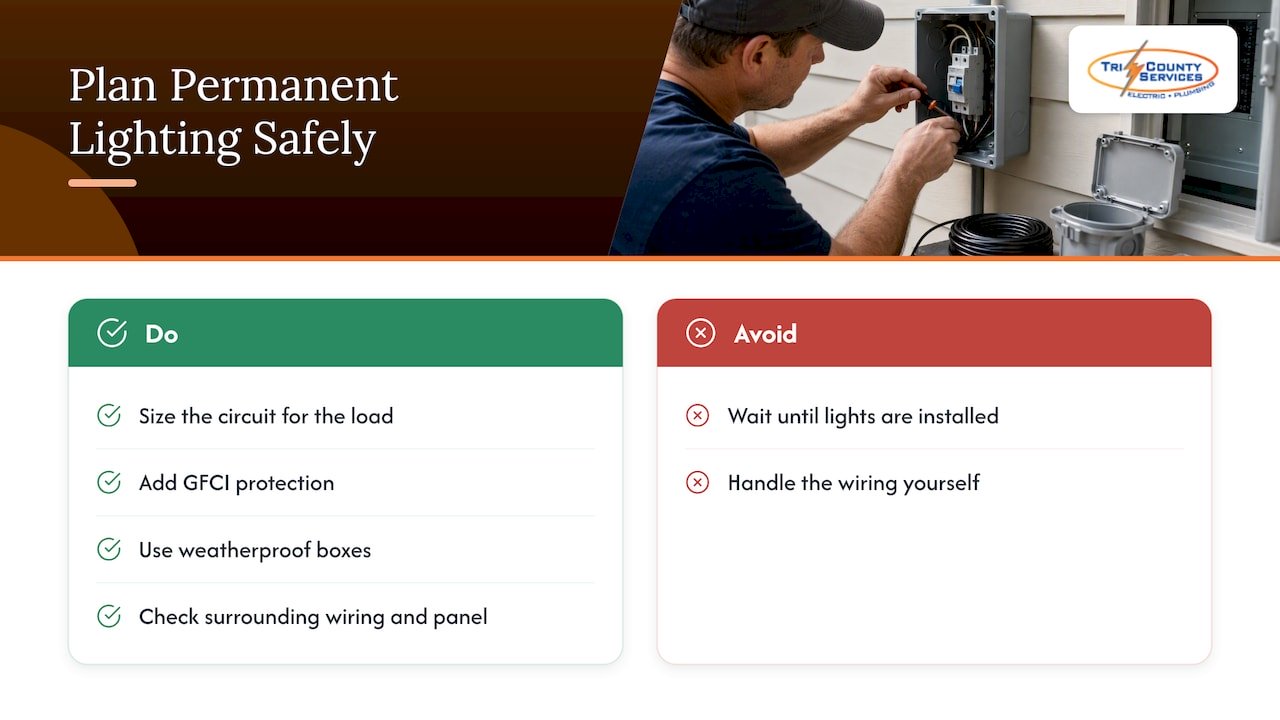
Our view is simple. Permanent lighting should be planned like any other fixed fixture on your house. That means a circuit sized for the load, GFCI protection, weatherproof boxes and a quick safety check of the surrounding wiring and panel. Our technicians are certified, we schedule flexibly to keep disruption low and we respect your home while we work. We also give clear, upfront pricing before work begins.
If you are tempted to handle the wiring yourself to save a few dollars, we would ask you to call first. Exterior circuits, ladders and live service equipment are where small mistakes become serious ones, and a professional visit is far less expensive than a fire or an injury.
— Lindsay Paramore
How Tri-County Services Electric & Plumbing can help
We handle the electrical foundation that permanent holiday lighting depends on: exterior outlets, dedicated circuits, GFCI protection, surge protection for the electronics in your controller and panel capacity. See our outdoor lighting installation and control systems page for what we do outside the home, or our professional electrical installation services for the full range.
If you are not sure where to start, our troubleshooting visit will tell you what your current wiring can support. Call our office at (440) 253-0332 to schedule.
A simple plan for this season
It is late October, which is a good time to plan. Crews and electricians fill up as the holidays approach, and temperatures are still workable for exterior work.
- Walk the outside of your house. Note where your exterior outlets are, whether they have weatherproof covers and whether any look cracked or corroded.
- Check your breakers. If circuits trip often or the panel is crowded, deal with that first.
- Have your exterior power assessed. A professional can tell you whether a dedicated GFCI-protected circuit is needed.
- Fix the roofline basics. Repair damaged trim, gutters or flashing before anything is mounted to them.
- Choose certified products. Insist on products marked for all-year exterior use.
- Book the installation. Have the electrical work done before the lighting crew arrives, so both jobs go smoothly.
If you are still going with a temporary display this year, the same basics apply. Use GFCI-protected outlets, keep cords out of trees and shrubs and take the display down within the 90-day window. For more on the general safety picture, Entergy’s holiday lighting tips cover testing, outlets and cord condition.
FAQ
Can I leave regular Christmas lights up all year?
No. Standard seasonal strings are made for temporary use, and the NEC limits temporary holiday lighting to 90 days. Year-round lighting needs products certified for all-year exposure and an installation that meets permanent wiring rules. Call us at (440) 253-0332 if you want an electrician to look at what you have.
Does permanent holiday lighting need its own circuit?
Often it is the best approach. A dedicated circuit with GFCI protection keeps the lighting from overloading outlets that also power other things. An electrician can check the load on your existing circuits and tell you whether a new one is warranted.
Will permanent lights raise my electric bill much?
LED systems use far less power than older incandescent displays. ENERGY STAR reports that certified decorative strings use about 92% less energy than conventional ones. Your actual cost depends on how many hours you run the lights and at what brightness.
Who should do the electrical hookup?
A professional electrician. The connection involves your panel, an exterior circuit, weatherproofing and ground-fault protection, all of which affect shock and fire risk. Our office can be reached at (440) 253-0332.
Is it a problem if my exterior outlets trip all the time?
It can be. A GFCI that trips repeatedly may be reacting to moisture or a fault, and resetting it again and again does not fix the cause. Have an electrician inspect the circuit before you add any lighting load to it.
Sources
- String Lights for All-Year Use, UL 588 Supplement SD | UL Solutions
- Holiday Lighting: Display Safety and the NEC | IAEI Magazine
- Holiday Safety | CPSC
- Holiday Decorating Safety Tips | UL Standards & Engagement
- Decorative Light Strings | ENERGY STAR