

Yes, in most cases you should, and especially if your display goes beyond a single strand on the porch. Hanging lights on a roofline means ladder work, and powering them means asking your outdoor outlets and circuits to carry a load they may never have carried before. A professional deals with both, and spots problems before they turn into a tripped breaker, a shock or a fire. Below, we explain when a pro is worth it, what it costs, and what to ask before you book.
TL;DR
- Hire a pro if your display covers a roofline, runs on several outlets, or needs a new outdoor outlet or dedicated circuit.
- Professional installation averages about $444 nationally, and complex homes cost more. A new outdoor outlet typically adds $120 to $200.
- Electrical equipment is involved in 40% of home Christmas tree fires according to the NFPA data we reviewed, and decorating sends thousands of people to the ER each season.
- Book early. The best time to talk about lights is before the season starts, not the week of Thanksgiving.
- Call Tri-County Services Electric & Plumbing at (440) 253-0332 to have your outdoor electrical checked before the lights go up.
Table of Contents
- What you are really hiring for
- Signs you should call a professional
- The real risks of going it alone
- What professional holiday lighting costs
- Electrician, decorator or both?
- How to prepare for the visit
- Our perspective
- Get your home ready before the season
- Frequently asked questions
- Sources
What you are really hiring for
Most people think of holiday lighting as a decorating job. It is two jobs. One is physical: getting strands onto gutters, shingles and trim at height, then taking them down again in January. The other is electrical: delivering safe power to everything you hang.
A decorating crew can handle the first job. The second is where an electrician earns the call. An electrician looks at the outdoor receptacles, the circuit behind them, the weatherproof covers and the ground-fault protection, and tells you whether the system can handle the display you have in mind. Lighting installers generally work from your existing outlets, so they need those outlets to be in good shape and to have access to them.
If you want the pros-and-cons rundown in our own words, our post on professional holiday lighting installation covers why we say to leave the ladder to the pros.
Signs you should call a professional
Not every display needs an electrician. A small, plug-in-and-go setup on a sound outlet is a different matter from a whole-house design. These are the situations where we would pick up the phone first.
Your display covers the roofline or second story
Falls, cuts, shocks and burns are the most common decoration injuries. The NFPA reports that about 11,000 people are treated in emergency rooms each year during the 60-day winter holiday period for decoration-related injuries. Ohio winters add wet shingles, frost and early darkness to the mix. A professional crew brings the right ladders, fall protection and experience, and carries the risk instead of you.
You have a limited number of outdoor outlets
Many homes have one or two exterior receptacles, often on the same circuit as a garage or a bathroom. Plugging in a large display and then adding inflatables, a heated fixture or a pressure washer can overload that circuit. If your breakers trip when the lights are on, that is a sign you may need a dedicated circuit installed by a professional, not more extension cord daisy-chains, according to HomeAdvisor’s cost guide.
Your outlets are old, cracked or uncovered
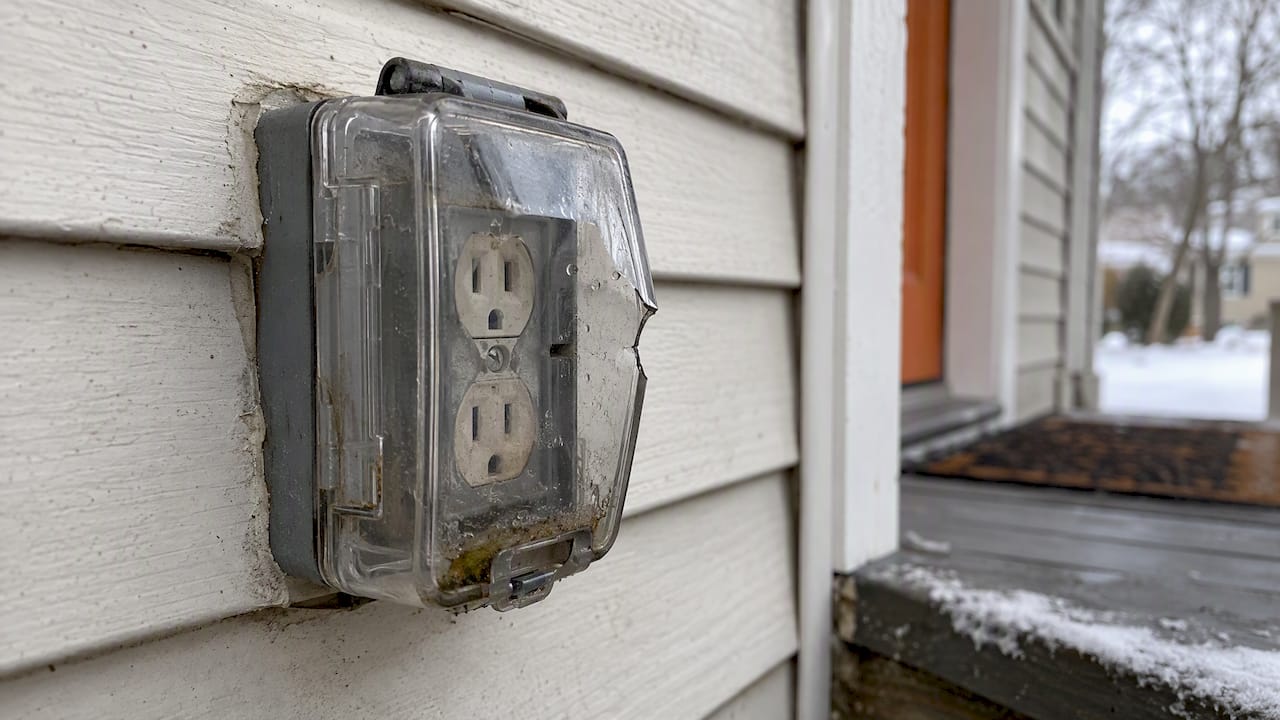
Outdoor receptacles take a beating from freeze-thaw cycles. A cracked cover, a loose receptacle or one that never had ground-fault protection is a poor foundation for weeks of continuous use. Under the National Electrical Code, outdoor 125-volt, 15- and 20-amp receptacles must be GFCI protected, and a receptacle needs an in-use weatherproof cover while a plug is connected. If you cannot tell whether yours meet that standard, that is exactly what an inspection is for. Local code can differ, so an electrician who works in your municipality is the best judge.
You want timers, smart controls or permanent lighting
Controls are where a display becomes a system. Timers, photocells and smart controllers need to be matched to the load and wired or plugged in correctly. If you want help picking and setting up timers and controls for holiday lighting, plan this at the start, since it affects how many outlets you need and where they should be. For permanent or year-round lighting, see our outdoor lighting installation and control systems page.
You have had electrical trouble before
Flickering lights, warm outlets, buzzing, or breakers that trip for no obvious reason should be looked at before you add load. Adding a few hundred watts of lights to a system that already has a problem is how a nuisance becomes an emergency.
The real risks of going it alone
Holiday fires are not common, but they tend to be serious. NFPA figures show that U.S. fire departments responded to an estimated average of 835 home structure fires per year that began with decorations, not counting Christmas trees. The NFPA also notes that half of decoration fires happen because decorations are placed too close to a heat source.
The mistakes that cause trouble are usually small ones:
- Damaged strands. Frayed wire, cracked sockets and loose connections are easy to miss before the strand goes up. The CPSC advises checking each set and using only lights tested by a nationally recognized laboratory, such as UL or ETL.
- Overloaded circuits. Chaining too many sets together, particularly older incandescent ones, is a leading cause of overheating. A professional adds up the load before anything is plugged in.
- Nails and staples. These can pierce wire insulation and cause shorts. Professionals use light clips made for each roof and trim type, which protect both the wiring and your siding.
- Wet connections. Plugs sitting in snow or a puddle, with no in-use cover and no ground-fault protection, are a shock hazard.
- Heat and dry material. Lights against a dry tree or flammable decorations add fire risk. Roof materials matter too: this overview of fire safety tips for shingle roofs is a reminder that what is under your lights is part of the equation.
There is also a cost to getting it wrong that does not show up on an invoice: a damaged roofline, a night with no power in January, or an insurance conversation you do not want to have. A professional visit is cheap by comparison.
What professional holiday lighting costs
Prices vary with the size of your home, the height of the roofline, the type of bulbs and whether takedown is included. These national figures give you a frame.
| What you are paying for | Typical cost | Source |
|---|---|---|
| Professional installation, setup and takedown (average project) | About $444; range $220 to $684 | HomeAdvisor |
| Basic residential packages | $250 to $650 | Fixr |
| Deluxe or multi-roofline installations | $500 to $1,500 | Fixr |
| Basic professional installation per linear foot | $5 to $10 | Fixr |
| New dedicated outdoor outlet | $120 to $200 per outlet | HomeAdvisor |
| Professional timer installation | $40 to $120 per hour | HomeAdvisor |
| Standalone outdoor timer (product only) | $12 to $50 | HomeAdvisor |
These are national averages, not Tri-County Services Electric & Plumbing prices. Labor is the biggest piece. Fixr’s data puts it at roughly 65% of the total project cost.
A worked example
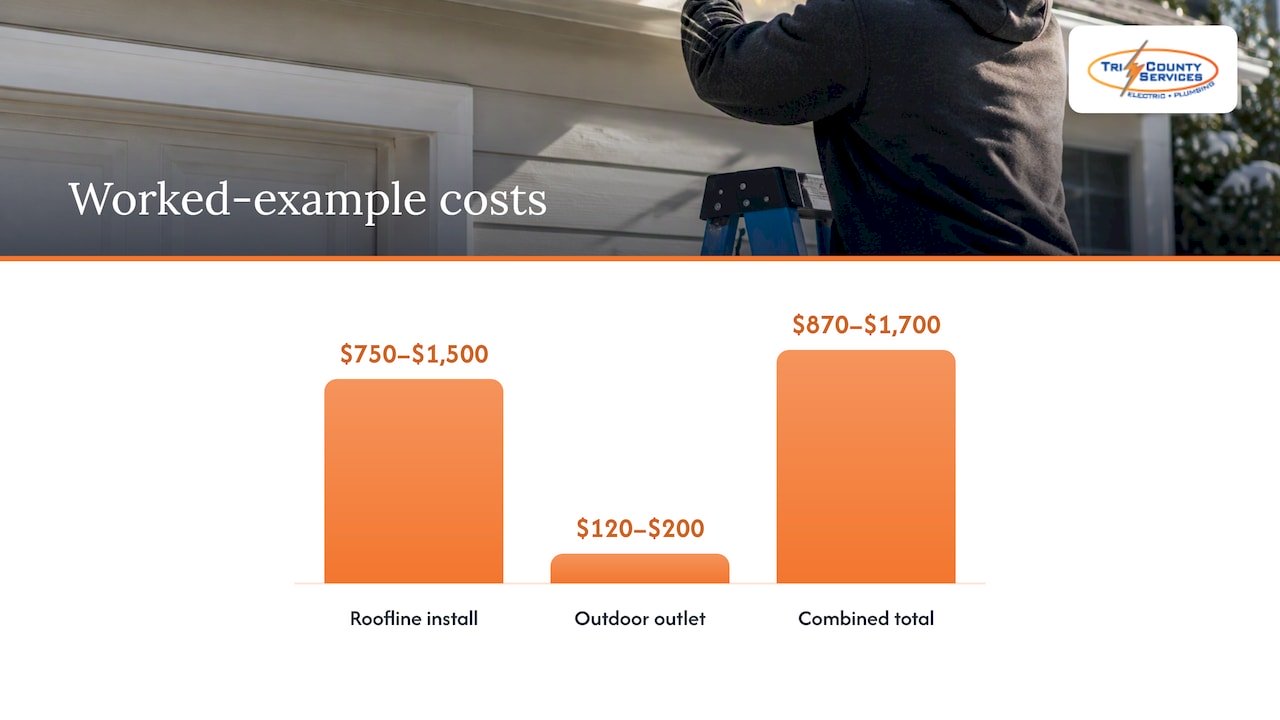
Say you have a two-story Northeast Ohio colonial with about 150 feet of roofline. At the $5 to $10 per linear foot range, a basic install would land between $750 and $1,500 before extras. Add a new outdoor outlet at $120 to $200, and you may be looking at a total of roughly $870 to $1,700. That is a calculation from the published ranges, not a quote, and your actual price depends on the design and the house. It shows why the number a neighbor paid for a ranch with a short roofline may not apply to you.
Where the electrical cost fits
If an electrician needs to find out why a circuit keeps tripping, our electrical troubleshooting is listed at $300-$500. Other electrical work, such as dedicated circuits, has no published price, because it depends on the run, the panel and the access. You can see what we offer on our electrical pricing guide.
Electrician, decorator or both?
The right answer depends on what you need.
| Your situation | Best first call |
|---|---|
| One strand on a sound porch outlet, no ladder | You may not need anyone, but check the cord and outlet cover |
| Roofline display on outlets you know are reliable | A professional lighting installer, after an electrical check |
| Breakers trip, outlets are old or you are adding a big display | An electrician, before any lights go up |
| Need a new outdoor outlet, dedicated circuit, timer wiring or surge protection | An electrician |
| Permanent or year-round architectural lighting | An electrician who handles outdoor lighting and controls |
The common thread: the electrical question comes first. A beautiful design that trips the breaker on opening night is not a success. If an electrician signs off on the power, whoever hangs the lights can focus on the design and the safety of the work at height.
How to prepare for the visit
A good professional starts with a site assessment. Industry guidance describes it as documenting roof measurements and any electrical challenges, such as too few outlets or limited circuit capacity, so the proposal is safe and accurate. To make that visit useful:
- Walk the outside after dark. Note which outlets you plan to use and which are hard to reach.
- Write down any breaker trips. Say which breaker, and what was running when it tripped.
- Gather your wish list. Roofline, trees, bushes, wreaths, inflatables, a lit path. Each one adds load.
- Ask about the lights themselves. Commercial-grade LED strands draw far less power than older incandescent sets, which changes how many you can run.
- Decide on takedown. Ask whether removal and storage are part of the price.
- Schedule early. Waiting until the first snow means competing for the same few weekends as everyone else.
Our perspective
We have worked on Northeast Ohio homes and businesses since 1975, and the holiday season brings the same few calls year after year. A breaker that trips every night at 5 p.m. when the lights come on. An outdoor outlet that has not had a cover since the house was built. An extension cord run through a window because there is no outlet near the front of the house.
None of those are decorating problems. They are electrical problems that decorating exposes. That is why we tell homeowners to treat the electrical check as step one. It is a short visit, it costs far less than a repair after a failure, and it lets you plan the display around what your home can safely carry.
We also do not encourage homeowners to climb onto a roof with a bundle of cords and a staple gun. If you want a custom display, hire a professional. If you want us to make sure your home’s power can support it, call us. Our team is certified, we schedule flexibly to keep the disruption to your day small, and we treat your home with respect.
Cold weather adds its own electrical stresses to the picture, which we cover in our guide to winter electrical safety for Ohio homes. For more detail on layout and placement, our holiday outdoor lighting installation tips go further.
— Lindsay Paramore
Get your home ready before the season
If you are thinking about a bigger display this year, start with the power. Tri-County Services Electric & Plumbing can inspect your outdoor receptacles, find out why a breaker keeps tripping, add outdoor outlets or dedicated circuits, and talk through whole-home surge protection for the electronics inside the house. See our electrical pricing guide for the services we offer, or call our office at (440) 253-0332 to schedule.
Frequently asked questions
Can you pay someone to put up Christmas lights?
Yes. Many companies offer design, installation, maintenance and takedown. Pricing is typically by the linear foot or as a package, and national averages for a typical home are around $444. Before the crew arrives, have an electrician confirm your outlets and circuits can handle the load.
How much does an electrician charge to install outdoor outlets for lights?
Nationally, a new outdoor outlet typically costs $120 to $200 per outlet, and new outdoor wiring can add $50 to $100 per hour for a technician. Your price depends on the distance to the panel and the wall construction. Call us at (440) 253-0332 and we will talk through your situation.
Is it safe to plug a lot of Christmas lights into one outlet?
Not without checking the load. Overloading is a primary cause of overheating, and the CPSC cautions against connecting too many incandescent sets together. LED strands draw less power, but the outlet, circuit and extension cords still need to be in good condition and rated for outdoor use. If breakers trip, stop and call a professional.
When should I book holiday lighting help?
As early as you can. Industry professionals recommend discussing holiday lighting well before the season begins, so there is time for assessment and for any electrical work. Since it is already late October, call soon if you want outlets or circuits added before the lights go up.
Sources
- HomeAdvisor: How Much Do Professionally Installed Christmas Lights Cost?
- Fixr: Cost to Install Christmas Lights
- NFPA: Winter holidays fire facts
- NFPA: Winter holiday safety tips
- CPSC: Dos and Don’ts of Holiday Decorating
- Jobber: How to price Christmas light installation
- NEC outdoor wiring rules: receptacles and weatherproofing