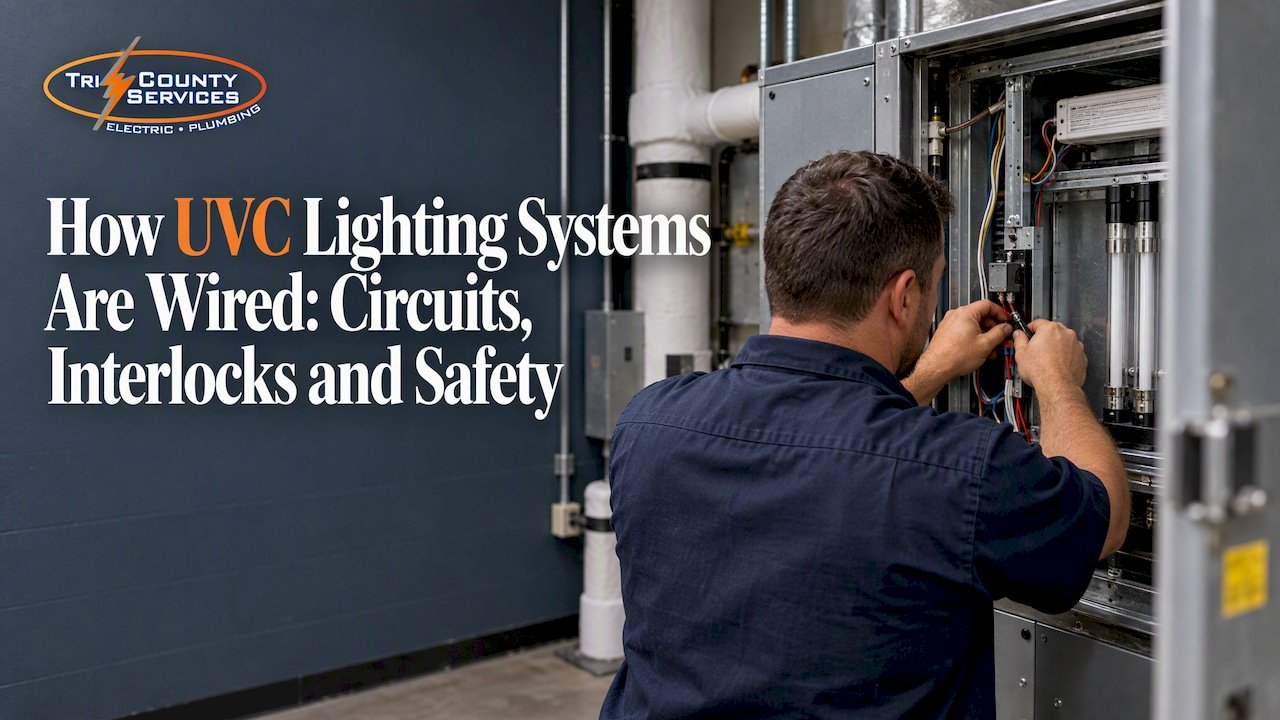

Most UVC lighting systems are wired in three parts: a power feed (usually 120V, sometimes 24V) that reaches a power supply or ballast, a low-voltage or lamp lead that runs from that ballast to the lamp, and a set of safety interlocks that cut power the moment someone opens an access door. The details change with the product, the equipment it sits in and the building, which is exactly why the wiring should be planned and connected by a professional electrician, not improvised from a manual.
This guide walks through what is actually happening behind the cover of a UVC system, what the manufacturers and engineering bodies say about it, and where a home or business owner in Northeast Ohio should hand the job to a pro. At Tri-County Services Electric & Plumbing, we have been doing electrical work for homes and businesses since 1975, and UVC hookups are one of those jobs where the wiring is only half the story. The other half is safety.
TL;DR
- A UVC system is a lamp, a power supply or ballast, a feed circuit and, in HVAC equipment, door interlock switches wired in series so that opening any access panel kills the lamp.
- Residential units commonly run on 24V or 120V depending on the model, and a voltage mismatch can destroy the lamp.
- UVC light harms eyes and skin, so the interlock is a safety device, not an accessory.
- Drilling into air handlers and tapping equipment power risks damaging the system’s own controls. Call a pro first.
- Questions about a circuit for UV equipment? Call our office at (440) 253-0332.
Table of Contents
- What a UVC lighting system is made of
- The three common wiring layouts
- Where the power comes from: 120V, 24V and the mismatch problem
- Interlocks: the wiring that protects your eyes
- Why wiring mistakes in this equipment are costly
- Why you should call a pro electrician first
- Our perspective: treat UVC as an electrical project first
- What to have ready when you call
- Need electrical work for a UVC or HVAC project?
- Where UVC systems are used besides home HVAC
- FAQ
- Sources
What a UVC lighting system is made of
UVC (short-wave ultraviolet, roughly 200 to 280 nanometers) is the band used for germicidal work. Engineers call the application germicidal ultraviolet, or GUV. The CDC’s NIOSH describes GUV as a supplemental ventilation measure that can inactivate microorganisms when designed and installed correctly. It does not replace outdoor air requirements.
Whatever the brand, the electrical parts are the same family:
- The lamp. In HVAC work, low-pressure lamps are by far the most common, according to the NADCA white paper on UV in HVAC systems.
- The power supply or ballast. It converts the incoming voltage into what the lamp needs and limits current. Some are mounted outside the duct, with the lamp on a lead.
- The feed circuit. The wiring that brings power from the building, either from a dedicated branch circuit, a receptacle, or the equipment’s own control power.
- Safety devices. Door interlock switches, disconnects and warning labels.
- Optional controls. Indicator lights, runtime timers, relays that tie the lamp to the blower, or a control panel in larger systems.
The three common wiring layouts
Plug-in or cord-connected units
Some small units, such as wall-mounted or portable devices, simply plug into a receptacle. Some manufacturers also make products where the model decides the wiring: one installation guide tells installers to confirm their model before proceeding because wiring differs between plug-in and HVAC versions. Even with a plug, the receptacle has to be on a suitable circuit and in the right location, and that is an electrical question.
Duct and air handler kits (the typical home setup)
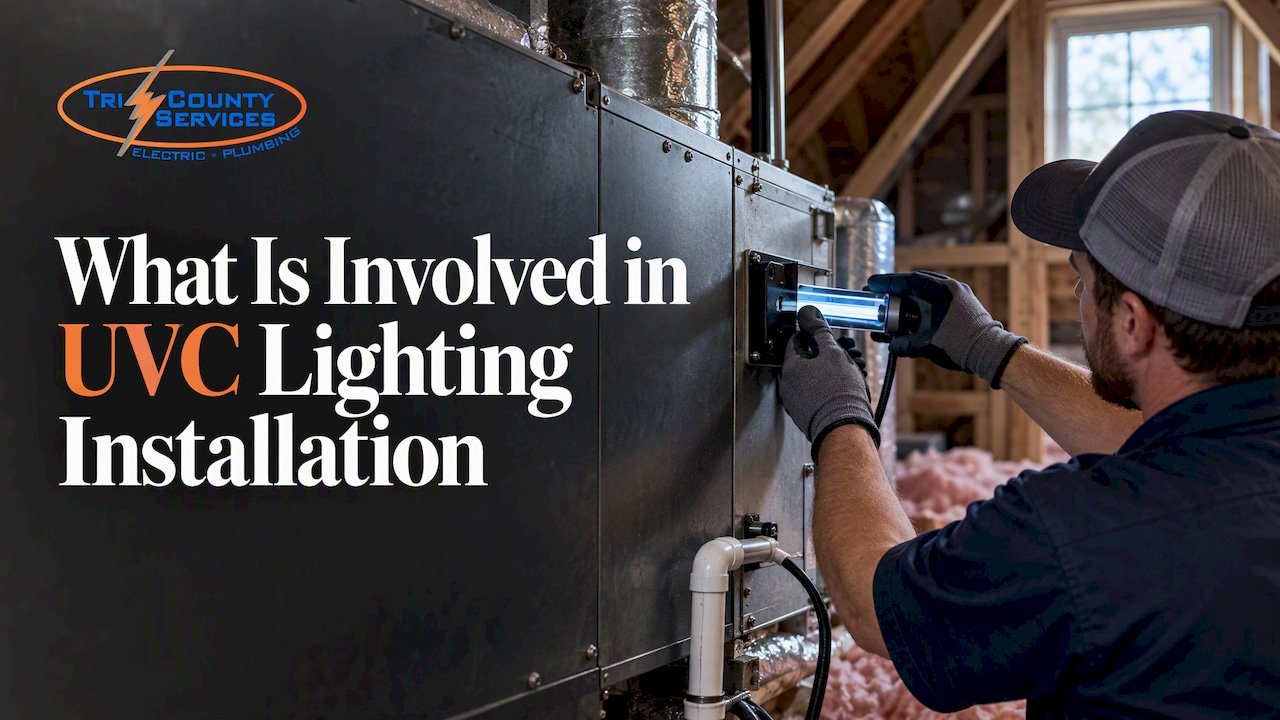
In a furnace or air handler, a small lamp assembly is mounted through a hole in the duct or cabinet, and a power supply sits on the outside. Installation sheets for these kits describe drilling a hole (a 1-inch hole in one manual), fastening a mounting bracket, inserting the lamp and then connecting the lamp lead to the power supply. The power supply then gets its feed, either line voltage or a 24V control transformer tap.
A published residential manual from another manufacturer says the power supply installation starts with a check of the supply voltage, and flags the lamp connection as a firm, aligned push-together fit that seals against moisture. These are manufacturer-specific details. Your unit’s own instructions rule.
Coil-section and commercial systems
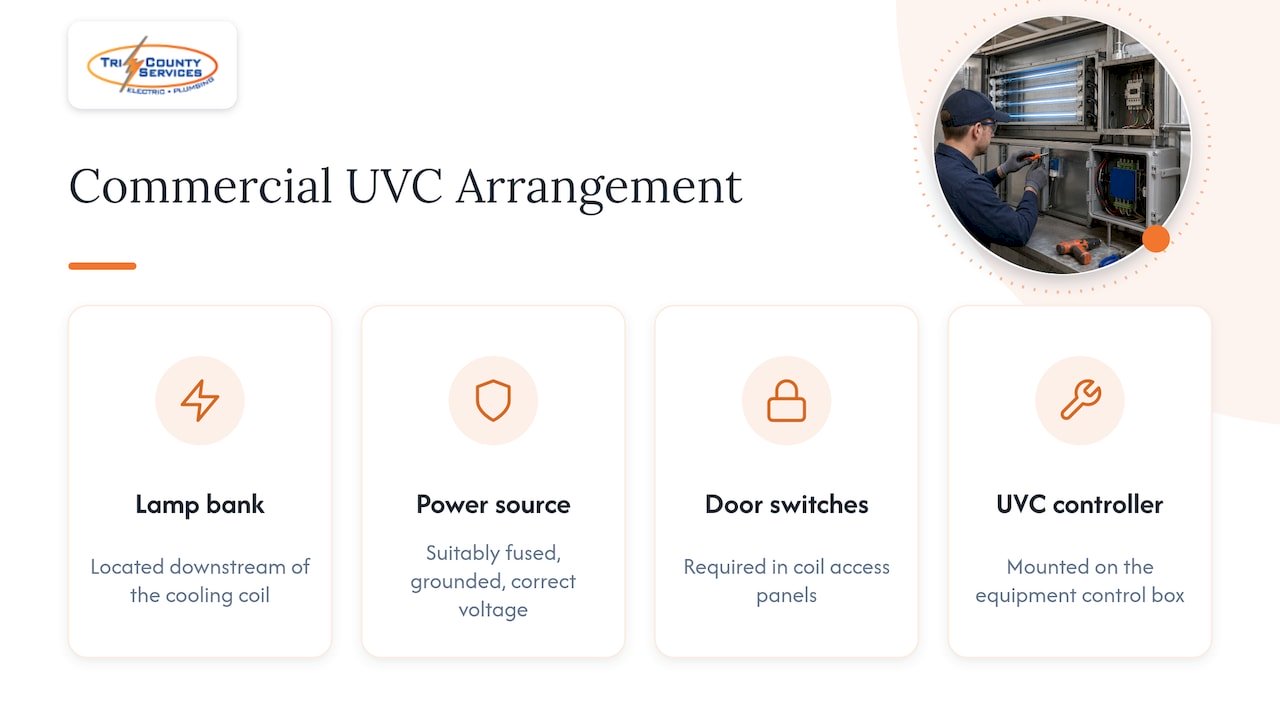
Larger air handlers use lamp banks downstream of the cooling coil, with a switch box, a junction box and an interlock switch at each access door. One manufacturer’s instructions state that the lamps sit downstream of the coil, that field-supplied interlock switches are required in the coil’s access panels, and that the power source must be suitably fused, grounded and protected with the correct voltage. Control-panel designs go further: one rooftop unit guide describes door switches and a UVC controller mounted on the control box of the equipment. (Always follow the document for your exact model.)
Where the power comes from: 120V, 24V and the mismatch problem
Residential UV lamps typically operate on a 24V or 120V supply, and which one you have depends on the product. That matters for two reasons.
Tapping the HVAC control circuit. A 24V unit is often fed from the system’s control transformer. That transformer has a limited capacity. Add a load it was not sized for and you can blow a fuse or stress the transformer that runs your thermostat, gas valve and blower relay.
Using a line-voltage circuit. A 120V unit needs a properly protected circuit with a proper ground. One manufacturer’s instructions go so far as to say that any mismatch between the power source and the lamp voltage will permanently damage the lamp, and they recommend ground-fault protection. Energy is cheap to supply and expensive to get wrong.
In many homes, the clean answer is a dedicated circuit or a safely wired junction near the equipment, with a disconnect that a technician can lock out. That is ordinary electrical work, and it is the work we do every week.
Interlocks: the wiring that protects your eyes
UVC exposure can injure the eyes and skin. That is why the best-designed systems treat the door switch as a core part of the circuit.
The ASHRAE handbook chapter on ultraviolet lamp systems recommends that lamp chambers have electrical disconnect devices, preferably positive disconnection devices that can be locked or tagged out, located outside the lamp chamber near the main access door. It also says the devices should be wired in series so that opening any access deenergizes the system, and that the on/off controls for UV lamps should never share a location with general room lighting.
In plain terms, that means:
- Each access panel that could let UV light escape gets a switch.
- The switches are wired in series with the lamp’s power. One open door breaks the whole loop. (Wired in parallel, one closed door would keep the lamp lit, which defeats the point.)
- The disconnect sits where a person can reach it before opening the unit, and where it can be locked.
One control-system document ranking for this topic describes the same idea: the door switches are wired in series outside the UVC control panel, and the series loop is brought to terminals inside the panel. Another manufacturer’s literature notes that UV equipment must be mounted at least 20 inches from certain materials unless they are shielded with foil or sheet metal, because UV can degrade them.
A simple wiring sequence, in concept
This is how a typical interlocked system is organized, not a do-it-yourself recipe:
- Line power arrives from a protected circuit to a disconnect.
- From the disconnect, power runs through the door switches in series.
- The switched power reaches the ballast or power supply.
- The ballast feeds the lamp through its lamp lead.
- Optional relays tie operation to the blower so the lamp runs only when air is moving, or the reverse, depending on the design.
The final step varies enough from one product to another that no generic diagram is safe to follow.
Why wiring mistakes in this equipment are costly
HVAC equipment is dense. A forum thread that shows up in search results quotes an installer who says local dealers will not put UV lights into an air handler body because they worry about damaging internal wiring. That is one homeowner-forum anecdote, not a rule, but it points at a real hazard: drilling or screwing into a cabinet without knowing what is behind the panel.
On the electrical side, the U.S. Department of Energy’s electrical safety lessons-learned report lists recurring causes of electrical incidents, including wiring mistakes combined with failure to verify that energy is safely off, and leaving unsafe conditions such as improper grounding. Those are the same failure modes that show up in any rushed hookup.
A short list of what can go wrong:
| Mistake | What can happen |
|---|---|
| Wrong supply voltage to the ballast | Lamp or power supply damage |
| Tapping an overloaded 24V transformer | Thermostat or control failures |
| Interlocks missing or wired in parallel | UVC exposure when a panel is opened |
| Drilling through unseen wiring or the coil | Shorts, refrigerant or drain issues |
| Poor grounding | Shock risk and nuisance trips |
| Splices outside a box | Code violations and fire risk |
Why you should call a pro electrician first
If you are a homeowner reading this and wondering whether to wire the unit yourself, our advice is to start with a phone call to a professional instead. Here is why.
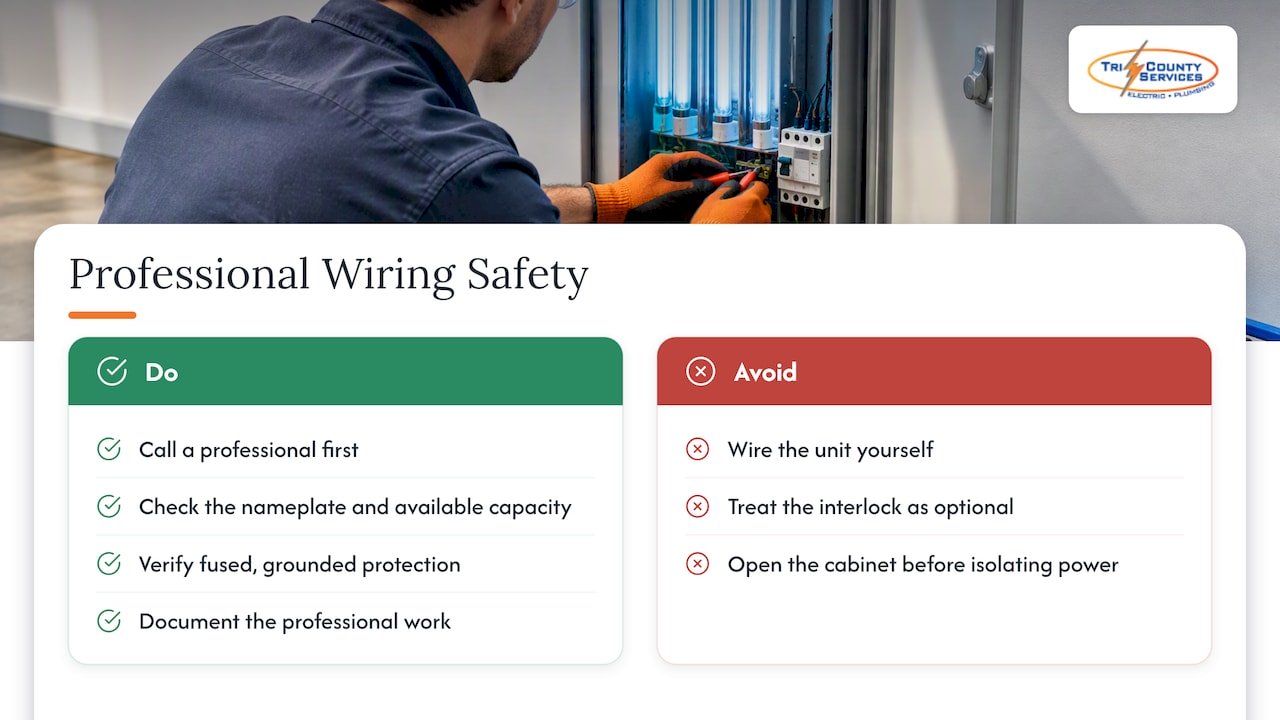
The voltage decision is not obvious. Whether a unit should be fed from the control transformer, a dedicated line-voltage circuit or a receptacle depends on the unit and on the load already on your equipment. A professional reads the nameplate, checks the available capacity and picks the safe source.
Protection and grounding are not optional. The manufacturers quoted above call for a fused, grounded, correctly protected source. Verifying that takes a meter and experience.
The interlock is the part people skip. It is easy to treat the door switch as optional, since the lamp “works” without it. But that is the very component meant to keep UVC light off your eyes and skin.
Your warranty and your insurance care. An equipment warranty or an insurer can ask who did the work. A documented professional job gives you a record.
You cannot see what you cannot see. Cabinets hide wiring, boards and coils. A technician knows what typically sits behind a panel and isolates power before opening anything.
For general home safety habits, our top 5 electrical safety tips article is a good companion read.
Our perspective: treat UVC as an electrical project first
We are a family-owned company that has served Northeast Ohio since 1975, and we have learned that a project that looks like an accessory often turns out to be a circuit question. UVC lighting is a good example. People think of it as a product you buy and clip in. We think of it as a load, a voltage source, a protective device and a safety loop that all have to agree with each other.
When a homeowner calls us about equipment like this, we start with the same questions we would ask about any new load. What voltage does it need? Where will the power come from? Is there capacity on that circuit? How will the equipment be shut off safely before anyone opens it? Our technicians are certified, they respect your home, and our scheduling is flexible so the work disrupts your day as little as possible.
We also believe a UVC lamp is not a fix for an electrical or air quality problem you have not diagnosed. If a system is tripping breakers, flickering or giving you trouble, we would rather find the cause first. Our electrical troubleshooting is listed at $300-$500 as a one-off service. Equipment-specific work, such as the circuit that serves a UV unit, is scoped after we see the job.
— Lindsay Paramore
What to have ready when you call
A few details help any electrician give you a straight answer:
- The make and model of your furnace or air handler, and the UV product if you have already bought it.
- The voltage stated on the UV unit’s label or manual.
- Where the equipment is located (basement, attic, closet) and how close it is to a panel.
- Whether your panel has open breaker spaces. If it is full or older, an electrical panel upgrade may come up in the conversation.
- Any symptoms: tripping breakers, dimming lights, or a thermostat that acts up when the blower starts.
If the real answer is a new dedicated circuit, that is a routine job for us. You can see our electrical service pricing guide for the services we list, and our installation page for what a professional install looks like. For a broader view, we also wrote a residential electrical installation guide for homeowners.
Need electrical work for a UVC or HVAC project?
Tri-County Services Electric & Plumbing handles the electrical side for homeowners and businesses across Northeast Ohio: circuits, panels, surge protection, troubleshooting and emergency repairs. Tell us what equipment you are adding and we will tell you what the electrical work involves. Call our office at (440) 253-0332, or start at our electrical pricing guide.
Where UVC systems are used besides home HVAC
Residential air handlers are only one use. The U.S. Department of Energy’s overview of GUV air treatment describes upper-room devices mounted on upper walls or ceilings to treat the air above occupants, so the room can be used while they run. Those systems depend on good air mixing between the upper and lower parts of the room.
For a building owner, the wiring picture changes again. Upper-room fixtures are hard-wired, often on their own circuit, and their controls must be kept away from ordinary light switches. ASHRAE’s handbook chapter notes the same point: on/off devices should sit where only authorized people can reach them. If you manage a commercial space and are weighing this, include the electrical scope in the planning from day one.
If your building also has life-safety lighting duties, our write-up on emergency lighting requirements covers a different but related set of code obligations.
FAQ
Are UVC lights wired in series or parallel?
The lamp itself is fed by its ballast or power supply, but the safety interlock switches are wired in series. That way, opening any one access door breaks the circuit and turns the lamp off. ASHRAE’s guidance describes this series arrangement for lamp chamber disconnects.
Do UV lights for HVAC run on 24V or 120V?
Both exist. Residential lamps usually run on a 24V or 120V supply depending on the model, so the label and manual decide. A mismatch between the supply and the lamp can permanently damage the lamp, so have a professional confirm it before power is applied.
Can I plug a UVC air purifier into any outlet?
Plug-in units are designed for a standard receptacle, but the outlet still needs to be in good condition and on a circuit that is not overloaded. If you are unsure about the outlet, a tripping breaker or a two-prong receptacle, call an electrician before you plug in.
Is UVC light dangerous?
Yes, direct exposure can injure eyes and skin, which is why manufacturers require interlock switches, warning labels and enclosed lamp chambers on in-duct systems. Never look at an energized lamp or open a lamp section without the power locked out.
Who should install the wiring for a UV light in my furnace?
A professional electrician should handle the power feed, protection and interlocks, in coordination with whoever services your heating and cooling equipment. In Northeast Ohio, you can call our office at (440) 253-0332 to talk through the electrical side.
Sources
- Blue-Tube UV-X manual
- Residential UV manual, power supply and lamp connection
- BioShieldUV installation guide
- Field Controls UV-Aire installation sheet
- Carrier 39M installation instructions
- ASHRAE Handbook, Ultraviolet Lamp Systems
- CDC NIOSH, About Germicidal Ultraviolet
- NADCA white paper on UV lighting in HVAC systems
- U.S. DOE Electrical Safety Report, April 2004
- U.S. DOE, GUV Air Treatment overview