
A UVC lighting system needs two kinds of expertise: someone who understands where the light belongs and how it affects your air handler, and someone who wires it safely, to code, with the right safeguards. In Northeast Ohio, the best results usually come from pairing the system’s manufacturer or an HVAC specialist with a professional electrician who handles power, controls, permits and inspection. Below, we compare your real options, explain what a safe job involves and tell you what to ask before anyone touches a wire. If you want the electrical side handled by a local family-owned team, call Tri-County Services Electric & Plumbing at (440) 253-0332.
TL;DR
- UVC (germicidal ultraviolet) lamps can burn eyes and skin within seconds, so the system should be designed, installed and tested by a qualified professional, not by trial and error.
- Most UVC jobs split into two parts: placement inside the HVAC equipment, and the electrical work (power supply, transformer, interlock switches, permit). Make sure someone owns both.
- Ask any contractor about GUV-specific training, how they will verify output, and who pulls the permit.
- Lamps lose germicidal output over time even when they still glow, so maintenance matters as much as installation.
- For the electrical side in Northeast Ohio, call Tri-County Services Electric & Plumbing at (440) 253-0332.
Table of Contents
- What a UVC lighting system actually is
- Why this is not a weekend project
- Your options compared
- What certification means here
- What UVC installation costs
- Permits and inspections in Northeast Ohio
- Maintenance: the part people forget
- Our perspective
- Get the electrical side done right
- FAQ
- Sources
What a UVC lighting system actually is
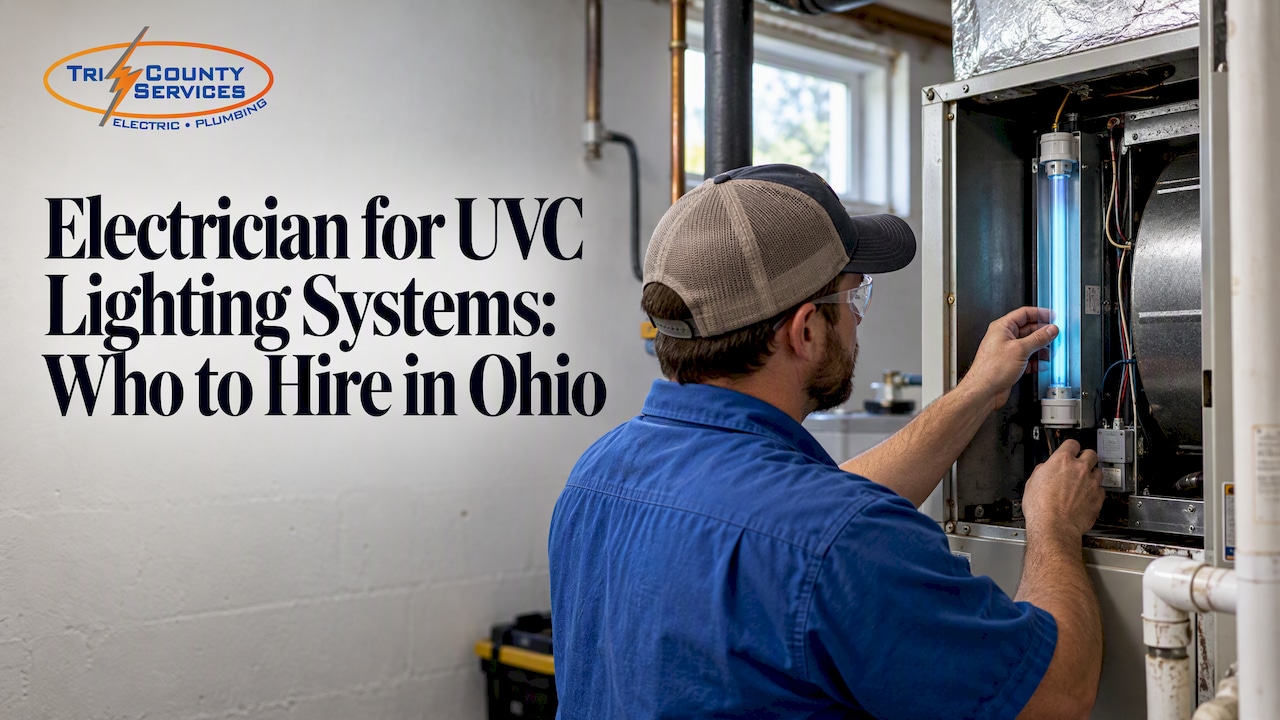
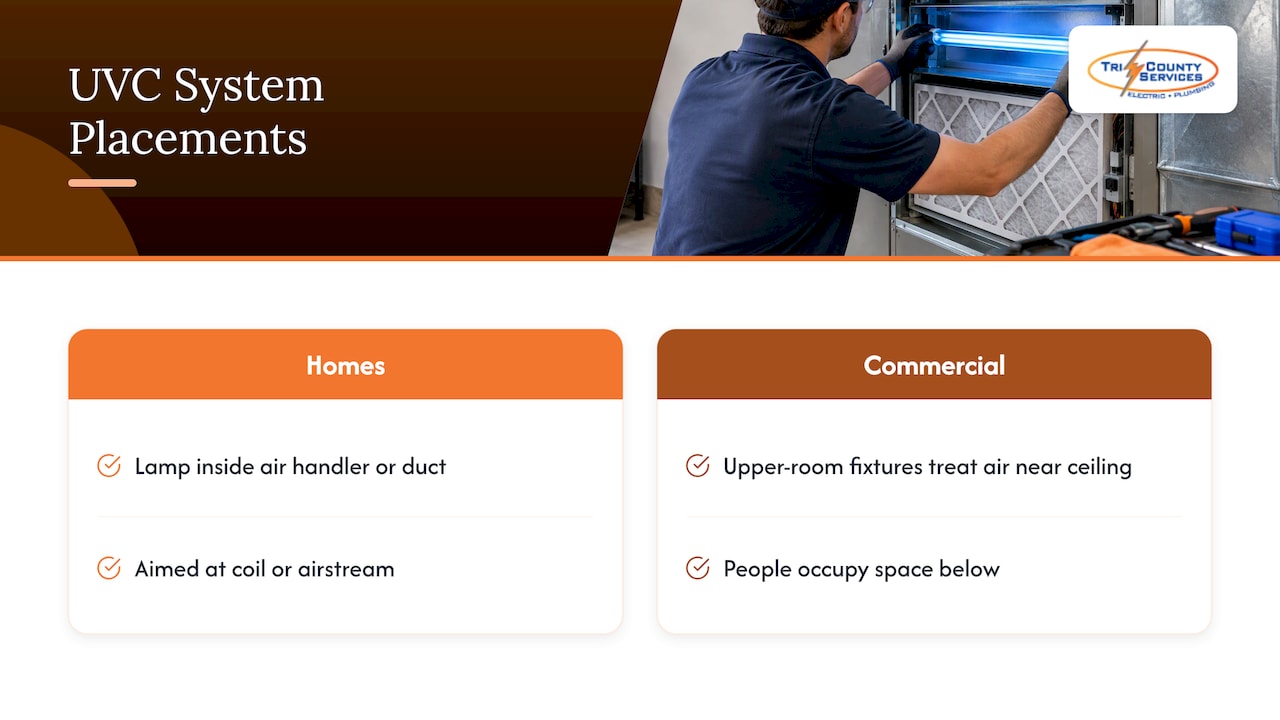
Germicidal ultraviolet, often shortened to GUV, uses ultraviolet energy to inactivate bacteria, viruses and mold. In homes, the most common version is a lamp mounted inside the air handler or ductwork, aimed at the cooling coil or the airstream. In commercial buildings you also see upper-room fixtures that treat the air near the ceiling while people occupy the space below.
UVC is not a cure-all. The U.S. Department of Energy’s GUV air treatment fact sheet frames it as one layer in a broader plan that includes ventilation and filtration. It does not replace filter changes or regular HVAC service. Think of it as a supplement that can help reduce mold growth on coils and treat air that passes the lamp.
One more point before you shop: the EPA says it does not review the safety or effectiveness of UV pesticidal devices the way it reviews registered products, so a claim that a lamp kills a specific virus rests on the manufacturer’s own testing. The EPA suggests looking for an establishment number on the product so it can be traced to where it was made. A good installer will help you read those claims skeptically.
Why this is not a weekend project
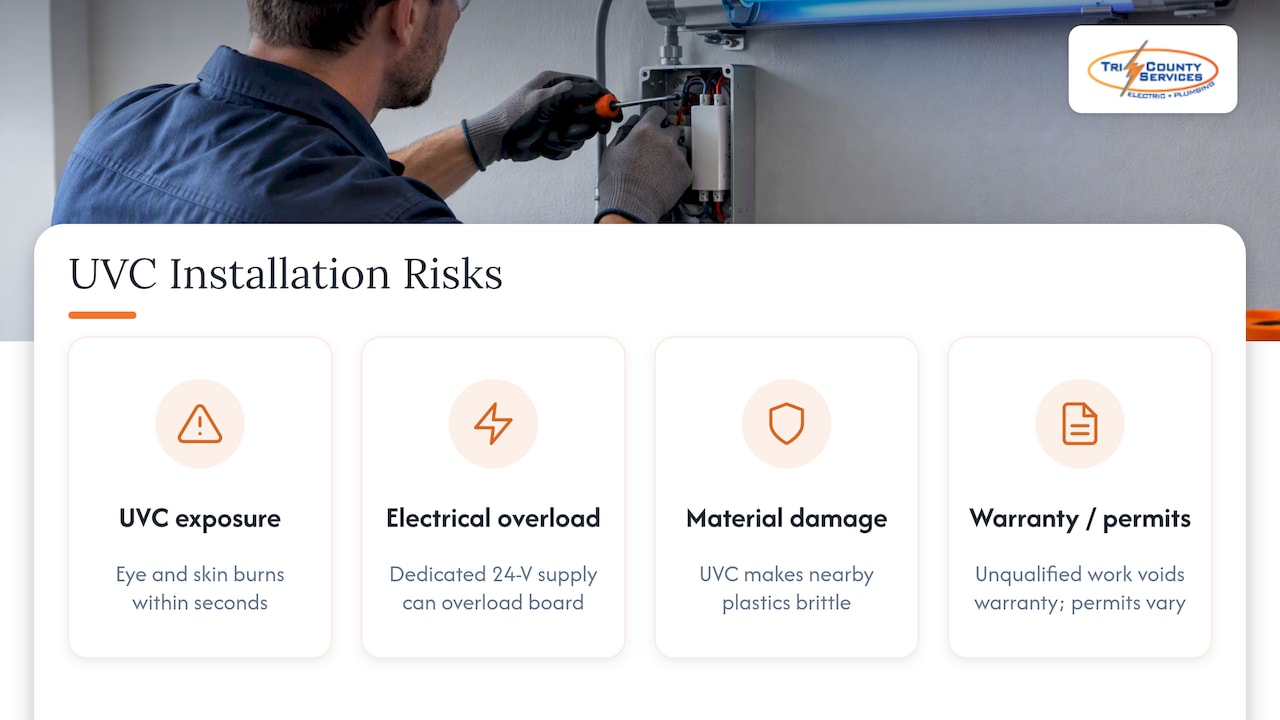
It is tempting to see a plug-in lamp kit online and assume it is a simple add-on. We would urge you to call a professional first, for four practical reasons.
Your eyes and skin are at risk. UVC exposure can cause painful burns to the eyes (photokeratitis) and skin within seconds, and the injury is easy to miss until hours later. That is why an installation guide from one UV manufacturer calls for safety interlock switches on any access panel that leads to the lamp, cutting power the moment the panel opens. Interlocks are wiring work, and they are easy to skip when you are guessing.
Your HVAC system’s control board can be damaged. Many UVC lamps need a dedicated 24-volt AC supply. According to a UV equipment supplier, pulling that power from the air handler’s own transformer can overload it and take the control board with it. A professional checks the load first and adds a dedicated transformer if needed.
UVC damages ordinary materials. Wire insulation, plastic parts and filter media in the lamp’s line of sight can turn brittle. Installation instructions from UV Resources warn that improper installation, adjustment or service can cause fire, electrical shock or injury and tell readers to consult a qualified installer or service agency. Shielding exposed components is part of a proper job.
Your warranty and your permit are on the line. The same BioShieldUV guide says installation by anyone other than a qualified professional voids the warranty. And one Ohio city’s building department lists permits for new circuits and hard-wired equipment changes. Rules differ by municipality, so call your local building department before work begins.
The CDC’s NIOSH page puts it plainly: GUV systems should be designed, installed and tested with the help of a qualified HVAC professional or a reputable UV-system manufacturer, covering fixture placement and code-compliant electrical connections.
Your options compared
There is no single “UVC electrician” license or title in Ohio, so you are really choosing among types of providers. Here is how they stack up.
| Option | Best at | Watch out for |
|---|---|---|
| HVAC contractor | Placing the lamp relative to coil and airflow, sizing for your equipment | May subcontract or limit the electrical work; ask who handles the permit |
| Manufacturer or UV-system specialist | Product knowledge, layout design for upper-room or large spaces | May be out of the area; often needs a local installer for the wiring |
| Professional electrician (such as our team) | Dedicated circuits, transformers, interlocks, controls, permits, inspections | Should coordinate with your HVAC contractor for work inside the air handler |
| General handyman or DIY | Low upfront cost | Eye and skin injury risk, damaged control boards, voided warranties, failed inspections |
For most Northeast Ohio homes, the strongest setup is an HVAC professional or the manufacturer defining where the lamp goes, with an electrician making sure it is powered and protected correctly. For offices, clinics, salons and other commercial spaces, upper-room systems add layout design and controls, which makes a manufacturer’s design support even more valuable.
Where an electrician earns their fee
The electrical scope is more than connecting two wires. A thorough electrician will:
- Check the existing circuit and the HVAC unit’s transformer capacity before adding any load.
- Install a dedicated circuit or a separate 24-volt supply where the equipment calls for it.
- Wire interlock switches so opening a service panel cuts power to the lamp.
- Confirm grounding, connections and wire protection, including shielding of anything in the lamp’s line of sight.
- Pull the required permit and be on site for the inspection.
- Label the system and show you how to power it down for filter changes.
If an electrician cannot answer where the lamp’s power comes from and how the interlock works, keep looking.
What certification means here
GUV has become specialized enough to have its own credentials. According to the University of Maryland’s GUV training hub, NALMCO offers programs such as the Certified Senior GUV Technician (CS-GUVT), which cover safe layout design and safety protocols. Homeowners are encouraged to ask contractors about their specific training and experience with these systems, not just general installation credentials.
So when you search for a certified UVC technician, treat the answer as a conversation, not a badge. Ask:
- Have you installed this exact type of system (in-duct, coil-irradiating or upper-room) before?
- Who designs the layout, and who tests it afterward?
- How will you verify the lamp’s output and the absence of stray UV where people can be exposed?
- Who pulls the permit, and will you be present at inspection?
- What happens to the manufacturer’s warranty under your installation?
A contractor who answers confidently and in specifics is worth more than one who quotes fastest.
What UVC installation costs
The CDC’s NIOSH guidance gives a rough benchmark: a typical room of about 500 square feet runs roughly $1,500 to $2,500 for an upper-room GUV installation. In-duct residential kits are a different product and will price differently, and your actual quote depends on your equipment and wiring.
On our side, we publish what we can. Electrical troubleshooting is $300-$500 as a one-off, and that visit is often the right first step when we need to evaluate your panel, circuit capacity and HVAC wiring. Dedicated circuit installation is quoted after we see the job, and you can review our electrical pricing guide for what we list. We do not publish a UVC package price, and we will not guess at one before looking at your system.
Permits and inspections in Northeast Ohio
Permit rules in Ohio are set locally. Adding a circuit or hard-wiring equipment commonly triggers a permit, and the inspector checks that the work meets code. Cities and townships around Cleveland, Akron and Canton each run their own building departments, so a quick call before you hire saves headaches. If you are new to the process, this permit inspection checklist walks through how to prepare for inspections and avoid reinspection fees.
A professional who works in your area regularly will already know what your local inspector expects. If an older home needs corrections before a new load can be added, our electrical code corrections page explains how we handle that.
Maintenance: the part people forget
A UVC lamp that glows is not necessarily a UVC lamp that works. NIOSH notes that lamps lose germicidal output over time, and that maintenance includes checking actual UV output and keeping the lamp clean, not waiting for it to burn out. Dust on a lamp blocks output, and an aging lamp may look fine while delivering far less than it should.
A sensible maintenance routine:
- Follow the manufacturer’s replacement interval rather than waiting for failure.
- Power the lamp down through the interlock or disconnect before opening any panel.
- Have a professional confirm output and inspect nearby wiring and plastic parts for UV damage.
- Schedule the check along with your regular HVAC service.
If your lamp flickers, trips a breaker, or your HVAC unit shows control board faults after an installation, stop and call a professional. Troubleshooting a UV system means working around live circuits and a hazardous light source, and that is not a spot for improvising.
Our perspective
We have served homes and businesses across Northeast Ohio since 1975, and the pattern we see with specialty add-ons is consistent: the product is rarely the problem. The problem is the power supply, the permit, or the shortcut somebody took to avoid either. A UVC lamp feels like an air-quality gadget, but electrically it is a hard-wired device in a sealed metal cabinet, near a control board that costs real money to replace.
Our view is simple. Let the manufacturer or HVAC specialist decide where the light goes. Let us make sure it is powered safely, protected by interlocks, inspected and documented. We schedule flexibly to limit disruption, and our technicians treat your home or workplace with respect. If your project reveals an overloaded panel or aging wiring, we will tell you plainly, because adding load to a weak system is how small projects become big repairs.
We would also rather tell you when UVC is not what you need. If your real issue is a musty smell, poor airflow or allergies, filtration, ventilation and HVAC maintenance deserve attention first.
— Lindsay Paramore
Get the electrical side done right
Tri-County Services Electric & Plumbing handles dedicated circuits, panel upgrades, troubleshooting and installation for residential and commercial clients across Northeast Ohio. If your UVC project needs reliable power and a clean inspection, start with our electrical pricing guide or read about our professional electrical installation services. To talk through your system, call our office at (440) 253-0332.
FAQ
Can any electrician install a UVC lighting system?
Any qualified professional electrician can handle the wiring, but the system design is a separate skill. Ask whether your electrician will coordinate with your HVAC contractor or the manufacturer, and whether they have worked on UV equipment before. Call our office at (440) 253-0332 if you want us to review the electrical scope.
Do I need a permit for UVC lighting in Ohio?
Often yes, especially when the job adds a circuit or hard-wires equipment. Requirements vary by city and township, so confirm with your local building department before work begins. A professional electrician typically pulls the permit and schedules the inspection.
How often should UVC lamps be checked or replaced?
Follow the manufacturer’s replacement schedule, because lamps lose germicidal output before they stop glowing. NIOSH guidance calls for verifying actual output and keeping the lamp clean. Have a professional do this alongside your regular HVAC service.
Is UVC lighting safe for my family?
When it is enclosed, shielded and wired with interlock switches, the exposure risk is controlled. Direct UVC contact can burn eyes and skin within seconds, which is why installation by a qualified professional matters. If anyone has been exposed to an unshielded lamp and has eye pain or skin redness, see a doctor.
Will UVC replace my air filter?
No. According to the Department of Energy, UVC works best alongside ventilation and filtration, not instead of them. Keep up your filter changes and HVAC maintenance.
Sources
- About Germicidal Ultraviolet (GUV), CDC NIOSH
- GUV Air Treatment: Overview, Types, and Technologies, U.S. Department of Energy
- EPA Urges Consumers to Beware of Misbranded Antimicrobial Household Products
- GUV training, University of Maryland GUV Hub
- BioShieldUV installation guide
- UV Resources general installation instructions
- Fresh Aire UV
- Building Permits, City of Fairfield, Ohio