

Most residential electrical jobs fall into predictable bands: a device swap runs $50 to $200, a light fixture or ceiling fan install lands between $100 and $500, a dedicated circuit costs $300 to $1,200, a panel upgrade can cost several thousand dollars, a whole-house rewire can range widely in cost depending on size and complexity, and an EV charger installation cost varies significantly based on panel work and site conditions. The worked examples below show the math behind those numbers so you can check any quote against real line items.
TL;DR:
- Panel upgrades and full rewires can significantly increase costs, especially if subpanels or large-scale demolition are required, adding thousands of dollars to the estimate.
- Electricians’ labor costs include overhead and profit margins that often double the technician’s wage, meaning the true job cost is higher than just hours times hourly pay.
- Permit and inspection fees are common for jobs involving new circuits or panel work, potentially adding hundreds of dollars to the total, depending on local regulations.
- After-hours and emergency service calls typically carry higher rates, with weekend or holiday work increasing the total bill compared to scheduled daytime visits.
- Accurate DIY estimates require understanding your panel’s capacity, listing all devices involved, and considering project scope, with multiple quotes helping to avoid unexpected expenses.
Table of Contents
- Typical Cost Ranges by Job
- How Electricians Charge for Labor and Materials
- Worked Example Price Breakdowns
- Key Factors That Change the Price
- How to Estimate Your Own Job Before You Call
- When to Call a Professional and Red Flags to Avoid
- Tri-County’s Field Perspective and Homeowner Prep Checklist
- Getting a Written Estimate from Tri-County Services Electric & Plumbing
- Authoritative Links and Calculators
- Sources
- FAQ
Typical Cost Ranges by Job
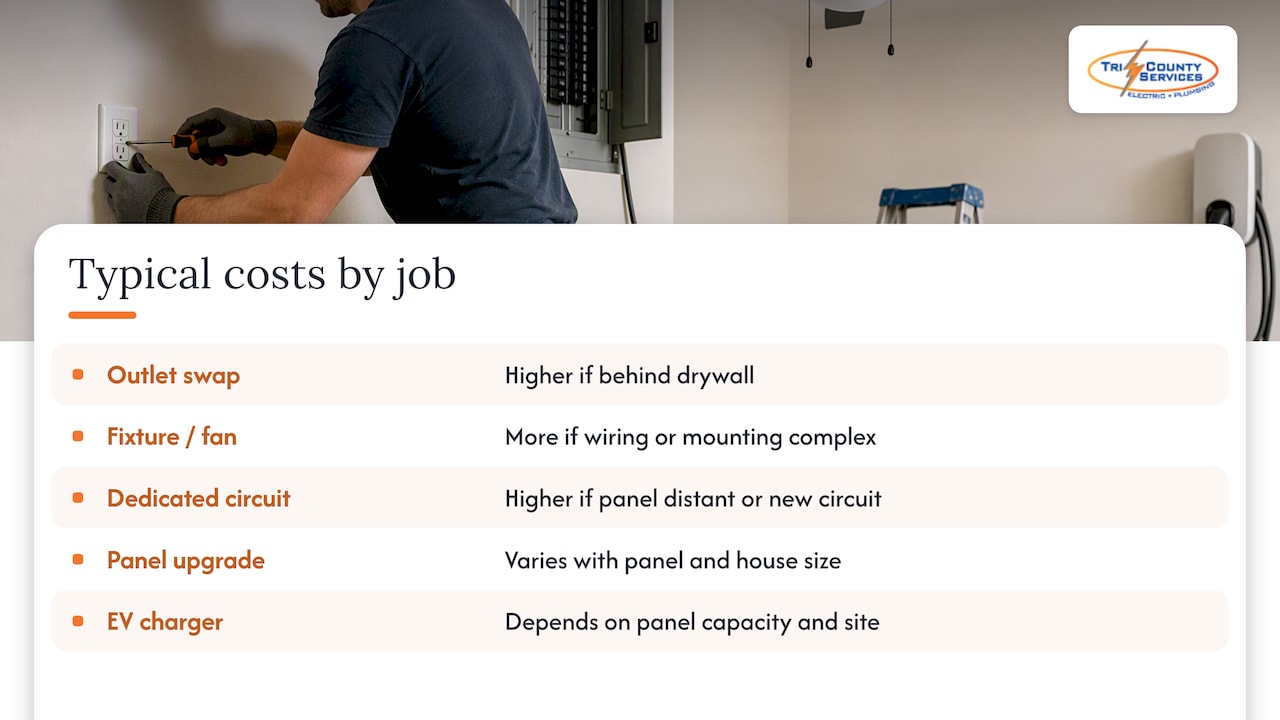
Prices shift with the job’s complexity, the materials involved, and how much of your house the work touches. A simple outlet swap on an accessible wall costs less than if behind finished drywall or far from the panel. Outlet or switch replacement costs vary with wiring and box condition. Fixtures and ceiling fans cost more if wiring or mounting is complex. Dedicated circuits and dryer outlets cost more when panel distance or new circuits are needed. Panel upgrades and whole-house rewires vary widely depending on panel condition, house size, and access. EV charger installation costs depend heavily on panel capacity and site specifics.
Permits typically get triggered by panel upgrades, new circuits, service changes, and full rewires, adding inspection time and a filing fee to the schedule. After-hours or emergency calls commonly carry a rate premium over standard daytime pricing, so a Saturday night breaker problem costs more than the same fix scheduled during the week.
How Electricians Charge for Labor and Materials
Pricing generally follows one of two models. Diagnostic and repair work is often billed hourly, while installations with a predictable scope, like a panel upgrade or a fixture swap, are more often flat-rate. Flat pricing gives you cost certainty before work starts; hourly billing makes more sense when the scope is unclear until someone opens a wall or traces a circuit.
- Hourly rates: residential electrical labor commonly runs in a wide range depending on region and the complexity of the job.
- Trip or minimum service fee: most companies charge a baseline fee for a service call that covers travel and diagnostic time, even for a five-minute fix.
- Overtime and after-hours rates: emergency or weekend calls typically carry a higher hourly rate than standard business hours.
- Material markup: materials are billed at cost plus a markup percentage to cover ordering, handling, and warranty support.
The gap between what a worker earns and what a company must charge is bigger than most homeowners expect. A burdened labor rate, which factors in payroll taxes, insurance, tools, and downtime, can run far higher than the technician’s wage alone, according to an electrical estimate calculator that breaks labor burden and markup into their component parts. That difference between wage and true cost is why a seemingly simple call rarely prices out at just “hours times hourly pay.”
Overhead (rent, vehicles, insurance, admin staff) and profit margin are separate line items layered on top of labor and material cost. Margin and markup are not the same thing: markup is added to cost to reach a price, while margin is the percentage of the final price that is profit. A contractor’s electrical bid calculator shows why generic per-square-foot rules of thumb miss the mark. Residential service and remodel work often targets a healthy profit margin once overhead and material markup are built in.
Worked Example Price Breakdowns
Real numbers help more than percentages. These three scenarios use illustrative labor rates and hours, so scale the hourly figure to your area before comparing against a quote.
- Device swap plus two outlet replacements. Say the job takes 2 hours at a burdened labor rate of $95 per hour, for $190 in labor. Materials (outlets, cover plates, wire nuts) run about $25, marked up to $35. No permit is needed for this scope. Add $30 in overhead and margin, and the total quote lands near $255, comfortably inside the $50 to $200 per-device band once you account for the trip fee covering two items in one visit.
- Recessed dryer outlet installation. This job runs 3 hours of labor at the same $95 burdened rate, for $285. Materials, including a 30-amp breaker, outlet, and wire, run roughly $60 billed at $80 after markup. A permit and inspection add $75 in many jurisdictions. Overhead and margin add another $60, bringing the total to around $500, right in the middle of the $200 to $600 dryer-outlet range.
- Level 2 EV charger with a panel capacity check. Budget 4 hours of labor at $95 per hour for $380, plus a 1-hour panel assessment at the same rate for $95, totaling $475 in labor. Materials for the charger circuit, breaker, and conduit run about $150 marked up to $200. A permit typically adds $100. Overhead and margin add roughly $150, bringing the estimate to about $925, assuming the panel has open capacity. DOE guidance on EV charging infrastructure notes that retrofit installs often cost far more than new-construction wiring because of demolition and longer conduit runs, and multifamily Level 2 retrofits averaged around $6,000 per connector as of 2025 when panel or service upgrades were required. A home charger install cost can increase significantly when a subpanel or service upgrade is required.
The line item most likely to blow up any of these numbers is panel capacity. If the panel is full or undersized, add a $1,500 to $4,000 panel upgrade before the rest of the job can even start. Trenching through concrete instead of dirt or lawn also adds cost fast, whether for a dryer circuit or an EV charger run to a detached garage.
Key Factors That Change the Price
A handful of conditions explain most of the spread between the low end and high end of any quote.
- Panel capacity: a full breaker panel forces a subpanel or full upgrade before new circuits can be added.
- Access and demolition: finished walls, tight crawlspaces, or ceilings without attic access mean cutting and patching drywall.
- Wiring age and type: older aluminum wiring or knob-and-tube systems often need more than a simple splice-in fix.
- Permits and inspections: any job that touches the panel or adds a circuit usually needs a permit and a follow-up inspection.
- Material price swings: copper and other metals used in wiring can shift in cost over a matter of months, which contractors sometimes manage with contingency built into the quote.
- Time of day: after-hours and weekend calls carry higher rates than scheduled weekday work.
- Scope creep: a “quick fix” that uncovers deteriorated wiring behind the wall can turn a $200 job into a $600 one.
Pro Tip: Bundle small tasks like a fixture swap, an outlet repair, and a smoke detector check into a single visit. You’ll pay one trip fee instead of three.
How to Estimate Your Own Job Before You Call
A little prep work turns a vague quote request into an apples-to-apples comparison across contractors.
- Count devices and note access. Walk through and list every outlet, switch, or fixture involved, noting whether walls are finished or open.
- Check your panel. Note the labeled amperage (100, 150, or 200 amp) and whether there’s open breaker space.
- Run the numbers. Use a sample breakdown above or an electrical bid calculator to sanity-check labor, materials, and permit costs, then add a 5% to 15% contingency for hidden conditions.
- Collect two or three written quotes. Compare scope, permit handling, timeline, and warranty side by side rather than just the bottom-line number.
When you call for quotes, ask the same questions of each contractor:
- Does the quote include permit fees and inspection scheduling?
- Is the price flat-rate or hourly, and what happens if the job runs long?
- What’s included in the material markup, and is there a warranty on parts and labor?
When to Call a Professional and Red Flags to Avoid
Some signs mean stop troubleshooting and call for help immediately: burning smells, visible sparks, warm outlet covers, or a breaker that trips repeatedly under normal use. Homes with knob-and-tube wiring or aluminum branch circuits often need a full evaluation rather than a quick patch, since these systems carry known failure risks that a simple repair won’t fix.
- Repeated breaker trips often point to an overloaded circuit or a failing component, not a one-time glitch.
- Burning smell or discoloration around an outlet or panel means stop using that circuit and get it checked.
- Aluminum or knob-and-tube wiring typically needs a professional assessment before any additional load is added.
- Any job that touches the panel or adds a circuit usually requires a permit and inspection to stay code-compliant.
Skipping a professional inspection on any of these issues risks both safety and resale value, since an uninspected panel or outdated wiring can complicate a home sale later. Tri-County Services Electric & Plumbing can inspect the system, provide a written estimate, and handle permit filing. Call (440) 253-0332 to get a professional opinion before a small issue becomes a bigger repair.
Tri-County’s Field Perspective and Homeowner Prep Checklist
The most common surprise homeowners run into is discovering the panel can’t support the new circuit they want, whether that’s for a hot tub, a workshop, or an EV charger. Having your panel’s labeled amperage, a rough sketch of the affected rooms, and photos of any existing damage ready before an estimate visit speeds up the process considerably. A written quote typically spells out labor hours, material costs, permit handling, and an estimated timeline, so there’s no guessing later about what was included. Call before starting any project that touches your panel or adds new circuits to discuss the scope in plain terms at (440) 253-0332.
— Lindsay Paramore
Getting a Written Estimate from Tri-County Services Electric & Plumbing

A clear quote beats a rough guess every time, and that’s the point of Tri-County’s estimate process. Our technicians walk the job in person, check your panel’s capacity, and hand you a written scope that covers labor, materials, permit fees, and a realistic timeline before any work begins. Whether you need a panel upgrade, an EV charger installed, or a repair on troublesome wiring, you’ll know the number before you commit to it. Visit our electrical pricing guide to see typical service pricing, or call (440) 253-0332 to schedule a written estimate for your home.
Authoritative Links and Calculators
- Electrical estimate calculator: breaks down labor burden, markup, and break-even pricing.
- Electrical bid calculator: builds project-specific quotes from labor, materials, and margin inputs.
- DOE EV charging infrastructure guidance: explains retrofit cost drivers for charger installs.
- Tri-County’s pricing guide: outlines typical Tri-County service pricing.
- How to price electrical work: covers minimum trip fees and bundling strategy.
Sources
- Electrical Estimate Calculator (NEC 2023) — HardHatMath
- Electrical Bid Calculator | Labor, Materials and Margin | EleCalculator
- Electric Vehicle Charging for Multifamily Housing
- How to price electrical work (Housecall Pro resources)
FAQ
How much does it cost to rewire a 2,000 square foot house?
A whole-house rewire cost varies widely depending on wall access, wiring type being replaced, and drywall repair needed. Homes with finished walls and multiple floors tend toward the higher end because of the demolition and patching involved.
What do electricians normally charge per hour?
Hourly labor rates vary by region and job complexity, and most companies also apply a minimum trip or service fee to cover travel and diagnostic time. A burdened labor rate calculator shows why the true hourly cost to a company runs well above a technician’s wage alone.
How do I estimate labor cost for electrical work?
Start with a burdened hourly rate that includes wages, payroll taxes, and insurance, then multiply by estimated hours and add material costs, permit fees, and a contingency of 5% to 15% for hidden conditions. An electrical bid calculator walks through each of these inputs step by step.
How much should an electrician charge for a small job?
Small jobs like an outlet or switch replacement typically run $50 to $200, while a light fixture or ceiling fan installation runs $100 to $500. Bundling several small tasks into one visit avoids paying multiple trip fees, since providers commonly charge a minimum service call fee per visit.