
Call 911 immediately if you see downed lines, fire, sparks, or anyone in contact with electricity. For a grid-wide outage, call your electric utility. For problems inside your home, such as a burning smell, repeated tripped breakers, or a damaged meter base, call a professional electrician. Do not attempt to fix any of this yourself.
TL;DR:
- Power outages caused by utility issues often affect entire neighborhoods, while internal home problems typically involve the meter base or wiring inside the property.
- Homeowners should prioritize safety by staying clear of downed lines and damaged equipment before calling emergency services or electricians.
- Professionals use thermal imaging, voltage checks, and detailed inspections to quickly diagnose and stabilize electrical faults during emergency visits.
- A recurring breaker trip, warm outlets, or burning odors indicate underlying wiring issues that require immediate inspection and possibly a panel upgrade.
- DIY repairs are risky, especially when damage involves the service drop or meter, which require certified electricians and coordination with utility crews for safe re-energization.
Table of Contents
- Immediate safety steps and triage for homeowners
- Who to call: utility, 911, or a professional electrician, and why
- What a professional electrician will do during an emergency visit
- Responding to electric shock and medical emergencies
- Food, medication, and generator safety during outages
- Prevention, inspections, and when to schedule professional follow-up
- Publisher perspective: why call a family-owned electrical team
- Getting help from Tri-County Services Electric & Plumbing
- Sources
- FAQ
Immediate safety steps and triage for homeowners
Before you call anyone, your first job is to keep yourself and your family away from danger; for detailed guidance on how to handle emergency repairs effectively, see how to handle emergency repairs for UK properties effectively. A downed power line, a scorched outlet, or a wet electrical panel can all be lethal, and figuring out the source of the problem matters less right now than staying clear of it.
- Stay away from any downed line and keep children and pets back, then call 911 to report the exact location.
- Check whether your neighbors have power before touching your breaker panel: a shared outage points to the grid, not your wiring.
- If only your home lost power, look at the panel for a tripped breaker, but skip this step entirely if the panel looks wet, scorched, or damaged.
- Turn off major appliances and unplug sensitive electronics so a surge does not damage them when power returns.
- Use flashlights instead of candles near any area with exposed wiring or water.
Portable generators cause their own emergencies when used carelessly, so never run one indoors or in a garage.
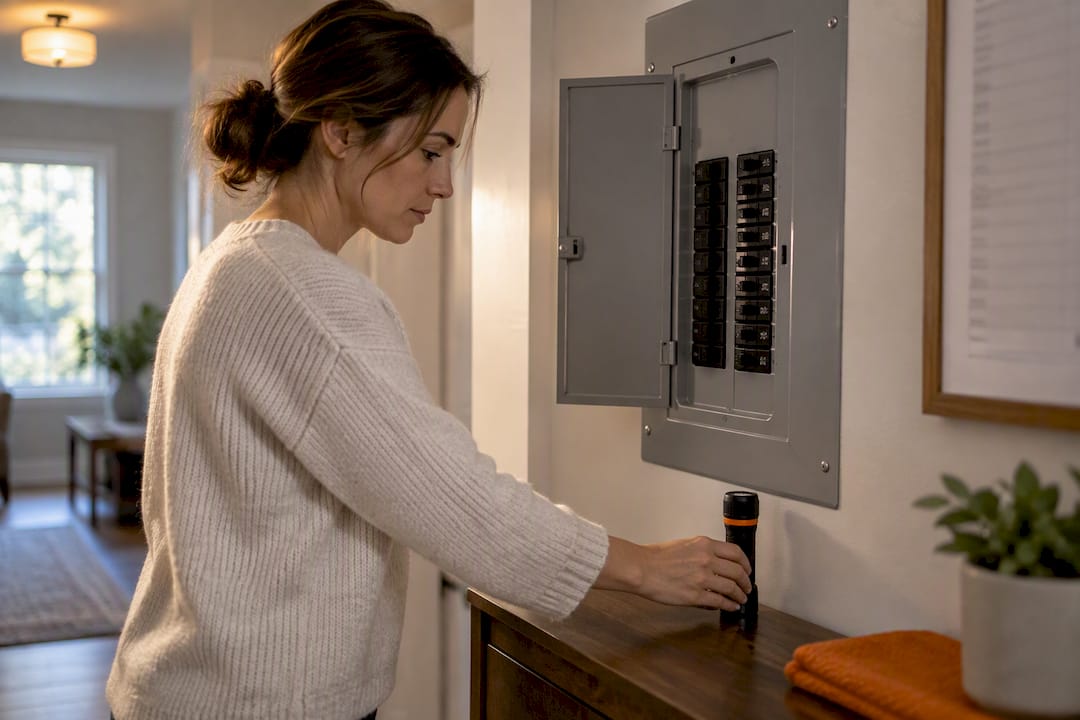
Pro Tip: Keep a flashlight and a written list of your breaker panel’s labels near the panel itself. It saves time for you and for any electrician who has to work fast.
Who to call: utility, 911, or a professional electrician, and why
The right call depends on where the failure is, not just what it looks like. A dead porch light and a dead block have very different causes and very different fixes.
- Check your neighbors first. If their power is also out, the problem is almost certainly on the utility’s side of the system.
- Look for visible damage outside your home, such as a leaning pole, a line on the ground, or a scorched transformer, and report it to your utility or to 911 if anyone is at risk.
- Report the exact location, any downed lines, signs of fire, and any injuries when you call 911 or your utility so crews can respond correctly the first time.
- Call a professional electrician when the problem sits inside your property line, such as at the meter base, the service mast, or your interior wiring, since utilities generally will not touch those parts.
Responsibility splits at the meter base in most cases: utilities maintain the lines and transformers that feed your home, while homeowners are responsible for the meter base and service mast themselves, according to guidance published by a Midwestern electric utility, OPPD. If that hardware is damaged, the utility typically will not restore power until a qualified electrician repairs and certifies it safe.
What a professional electrician will do during an emergency visit
An emergency call is not just a repair, it is a diagnosis under pressure. A technician arriving at a home with a sudden electrical failure works through a sequence designed to find the fault fast and make the property safe before anything else.
- Isolate the faulty circuit and run voltage checks to confirm where current is behaving abnormally.
- Use thermal imaging to spot hotspots from failing connections that are invisible to the eye, a method described by NIOSH as a way to catch fire risks before they progress.
- Inspect the panel and meter hardware for damage, corrosion, or loose connections.
- Stabilize the situation immediately, such as replacing a blown fuse or isolating a bad circuit, while flagging bigger jobs like a panel upgrade or rewiring for a follow-up visit.
When damage involves the service drop or meter, the electrician often coordinates directly with utility crews so the property can be safely re-energized. This is exactly why DIY attempts are risky: a homeowner poking around a damaged panel has none of the protective gear, lockout procedures, or training that keep a technician safe while working on a live or recently live system.
Responding to electric shock and medical emergencies
A shock injury can look minor and still cause serious internal damage, so treat every electric shock as a medical event, not just an inconvenience.
- If someone is still in contact with electricity, do not touch them. Call 911 first, then cut power at the source if you can do so without putting yourself at risk.
- Begin CPR if you are trained and the person has no pulse or is not breathing.
- Seek medical evaluation even after a minor shock, since hidden injuries like irregular heart rhythms are not always obvious right away.
- Call the fire department and EMS for any extrication or advanced medical care beyond basic first aid.
Prompt CPR within the first few minutes of an electrical injury can be lifesaving, and rapid access to advanced cardiac care meaningfully improves outcomes, according to an electrical injury alert published by NIOSH/CDC. Every minute matters more than most people assume when it comes to this kind of injury.
Food, medication, and generator safety during outages
An outage becomes a second emergency once food spoils or medication loses its cold chain, so plan for both the moment the lights go out.
- An unopened refrigerator keeps food cold for about four hours, and a full, unopened freezer holds a safe temperature for up to 48 hours, per Ready.
- Discard any perishable food that has sat at or above 40°F for two hours or more.
- If you take medication that needs refrigeration, talk to your pharmacist about how long it stays safe and whether it needs replacing, since label instructions vary.
- Run portable generators outdoors, at least 20 feet from windows, doors, and vents, and never connect one directly to household wiring without a professionally installed transfer switch, based on Ready.gov’s generator safety guidance.
- Keep generators away from rain or standing water, and unplug sensitive electronics before power returns to avoid surge damage.
Pro Tip: If you rely on a generator every storm season, a permanently installed home generator with an automatic transfer switch removes the backfeed risk entirely.
Prevention, inspections, and when to schedule professional follow-up
Most sudden failures have a history. A breaker that trips once is a nuisance, but one that trips repeatedly, an outlet that feels warm, or a burning smell near the panel are signs that something is actively failing.
- Schedule an inspection right away if you notice repeated breaker trips, a burning odor, warm outlets, or visible arcing.
- Consider a panel upgrade if your home’s electrical demand has outgrown its current setup.
- Whole-home surge protection and a properly installed backup generator both reduce the odds of a repeat emergency.
- Plan a routine safety check after major storms, in older homes, or after any sign of wildlife damage to wiring, since these situations often hide problems that surface later.
Emergency visits focus on stopping the immediate hazard, while scheduled upgrade work addresses the root cause, which usually means a different scope and a different appointment.
Publisher perspective: why call a family-owned electrical team
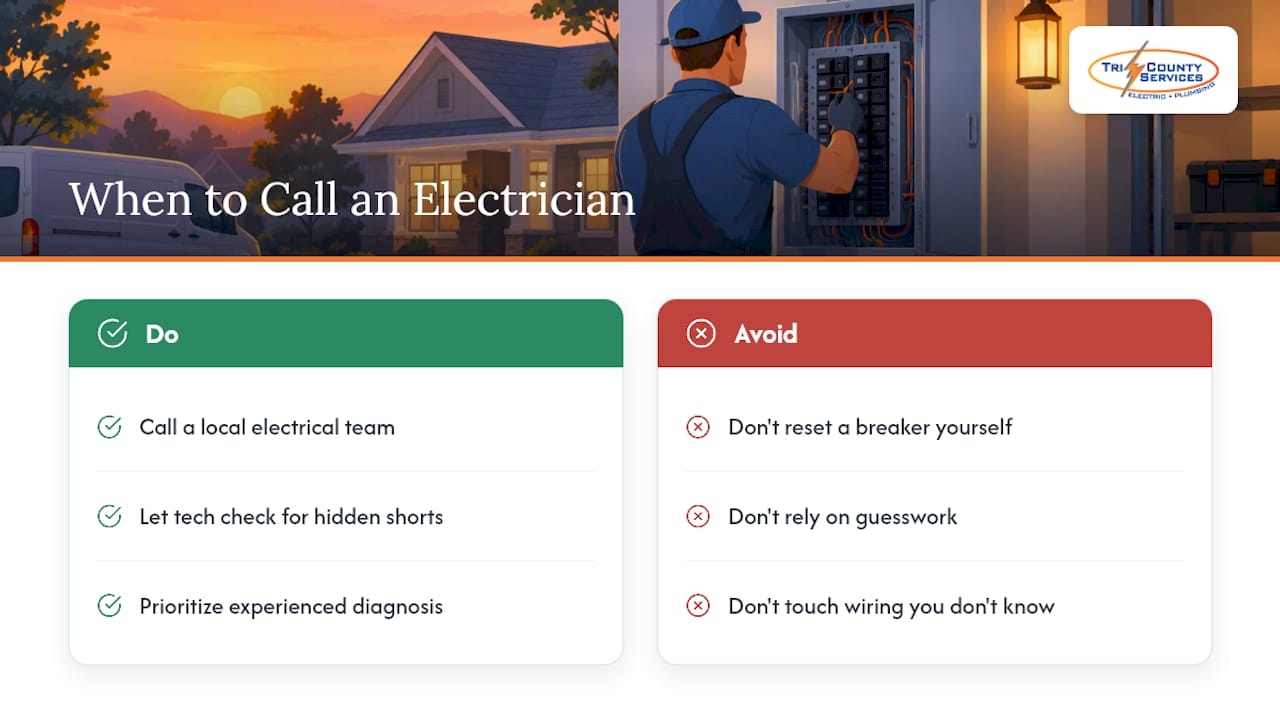
Sudden electrical failures reward calm, methodical work over guesswork, and that is the gap most homeowners underestimate. It is tempting to treat a tripped breaker as a five-minute fix, but the real skill in an emergency call is knowing what not to touch and why. A technician who resets a breaker without checking for a hidden short has only delayed the next failure, sometimes with worse timing.
A local electrical and plumbing service company has worked on homes and businesses in the region for decades, gaining experience with the slow buildup behind most “sudden” failures: aging panels, overloaded circuits, and wiring that was fine for the house it was built for but not for the one it became. That kind of pattern recognition is worth more during an emergency than speed alone.
— Lindsay Paramore
Getting help from Tri-County Services Electric & Plumbing

Tri-County Services Electric & Plumbing handles the exact situations covered here: burning smells, repeated breaker trips, damaged meter bases, and the stabilization work that has to happen before a bigger repair can be scheduled. As a locally operated team, we aim to respond promptly to homeowners and treat every property with care and respect.
If your panel is arcing, your breakers keep tripping, or you just found scorch marks near an outlet, that is not a wait-and-see problem. Our electrical repair service covers diagnosis and repair for exactly these calls, and our electrical troubleshooting service runs $300 to $500 depending on the scope of the issue. Call (440) 253-0332 and we will walk you through what to do until help arrives.
Sources
The CDC and Ready.gov publish free, detailed guidance on electrical hazards, outage prep, and generator safety.
FAQ
What causes electric current in the human body?
Electric current moves through the body when it completes a circuit between a power source and the ground, often through wet skin, damaged wiring, or direct contact with a live conductor. Water dramatically lowers the body’s resistance, which is why the CDC warns against touching electrical equipment that has gotten wet.
How to handle electric shock?
If someone is still touching the electrical source, do not touch them. Call 911, cut power at the source if you can do it safely, and begin CPR if you are trained and the person has no pulse or is not breathing, since prompt CPR can be lifesaving according to NIOSH/CDC.
How to prevent electric shock at home?
Never touch electrical panels or outlets that are wet, and call a professional instead of investigating them yourself. Keeping a safe distance from any downed line and having aging wiring or panels inspected regularly are two of the most reliable ways to avoid a shock at home.
What qualifies as an electrical emergency?
Downed power lines, visible sparks or arcing, a burning smell near outlets or the panel, and repeated breaker trips all qualify as electrical emergencies that need immediate professional attention. Anyone in contact with live electricity or showing signs of shock is also a medical emergency, which means calling 911 first.