
The fastest, most reliable way to cut outages and emergency repair bills is a documented preventive maintenance program built around NFPA 70B. More than two-thirds of commercial electrical failures are preventable, and unmaintained equipment fails three times more often than equipment on a schedule, according to AIG’s electrical preventive maintenance guidance. Call a professional to schedule an inspection before the next breaker trip forces the issue.
TL;DR:
- Properly scheduled preventive maintenance, including infrared scans and load trending, can catch issues early and significantly reduce costly outages and emergency repairs.
- Equipment-specific checklists, such as torque checks for breakers and insulation tests for motors, optimize maintenance accuracy and prevent failures.
- Infrared thermography is a critical early-warning tool that detects heat from loose connections and deteriorating components, improving safety and reliability.
- Inspection frequency should align with equipment criticality, with high-risk systems checked more often, and condition-based triggers are more effective than fixed schedules.
- Maintaining detailed, documented procedures and logs aligned with NFPA 70B and OSHA standards provides legal and insurance protection during incident investigations.
Table of Contents
- What Should a Commercial Electrical Maintenance Program Include?
- Maintenance Checklist by Equipment Type
- How Do Infrared and Electrical Testing Catch Problems Early?
- How Often Should Commercial Electrical Systems Be Inspected?
- What Do NFPA 70B and OSHA Require for Maintenance?
- What Should You Do During an Electrical Outage or Fault?
- How Tri-County Services Electric & Plumbing Builds Maintenance Programs That Work
- Why Maintenance Belongs in the Risk Management Budget
- Get a Commercial Electrical Maintenance Plan Built for Your Building
- Sources
- FAQ
What Should a Commercial Electrical Maintenance Program Include?
Most facilities still run on a “fix it when it breaks” model. That approach is exactly what reliability engineers call run-to-failure maintenance, and it’s the single biggest driver of preventable outages in commercial buildings. Reliability-centered maintenance (RCM) flips that logic: instead of waiting for a breaker to trip or a motor to seize, you schedule inspections and repairs based on how critical the equipment is and how it actually degrades over time.
A working electrical maintenance program (often shortened to EMP) needs a few non-negotiable pieces to function:
- Documented procedures for every piece of equipment, covering what gets checked, how often, and by whom.
- A computerized maintenance management system (CMMS) to track work orders, flag overdue tasks, and build a maintenance history you can hand to an insurer or inspector.
- Scheduled inspections on a calendar, not a “when someone notices something” basis.
- Predictive monitoring, including thermal scans and load trending, to catch problems before they become failures.
- Planned outages for repairs, so de-energized work happens on your terms instead of during a 2 a.m. emergency call.
The financial case is not subtle. Reactive repairs after equipment fails cost 3 to 5 times more than proactive maintenance, per the same AIG analysis. That gap comes from overtime labor, expedited parts shipping, lost production, and in some cases, damage that spreads to adjacent equipment because nobody caught the failing component in time.
Pro Tip: Ask any contractor bidding on your maintenance work whether they use a CMMS. If they’re tracking your building on a clipboard or a spreadsheet that lives on one laptop, you have no real maintenance history and no defensible documentation if an insurer ever asks for one.
Maintenance Checklist by Equipment Type
Different equipment fails in different ways, on different timelines, which is why a single blanket “inspect everything annually” plan wastes money on low-risk gear while leaving high-risk gear exposed. Break the checklist down by system.
- Panels and switchgear: Visual inspection for discoloration, corrosion, or signs of arcing; thermal scan of connections under load; verify labeling matches current circuit assignments.
- Breakers and connections: Torque checks on lugs and bus connections, since loose connections are one of the most common causes of hot spots and eventual failure.
- Motor control centers and motors: Insulation resistance testing, vibration checks, and load balance verification across phases.
- UPS systems: Battery capacity testing, runtime verification under simulated load, and inspection of ventilation and cooling.
- Emergency lighting and generators: Monthly functional tests, annual load-bank testing on generators, and battery replacement on the manufacturer’s schedule, not just when a light fails to come on.
- Branch circuits: Prioritize circuits feeding critical operations (server rooms, refrigeration, life-safety systems) over circuits feeding low-impact areas like storage closets.
Torque checks, insulation resistance testing, and any work inside an energized panel require qualified technicians with the right personal protective equipment. This isn’t a job for building maintenance staff with a multimeter. A professional electrical repair team has the training, insurance, and test equipment to do this work without turning a routine check into an incident.
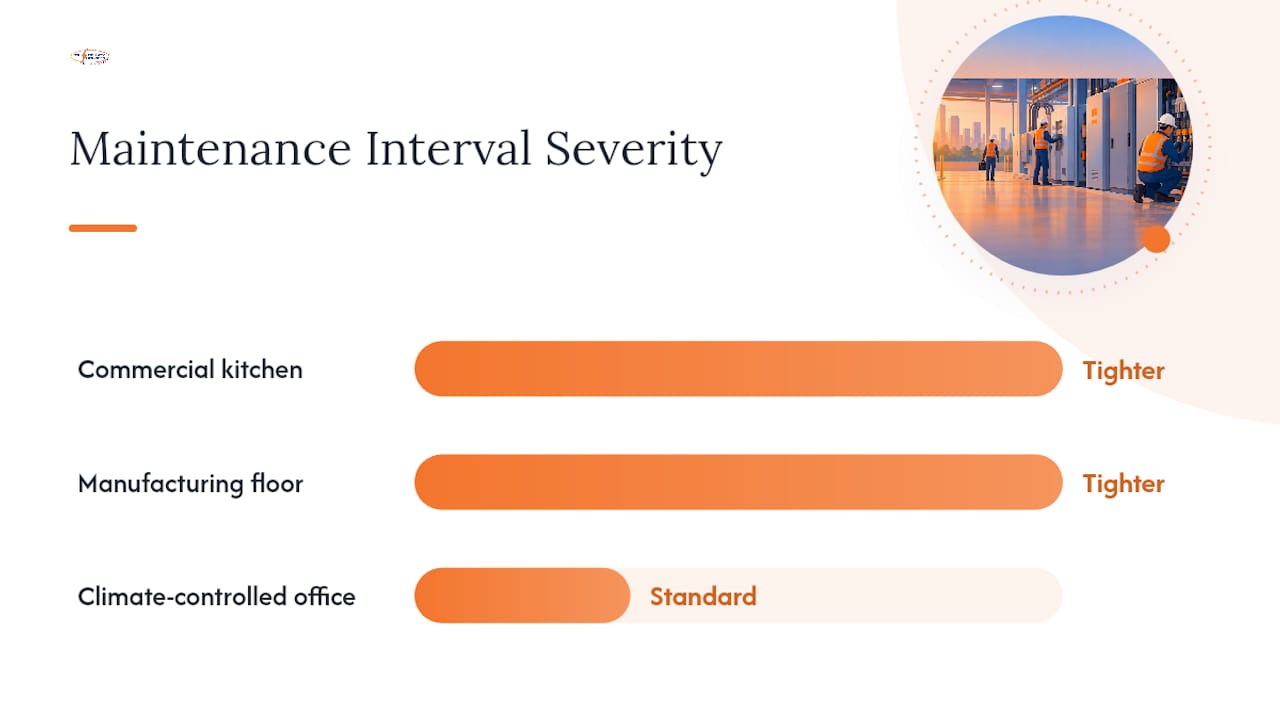
Pro Tip: Environment changes the schedule. A commercial kitchen or a manufacturing floor with heavy dust and vibration needs tighter intervals than a climate-controlled office building running the same equipment.
How Do Infrared and Electrical Testing Catch Problems Early?
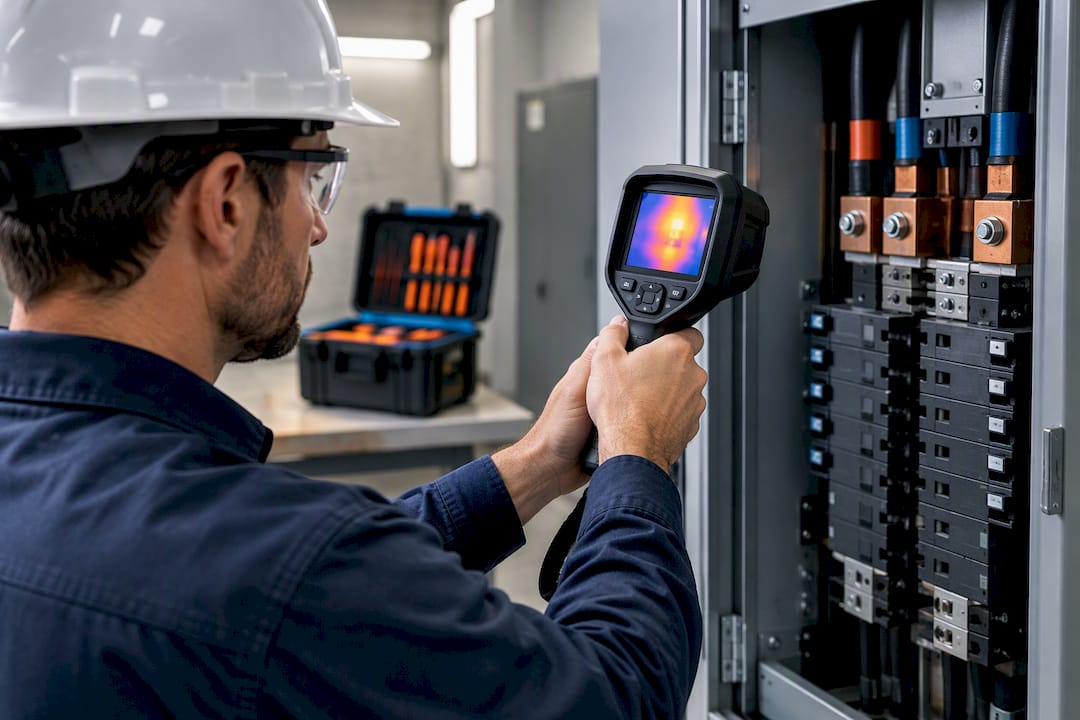
Infrared thermography is the single most useful early-warning tool in commercial electrical maintenance, and it works because failing connections generate heat long before they generate smoke. A qualified technician scans panels, switchgear, and connections while the building is under a normal to peak operating load, since a cold system under light load can hide a problem that would show up clearly during a busy shift. Critical gear should get an IR survey at least every one to three years, and buildings with older infrastructure or heavy electrical loads often benefit from annual scans.
IR is one tool in a broader testing toolkit. A complete inspection and testing program typically includes:
- Insulation resistance testing to detect degrading wire insulation before it causes a ground fault.
- Breaker timing tests to confirm protective devices trip within their rated time, not slower.
- Relay testing on protective relays that coordinate fault isolation across a distribution system.
- UPS runtime and load testing to verify batteries actually deliver rated backup time, not just a passing self-test.
Protective device testing protocols set by organizations like NETA and IEEE exist for a reason that goes beyond box-checking: when protective devices aren’t tested on schedule, the clearing times used in arc-flash incident energy calculations can be wrong. That means your posted PPE requirements and safe-approach boundaries might be based on numbers that no longer reflect reality, which raises real injury risk for anyone working near that equipment.
How Often Should Commercial Electrical Systems Be Inspected?
Frequency should track how critical the equipment is, not a one-size-fits-all calendar. A reasonable baseline looks like this:
- Weekly to monthly: Visual checks on accessible panels, emergency lighting function tests, and generator exercise runs.
- Quarterly: Functional testing on UPS systems and load verification on branch circuits serving critical operations.
- Annually: Protective device testing, insulation resistance testing, and generator load-bank testing.
- Every one to three years: Full infrared surveys on switchgear and panels, timed around the highest realistic load period.
Prioritization comes down to a simple downtime cost model: rank equipment by what it costs per hour if it fails, not by how old or expensive it is. A CMMS with condition-based triggers helps here, flagging equipment when a sensor reading crosses a threshold instead of forcing a technician to inspect gear that’s clearly fine on a fixed schedule. That approach, paired with condition-based monitoring, has shown measurable savings in DOE Federal Energy Management Program pilot case studies, largely by cutting the unnecessary work that causes alarm fatigue and burns budget on equipment that didn’t need attention yet.
What Do NFPA 70B and OSHA Require for Maintenance?
NFPA 70B stopped being a suggestion in 2023. It moved from a Recommended Practice to a formally adopted Standard, and that shift matters more than it sounds like it should. Under a Recommended Practice, “condition of maintenance” was a nice idea. Under a Standard, it becomes the benchmark insurers and inspectors can point to when asking whether your equipment was properly maintained before a failure or a fire.
- NFPA 70B now anchors what counts as an adequately maintained electrical system, and NFPA’s own training materials are built around helping facility managers set schedules that meet it.
- OSHA’s arc-flash guidance requires employers to estimate incident energy and document hazards, and that requirement applies at lower voltages than most facility managers assume, not just in high-voltage industrial plants.
- OSHA’s electrical work-practice standard requires de-energizing equipment when feasible, along with lockout/tagout procedures and documented training for anyone doing electrical work.
Here’s the part that gets missed: documentation isn’t paperwork for its own sake. When an insurer investigates a claim or an inspector shows up after an incident, a maintenance log with dated IR scans, torque checks, and protective device tests is the difference between “this was an unforeseeable failure” and “this facility had a known issue it never addressed.” One protects you. The other doesn’t.
What Should You Do During an Electrical Outage or Fault?
An outage at 6 p.m. on a Friday feels like an emergency because it usually is one, but the right first moves are the same every time.
- Isolate power to the affected area if you can do so safely, without opening panels or touching equipment yourself.
- Evacuate the area if you smell burning, see smoke, or hear buzzing or arcing sounds.
- Call a professional electrical team immediately rather than attempting a fix, since misdiagnosing an electrical fault can turn a repairable problem into a dangerous one.
- Document what you observed (sounds, smells, which circuits went dark) to help the technician diagnose faster on arrival.
Most emergency calls trace back to root causes that a maintenance program would have caught: loose connections that finally let go, corrosion that finally bridges a gap, or a circuit that’s been quietly overloaded for months. A facility running a real PM program sees fewer of these calls in the first place, and emergency electrical repair costs drop accordingly, since technicians aren’t paying overtime premiums to diagnose a problem in the dark that a daytime inspection would have flagged weeks earlier.
How Tri-County Services Electric & Plumbing Builds Maintenance Programs That Work
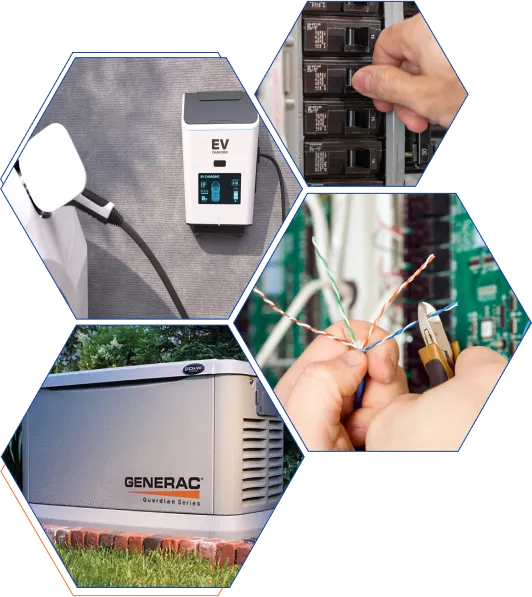
A local electrical and plumbing service provider with decades of experience shapes its commercial maintenance approach around skilled technicians, flexible scheduling built around your operating hours, and inspections that go beyond a quick visual pass. Services relevant to a commercial EMP include infrared scanning, panel upgrades, circuit and panel repairs, emergency response, and EV charger and generator installation for facilities adding new electrical load. Call (440) 253-0332 to schedule an inspection, or review current electrical pricing before your next budget cycle.
Why Maintenance Belongs in the Risk Management Budget
Most facilities budget for electrical maintenance as a line item they’d rather cut, then treat every failure as a surprise. It isn’t a surprise. It’s a predictable outcome of the run-to-failure mindset the industry keeps defaulting to, even after decades of data showing what it costs. Treat maintenance the way you’d treat insurance: as capital planning, not an expense to minimize. If you’re not sure where your building stands, call a professional and find out before the breaker tells you.
— Lindsay Paramore
Get a Commercial Electrical Maintenance Plan Built for Your Building
Building your own inspection schedule, sourcing test equipment, and training staff to interpret IR scans costs more in time and risk than hiring a team that already does this daily. This provider is the practical alternative to piecing together your own maintenance program: skilled technicians, flexible scheduling designed around your business hours, and clear, upfront pricing instead of guesswork.

If troubleshooting turns up a bigger issue, electrical troubleshooting runs $300 to $500, and panel-related findings can move straight into a panel upgrade without a second visit. For facilities exploring commercial electrical services for the first time, the process starts with a site visit, a written proposal, and a schedule that works around your operation, not against it. Call (440) 253-0332 to book an inspection and get a maintenance program started before your next slow season becomes your next emergency call.
Sources
- Standard for an Electrical Preventive Maintenance (EPM) Program — AIG
- Safely maintain electrical equipment according to NFPA 70B — NFPA blog
- Protecting employees from electric-arc flash hazards — OSHA
- Operational excellence: O&M beyond the basics — U.S. DOE / FEMP slides
FAQ
How Much Does a Commercial Electrician Charge Per Hour?
Rates vary widely by region, project scope, and whether the work is emergency or scheduled. For a defined diagnostic job, Tri-County Services Electric & Plumbing prices electrical troubleshooting at $300 to $500 as a flat rate rather than an hourly charge, so ask any contractor whether they quote by the hour or by the job before work starts.
What Are the Four Rules of Electrical Maintenance?
There’s no single universally codified “four rules” framework in NFPA 70B or OSHA guidance, so definitions vary by trainer. Most reputable programs cover the same ground regardless of how they number it: de-energize and lock out equipment when feasible, inspect and test on a documented schedule, use appropriate PPE based on current incident energy calculations, and keep records that support trending over time.
What Does Electrical Maintenance Include?
A complete program includes visual inspections, infrared thermography, insulation resistance and protective device testing, breaker torque checks, and generator or UPS load testing, all logged in a maintenance history. It also includes documented procedures and a CMMS to schedule work and track what’s been done, since untracked maintenance provides little defense if an insurer or inspector asks for proof.
What Is the Highest Paid Electrician Field?
Specialized commercial and industrial work, including high-voltage systems, generator and backup power installation, and controls work, tends to pay more than standard residential service work, reflecting the added training and risk involved. Facilities investing in newer systems like EV charging infrastructure or generator backup often need technicians with this broader skill set, which is one reason to vet a contractor’s specific experience before hiring for a commercial maintenance contract.