

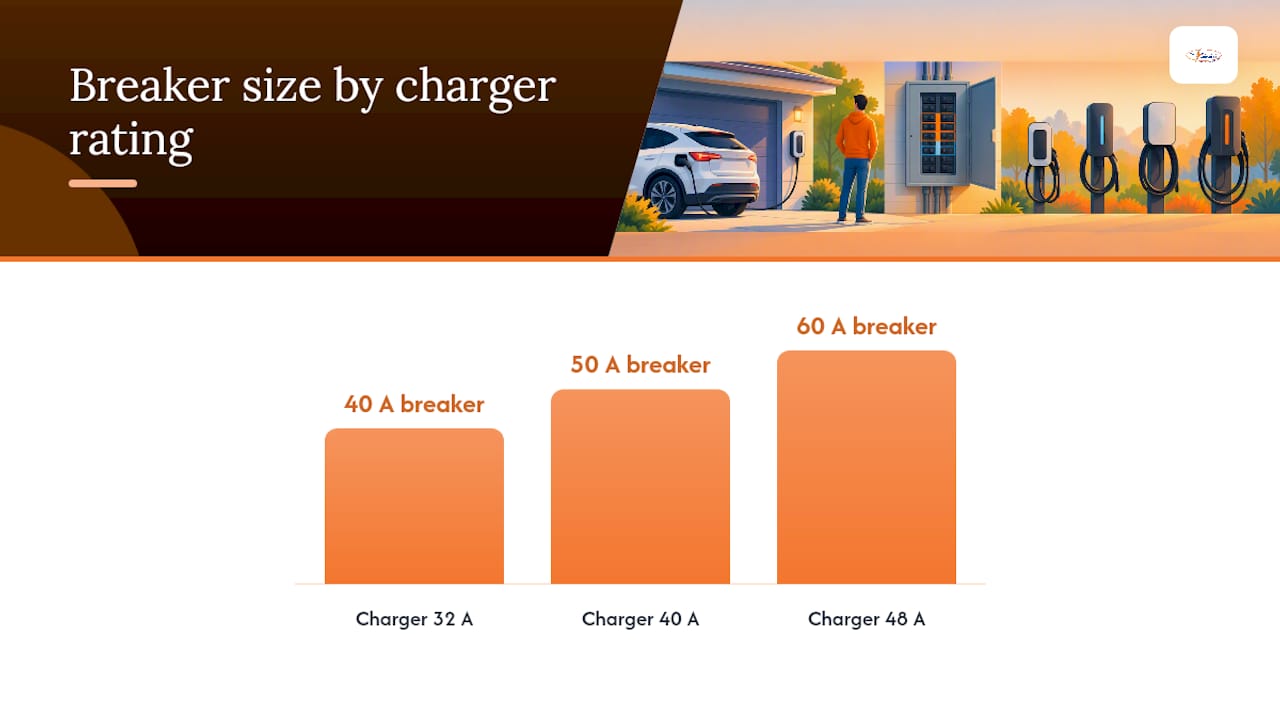
Your EV charger breaker size equals the charger’s rated amperage multiplied by 1.25, then rounded up to the next standard breaker rating. A 32-amp charger needs a 40-amp breaker. A charger rated near this level typically requires a 60-amp breaker. That math comes straight from the National Electrical Code, but the breaker is only half the equation. Wire gauge and your panel’s spare capacity still need to check out before anyone flips that switch.
TL;DR:
- The breaker size for an EV charger is determined by multiplying its rated current by 1.25 and rounding up to the next standard size, such as 20, 30, 40, or 50 amps.
- Longer runs, hot environments, or crowded conduit may require upsizing wiring beyond the basic calculation to prevent voltage drops and ensure safety.
- A panel must have both physical space and enough capacity to support the new circuit, with load calculations often needed for undersized or heavily loaded panels.
- Plug-in chargers are limited to continuous currents of 40 amps due to receptacle ratings, while hardwired units can handle higher continuous currents reliably.
- Accurate sizing involves reviewing the charger’s actual continuous current from the manual, considering upscaling factors, and ensuring compliance with the local electrical code and inspection processes.
Table of Contents
- What Size Breaker Do You Need for an EV Charger?
- How to Calculate the Correct Breaker Size Step by Step
- Why Wire Gauge Isn’t Just About the Breaker Rating
- Does Your Electrical Panel Have Room for an EV Charger?
- Should You Choose a Hardwired or Plug-In EV Charger?
- What the Code Actually Requires Before You Install
- What We See Go Wrong in the Field
- Why Guesswork Doesn’t Belong Near Your Panel
- Get Your EV Charger Installed Right the First Time
- Sources
- FAQ
What Size Breaker Do You Need for an EV Charger?
Electric vehicle charging equipment, often called EVSE (electric vehicle supply equipment), draws power for hours at a stretch. Because of that, the National Electrical Code classifies it as a continuous load, and continuous loads get a special sizing rule under NEC Article 625. The breaker and the wire feeding it both need to handle 125% of the charger’s rated draw, not just the draw itself.
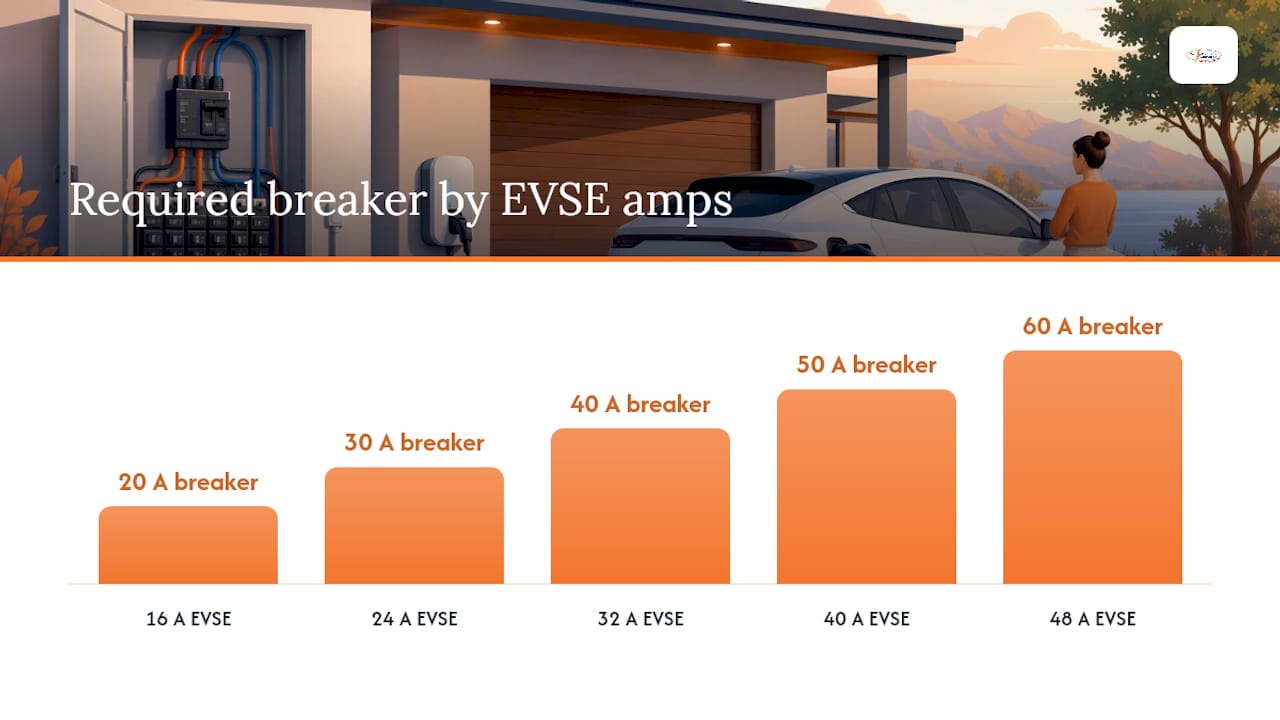
Here’s a quick reference for the pairings you’ll run into most often:
- 16-amp EVSE → 20-amp breaker → 12 AWG copper (common for basic Level 1 setups)
- 24-amp EVSE → 30-amp breaker → 10 AWG copper
- 32-amp EVSE → 40-amp breaker → 8 AWG copper
- 40-amp EVSE → 50-amp breaker → 6 AWG copper
- 48-amp EVSE → 60-amp breaker → 6 AWG copper (verify with a professional; some runs need 4 AWG)
Those wire gauges assume a relatively short, straightforward run on 75°C rated copper conductors and terminals. Longer runs, aluminum wiring, or crowded conduit can change that. Notice something about plug-in setups: even when the branch circuit supports 50 amps, the receptacle itself typically caps continuous draw at 40 amps. That’s a hardware limitation, not a code loophole, and it matters when you’re deciding between a plug-in unit and a hardwired one.
The one-line version of all this: take the nameplate amps, multiply by 1.25, and round up to the nearest standard breaker size (20, 30, 40, 50, 60 amps, and so on). Standard breakers don’t come in odd increments, so you’re always rounding toward the next size, never splitting the difference.
How to Calculate the Correct Breaker Size Step by Step
Every EVSE has a nameplate or a spec sheet that lists its “rated current” or “maximum continuous current.” That number is your starting point, and it’s usually printed right on the unit or buried in page one of the installation manual.
Here’s the sequence a professional runs through every time:
- Find the rated current. Check the nameplate, not the box the charger came in. Marketing materials sometimes round up.
- Multiply by 1.25. This is the NEC’s 125% continuous-load factor, and it’s the same math whether you frame it as “125% of the load” or “the load can’t exceed 80% of the breaker’s rating.” Both describe the identical relationship.
- Round up to the next standard breaker. If the math lands on 42.5 amps, you don’t get a 42.5-amp breaker. You go to 50.
- Match the wire gauge to the breaker, not the charger’s raw amperage. The conductor has to safely carry the breaker’s rating.
- Check for upsizing triggers. Long runs, high ambient temperatures, or crowded conduit can push you to a heavier gauge even after the basic math is done.
Walk through a real example. A charger rated at 32 amps continuous gets multiplied by 1.25, landing at 40 amps exactly. That’s a clean fit for a 40-amp breaker paired with 8 AWG copper. Bump the charger to 40 amps and the math gives you 50 amps, which calls for a 50-amp breaker and 6 AWG copper. Go up to 48 amps, near the top of what many residential Level 2 chargers offer, and 125% lands at 60 amps flat, a common ceiling for a single-family EV circuit.
Pro Tip: If your calculation lands exactly on a standard breaker size, like 40 or 60 amps, double-check the charger’s actual continuous rating against its manual. Some manufacturers list a “maximum” output that’s higher than the sustained rating used for code compliance, and using the wrong number throws off every step that follows.
The upsizing triggers are where DIY math tends to fall apart. A run longer than roughly 100 feet, a hot attic or garage ceiling, or a conduit stuffed with other circuits can all demand a heavier wire even when the breaker size doesn’t change.
Why Wire Gauge Isn’t Just About the Breaker Rating
A breaker protects the wire, not the other way around, so the conductor has to be rated to carry at least what the breaker allows. This is where ampacity tables come in. Most residential EV circuits get sized off the 75°C column of the NEC’s conductor ampacity chart, because that matches the temperature rating stamped on most breaker and charger terminals.
In practice, that means:
- 8 AWG copper is standard for 40-amp breakers on short, uncomplicated runs.
- 6 AWG copper covers 50 and 60-amp breakers under normal conditions.
- 4 AWG copper shows up when a 60-amp circuit runs a long distance or through a hot environment.
Voltage drop is the factor most homeowners skip. The NEC doesn’t hard-mandate a voltage drop limit for branch circuits, but the widely used design guideline caps drop at 3% for a branch circuit feeding a continuous load like an EV charger. Push a 40-amp circuit 150 feet from the panel and 8 AWG copper might technically pass the ampacity table while still losing enough voltage to slow charging and stress the equipment. That’s a case for jumping to 6 AWG even though the breaker didn’t change size.
Ambient temperature matters too. A wire run through an uninsulated garage ceiling in July doesn’t perform the same as one running through a conditioned basement. Derating factors in the NEC tables can shrink a conductor’s safe capacity by 10 to 20 percent in hot environments, which is often enough to bump you a full gauge size. Installer references built specifically for EV circuits, like PES Supply’s breaker and wire calculator, walk through these adjustments and consistently land on the same conclusion: the “standard” gauge for a given breaker is a starting point, not a guarantee.
Does Your Electrical Panel Have Room for an EV Charger?
Before any breaker gets installed, your panel has to have both physical space and electrical headroom for the new circuit. Two different homes with identical 200-amp panels can have completely different answers to “can this handle an EV charger” depending on what else is already drawing power.
Walk your panel and check for these things:
- An open slot or two for the new breaker (a 240-volt EV circuit typically needs a double-pole breaker, taking two slots).
- The main breaker’s rating, usually 100, 150, or 200 amps for most homes.
- What else is already running, especially electric water heaters, electric ranges, central air, or a second EV charger.
When a panel is older, undersized, or already loaded with high-draw appliances, a simple slot count isn’t enough. That’s when a professional performs a load calculation, essentially adding up your home’s existing demand against the panel’s rated capacity to confirm there’s genuine room for another 40 or 50-amp continuous load. DOE guidance on EV charging points to a few ways around a full service upgrade when that math comes up short: automatic load management systems (ALMS) that throttle the EV circuit when other appliances are running, meter collars that add capacity without a full panel swap, and utility time-of-use programs that shift charging to off-peak hours.
Pro Tip: If your panel is already at or near its main breaker’s rated capacity, don’t assume a bigger charger is the fix for slow charging. A load management device is often far cheaper than a full service upgrade, and it solves the actual bottleneck instead of tripping breakers.
Red flags that usually point straight to a panel or service upgrade include a main breaker rated below 100 amps, a panel with zero open slots, or a home already running electric heat alongside an electric water heater and range.
Should You Choose a Hardwired or Plug-In EV Charger?
Plug-in chargers, the kind that connect to a NEMA 14-50 or similar receptacle, are popular because they’re easy to swap or take with you. But that convenience comes with a ceiling: receptacle and cord ratings commonly cap continuous current at 40 amps, even on a circuit wired for 50 amps.
That 40-amp ceiling isn’t arbitrary. Repeated plugging and unplugging wears connection points, and a loose or corroded receptacle carrying continuous high current is a real fire risk. Anything above that range typically gets hardwired instead, with the charger’s supply wire landing directly on a junction box rather than a wall receptacle.
Here’s how the tradeoffs break down for homeowners:
- Plug-in units are easier to relocate or replace and don’t require rewiring if you upgrade to a different charger model later.
- Hardwired units handle higher continuous currents reliably and tend to be what inspectors prefer for 48 to 60-amp installations.
- Hardwired units eliminate the receptacle as a wear point, which matters for a circuit running daily for years.
If your charger’s nameplate current pushes past that 40-amp plug-in ceiling, hardwiring stops being optional. Below it, it’s a matter of preference and future flexibility.
What the Code Actually Requires Before You Install
NEC Article 625 governs electric vehicle charging equipment specifically, and its core sizing requirement is the same 125% continuous-load factor covered above. But code compliance isn’t just about hitting the right number.
Local jurisdictions don’t all enforce the same NEC edition at the same time. Some counties are still working off the 2020 NEC, others have adopted the 2023 edition with its updated language on energy management and bidirectional charging systems. That gap matters because an inspector working from a newer edition can flag something a homeowner assumed was settled by an older reference.
A permit isn’t paperwork for paperwork’s sake. It’s the checkpoint where someone with no financial stake in the installation verifies the breaker, the wire, and the panel all agree with each other before the circuit goes live.
Typical steps before energizing a new EV circuit include:
- Pulling an electrical permit through your local building department.
- Scheduling a rough-in inspection before walls close up, if applicable.
- Getting a final inspection after the breaker and charger are installed.
A professional installer who tracks the NEC edition enforced in your specific jurisdiction avoids the single most common reason EV installs fail inspection: applying outdated assumptions to a code cycle that’s already moved on.
What We See Go Wrong in the Field
Professional electricians have worked on electrical systems throughout Northeast Ohio since 1975, and EV charger circuits have become one of the most frequent calls received. A few patterns show up again and again:
- Breakers sized off the wrong number. Homeowners sometimes size a breaker off a charger’s maximum burst rating instead of its rated continuous current, undersizing the whole circuit.
- Wire gauge that matched the breaker but not the run. A conductor rated fine on paper can still fail a voltage drop check on a long garage run.
- Missing dedicated circuits. An EV charger sharing a circuit with anything else is a code violation and a real safety issue.
If your panel looks marginal, your amperage math lands right on a boundary, or you’re planning for a second EV down the road, that’s the moment to stop and call a professional rather than guess. Our EV charger installation team handles the load calculation, permit, and inspection process from start to finish. Call (440) 253-0332 for an assessment before you buy a breaker off a shelf.
Why Guesswork Doesn’t Belong Near Your Panel
The 125% rule is simple arithmetic, but simple arithmetic applied to the wrong nameplate number, an undersized wire, or an overloaded panel still produces a dangerous outcome. I’ve seen enough installer write-ups and NEC guidance to say plainly: the math is the easy part. Reading your specific panel’s condition and your home’s actual load correctly is where things go wrong.
If any part of your calculation feels uncertain, that uncertainty is the signal to bring in someone qualified before touching a breaker.
— Lindsay Paramore
Get Your EV Charger Installed Right the First Time
Sizing the breaker correctly is one piece of a job that also includes a panel assessment, permit filing, and a final inspection, and getting any one of those wrong means redoing the work. This company handles all of it as one process: checking your panel’s spare capacity, sizing the breaker and wire to your specific charger’s nameplate rating, pulling the permit, and scheduling the inspection so you’re not left guessing whether the install will pass.

EV charger installations are a rapidly growing part of the electrical services offered to homeowners in Northeast Ohio. Every assessment includes a look at whether load management hardware or a panel upgrade makes more sense for your situation, so you’re not paying for capacity you don’t need. Pricing for EV charger installation and panel work is available on our site, and our EV charger installation page has more on what to expect during a visit. Call (440) 253-0332 to schedule an assessment and get a breaker size that’s right the first time.
Sources
- Electric Vehicle Charging for Multifamily Housing (DOE)
- Charging Electric Vehicles at Home (AFDC)
- EV Charger Circuit Calculator | Breaker & Wire Size – PES Supply
FAQ
Does a Tesla charger need a 50 or 60-amp breaker?
It depends on the amperage setting on the Wall Connector. A unit set to 40 amps continuous needs a 50-amp breaker, while a unit set to 48 amps needs a 60-amp breaker, following the same 125% NEC calculation used for any Level 2 charger.
Can I use a 40-amp breaker for an EV charger?
Yes, but only for a charger rated at 32 amps continuous or lower, since 32 amps multiplied by 1.25 equals exactly 40 amps. Using a 40-amp breaker for a charger rated higher than 32 amps continuous violates the NEC’s continuous-load sizing rule.
What size wire do I need for a 60-amp breaker for an EV charger?
Most 60-amp EV circuits use 6 AWG copper wire on short, standard runs, though longer distances or hot ambient conditions can require upsizing to 4 AWG. A practical circuit calculator can help estimate this, but a professional should verify the run before wire is pulled.
Is a 60-amp breaker enough for an EV charger?
A 60-amp breaker supports EV chargers rated up to 48 amps continuous, which covers most residential Level 2 chargers on the market. If you’re planning to add a second EV or a higher-output charger later, discuss future capacity with a professional before finalizing the circuit size.
What’s the difference in breaker requirements between Level 1 and Level 2 chargers?
Level 1 chargers often work without new wiring, according to AFDC guidance. Level 2 chargers require a dedicated 240-volt circuit with a breaker sized at 125% of the charger’s continuous rating, commonly 40 or 60 amps.