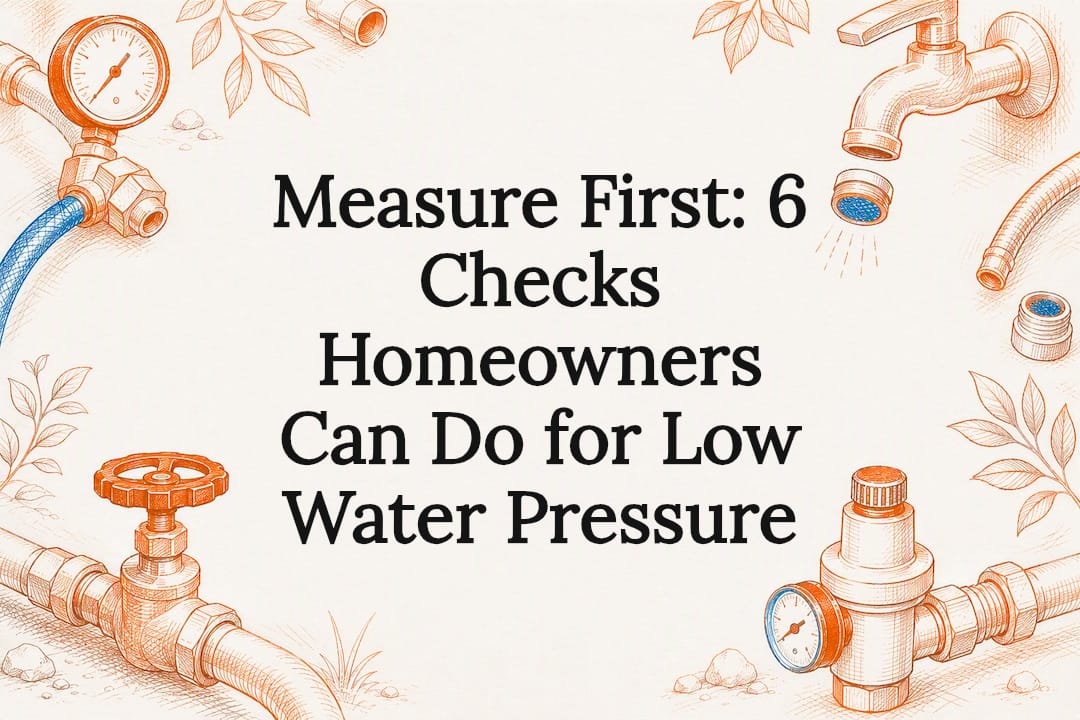


Most low water pressure problems trace back to one of five things: a partially closed valve, a clogged aerator, a failing pressure regulator, mineral buildup in old pipes, or a hidden leak. Start by testing your pressure with a hose-bib gauge at an outdoor spigot. If the reading is genuinely low, or you’re not comfortable running that test, call a professional for a full diagnostic before you spend money guessing.
TL;DR:
- Testing your household pressure with a hose-bib gauge at an outdoor spigot helps determine if the issue is upstream or fixture-specific.
- A gauge reading below 40 psi generally indicates a supply or pressure regulator problem, while higher readings with weak fixtures suggest localized clogs or buildup.
- Common causes include partially closed valves, municipal supply restrictions, failing pressure regulators, mineral deposits, or hidden leaks requiring professional detection.
- Cleaning aerators and checking valve openings are quick DIY fixes, but diagnosing complex issues like corroded pipes or slab leaks needs a trained technician.
- A professional diagnostic can accurately identify and fix pressure problems, especially when simple checks show normal pressure but fixtures remain weak.
Table of Contents
- What’s Causing Your Low Water Pressure?
- Fast Checklist: Six Things to Try Now
- How to Tell If It’s Your Supply or Your Fixtures
- Common Causes and What to Do About Each
- What You Can Safely Check Yourself
- What a Professional Diagnostic Visit Actually Covers
- The Troubleshooting Advice Most Guides Get Backwards
- Get Your Water Pressure Fixed by Tri-County Services Electric & Plumbing
- Sources
- FAQ
What’s Causing Your Low Water Pressure?
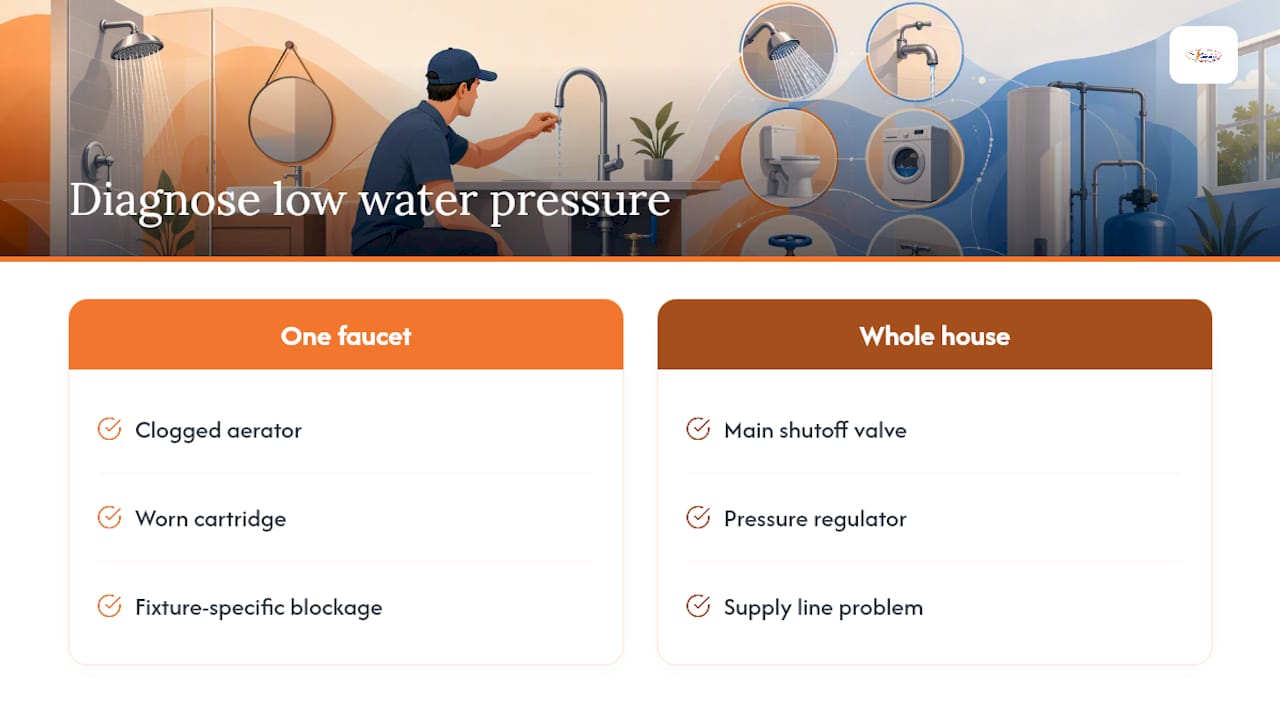
Before touching a single valve, figure out whether the problem is affecting your entire house or just one faucet. That single distinction points you toward the right fix and saves you from replacing parts that were never broken.
If only your kitchen sink or one shower runs weak, the cause is almost always local: a clogged aerator, a worn cartridge, or a fixture-specific blockage. If every tap in the house is affected, the issue lives upstream, in your main valve, your pressure regulator, or the supply line itself. That’s the first fork in the road, and it determines everything that follows.
Fast Checklist: Six Things to Try Now
Run through these in order. Most take two minutes each, and together they rule out the easy causes before you assume something’s seriously wrong.
- Compare hot and cold, indoors and outdoors. If only hot water is weak, suspect the water heater. If outdoor spigots run fine but indoor fixtures don’t, the problem is inside your plumbing.
- Ask a neighbor or check your utility’s website. Scheduled maintenance or a water main break can drop pressure across a whole block.
- Check that your main shutoff and meter valves are fully open. A valve that’s only partially open is one of the most common, and cheapest, causes of whole-house low pressure.
- Remove and clean your aerators and showerheads. Mineral deposits collect in these tiny screens fast, especially in hard-water regions.
- Watch your water meter for movement when nothing is running. A spinning dial with every fixture off is a strong leak signal.
- Test your incoming pressure with a hose-bib gauge. This gives you a real number instead of a guess.
Pro Tip: Screw the pressure gauge onto an outdoor spigot closest to your main line, make sure nothing else in the house is running water, and open the valve fully for the most accurate reading.
How to Tell If It’s Your Supply or Your Fixtures
A hose-bib pressure gauge costs little and tells you more in thirty seconds than an hour of guessing. Screw it onto an outside spigot, turn the water on fully, and read the dial with no other fixtures running.
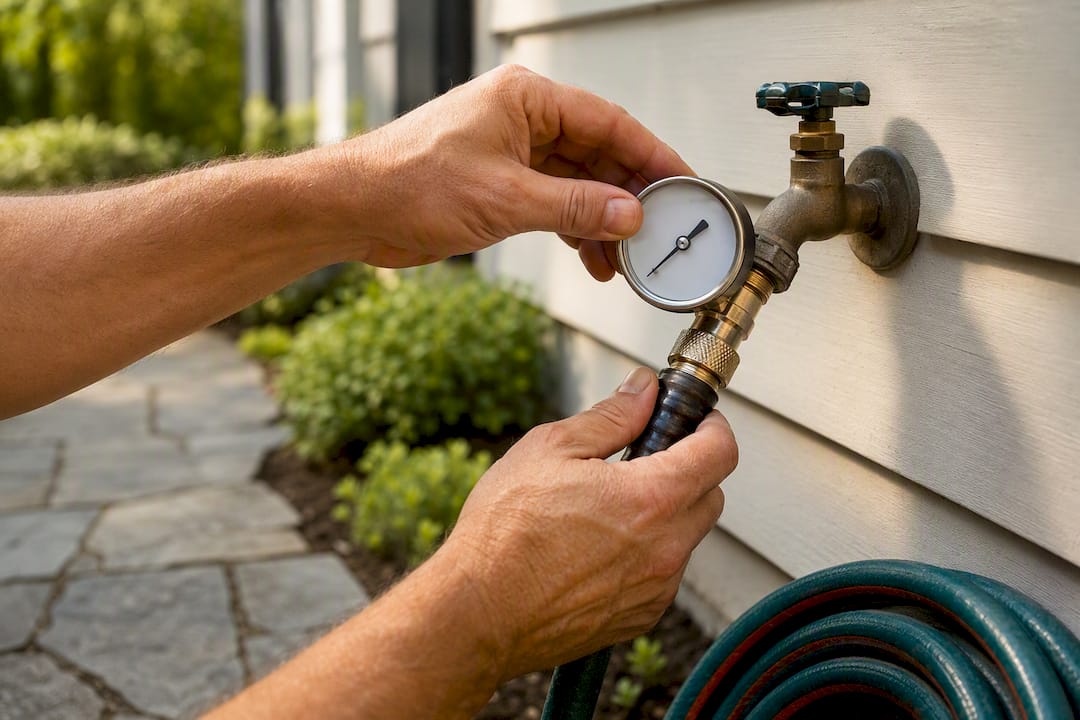
Here’s what the number means: typical household pressure runs between 45 and 80 psi, and most plumbing professionals consider anything under 40 psi genuinely low. A reading in that healthy range with one weak fixture points straight at that fixture. A low reading across the board points upstream.
From there, work through the rest of the sequence:
- Check the meter valve and main shutoff to confirm they’re open all the way, not just partially.
- If you have a pressure regulator (PRV), a reading that’s low at every fixture but the meter itself tests fine often means the regulator is failing or was set too low.
- If only hot water is weak, the water heater’s inlet screen or a failing dip tube is a likely culprit, not your main supply.
- Watch the meter’s leak indicator dial while everything is off. Movement means water is escaping somewhere you can’t see.
Each outcome tells a different story: a low gauge reading with a healthy meter dial suggests a supply or regulator issue, while a normal gauge reading with one stubborn faucet almost always means a clogged or aging fixture part.
Common Causes and What to Do About Each
Once you know whether the problem is whole-house or localized, these are the usual suspects, roughly in order of how often they show up.
A partially closed main or meter valve. This happens more than people expect, often after a plumbing repair, a meter swap, or seasonal shutoff. Verify both valves are turned fully to the open position; it costs nothing and rules out the simplest cause first.
Municipal supply problems. Utility companies sometimes restrict pressure during repairs, fire flow testing, or peak demand hours. If your neighbors report the same dip, the fix isn’t in your house at all. It’s temporary and usually resolves within hours.
A failing or mis-set pressure regulator. PRVs wear out like any mechanical part, typically every 10 to 15 years. When they fail, they produce that telltale even, whole-house pressure drop rather than one weak fixture. Diagnosing this properly means measuring pressure before and after the regulator, which is a job better suited to someone who works on these daily.
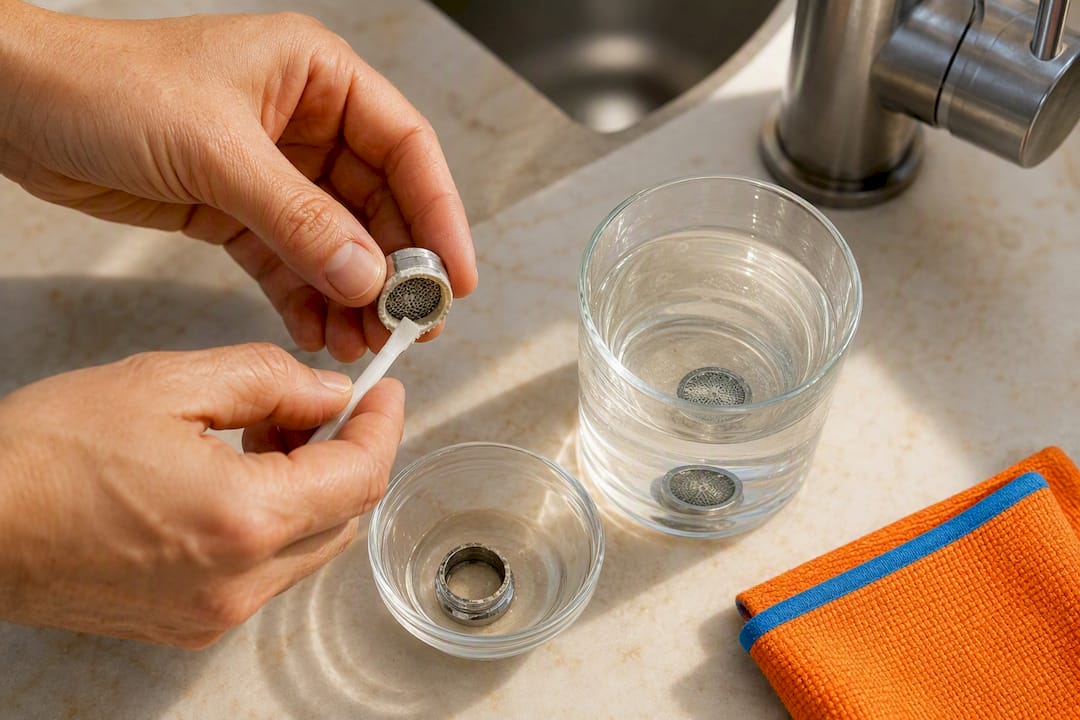
Clogged aerators, cartridges, and whole-house filters. This is the most overlooked fix on the list and it solves a surprising share of localized complaints, especially where hard water is common. Unscrew the aerator, soak it in vinegar, and check whole-house filter cartridges if you have one installed.
Mineral buildup and corroded pipes. Hard water leaves scale deposits that narrow the inside diameter of pipes over years, and old galvanized pipe corrodes from the inside out, restricting flow in ways no amount of cleaning fixes. If your home still has original galvanized lines from before the 1960s, repiping may be the only real solution. A quality whole-house filtration setup, like the systems detailed by Svenskt Vattenfilter, can slow future scale buildup, though it won’t reverse decades of existing corrosion.
Hidden leaks and slab leaks. A jump in your water bill, damp spots on flooring or drywall, or a hissing sound behind a wall are all signs water is escaping before it reaches your fixtures. These signs call for professional leak detection, not a wait-and-see approach, since a slab leak worsens the longer it runs.
Well system problems. If you’re on a private well, low pressure usually comes down to a waterlogged pressure tank, a clogged filter, or pump and power issues. Homeowners can check the tank’s air charge and inspect visible filters, but pump repairs and electrical troubleshooting belong to a qualified technician.
What You Can Safely Check Yourself
A handful of tasks are genuinely low risk and worth doing before you call anyone.
- Clean or replace aerators and showerhead screens; hand tools only, no plumbing skills required.
- Confirm main and meter valves are fully open by turning the handle or lever as far as it goes.
- Run the hose-bib gauge test at an outdoor spigot to get an actual pressure number.
- Check your water heater’s temperature and pressure relief valve for obvious signs of failure, without opening it up.
Some jobs look simple but carry real risk, and this is where a surprising number of homeowners get into trouble. Cutting into a supply line, replacing a pressure regulator without experience, or tearing into a wall to chase a suspected slab leak can turn a $200 repair into a $2,000 one if it goes wrong. Well pump and pressure switch issues often involve both plumbing and electrical wiring, and mixing water with amateur electrical work is a genuine safety hazard. If your troubleshooting points to a regulator, a well pump, or anything involving exposed wiring near water, that’s the moment to call a professional electrician or plumber instead of reaching for a wrench.
Pro Tip: If your gauge reading looks fine but pressure still feels weak at the tap, don’t start disassembling fixtures one by one. A professional can isolate the cause in minutes with the right tools instead of you spending a Saturday on trial and error.
What a Professional Diagnostic Visit Actually Covers
A trained technician doesn’t guess. A proper visit typically includes a static and dynamic pressure reading at multiple points in the house, an inspection of the PRV with before-and-after measurements, a check of visible and suspected hidden leaks, and an assessment of pipe condition where corrosion or scale is suspected.
Tri-County Services Electric & Plumbing has worked on homes and businesses across Northeast Ohio since 1975, and that kind of history means we’ve seen just about every version of a low-pressure complaint, from a stuck meter valve to a decades-old galvanized line finally giving out. Our plumbing team handles the repairs that actually restore pressure long term:
- Pressure regulator inspection and replacement
- Water line repair for leaks between the meter and the house
- Hot water tank diagnostics when only hot water runs weak
- Well pump and pressure switch evaluation, including the electrical side
We do not perform backflow testing, so if that’s what you need, look elsewhere for that specific service. For everything else on this list, call our office at (440) 253-0332 and we’ll get a technician out to figure out exactly what’s cutting your pressure.
The Troubleshooting Advice Most Guides Get Backwards
Most articles on this topic hand you a long list of possible causes and let you sort out which one applies. That backwards approach wastes time and, more often than people realize, money. The better sequence is the one this article leads with: test first, then diagnose, then fix. A ten-dollar gauge tells you more in thirty seconds than an afternoon of swapping parts based on guesswork.
The other place conventional advice falls short is in downplaying the fixture-versus-supply distinction. Homeowners fixate on dramatic causes like slab leaks when the real culprit, in a large share of cases, is a scaled-up aerator that costs nothing to clean. At the same time, people underestimate how often a PRV, a component most homeowners have never heard of, is the actual source of whole-house pressure loss.
My honest take: skip the temptation to start replacing parts before you’ve measured anything. Test, then diagnose the pattern (whole-house or single fixture), and only then decide whether it’s a five-minute fix or a job for someone who does this for a living. That order saves both money and frustration, and it’s the one step most guides skip entirely.
— Lindsay Paramore
Get Your Water Pressure Fixed by Tri-County Services Electric & Plumbing
If you’ve run through the checklist and the pressure is still weak, or the idea of testing a regulator or chasing a slab leak yourself doesn’t sound appealing, that’s exactly the point where a professional visit pays for itself. Tri-County Services Electric & Plumbing has spent decades in Northeast Ohio homes tracking down exactly this kind of problem, from a failing PRV to a corroded water line nobody knew was there.

Our plumbing technicians run the same gauge tests and diagnostic checks covered above, but with the equipment and experience to isolate the cause fast instead of guessing room by room. We work around your schedule, not the other way around, and we treat your home the way we’d want ours treated. If you’re also noticing power issues tied to a well pump or pressure switch, our electrical team handles that side too, all under one call.
Call (440) 253-0332 to schedule a diagnostic visit, or reach out through our site to get started.
Sources
- Why is my water pressure low? A guide for homeowners | Grundfos
- Portland
- 12 Reasons for Low Water Pressure in Your House | The Spruce
- Private wells | EPA
FAQ
What Do I Do if My Water Pressure Is Low?
Check that your main and meter valves are fully open, clean your aerators, and test the pressure with a hose-bib gauge at an outdoor spigot. If the reading is under 40 psi or you can’t identify the cause, call a professional for a full diagnostic.
Is 40 PSI Water Pressure Too Low?
Forty psi sits right at the edge of normal, since healthy household pressure typically runs between 45 and 80 psi. If you’re consistently reading below that, it’s worth having a professional check your regulator and supply line.
Why Is My Water Pressure Low When I Use Only Two Faucets?
Running multiple fixtures at once splits your available flow between them, so a drop when two are open at the same time is often normal rather than a sign of a problem. If pressure stays weak even with just one fixture running, that points to a fixture-specific clog or an upstream issue instead.
Why Is My Water Pressure Low but No Leak?
Low pressure without a leak usually points to a closed or partially closed valve, a failing pressure regulator, mineral buildup narrowing your pipes, or a municipal supply issue affecting your neighborhood. A hose-bib pressure test is the fastest way to narrow down which one applies to your house.