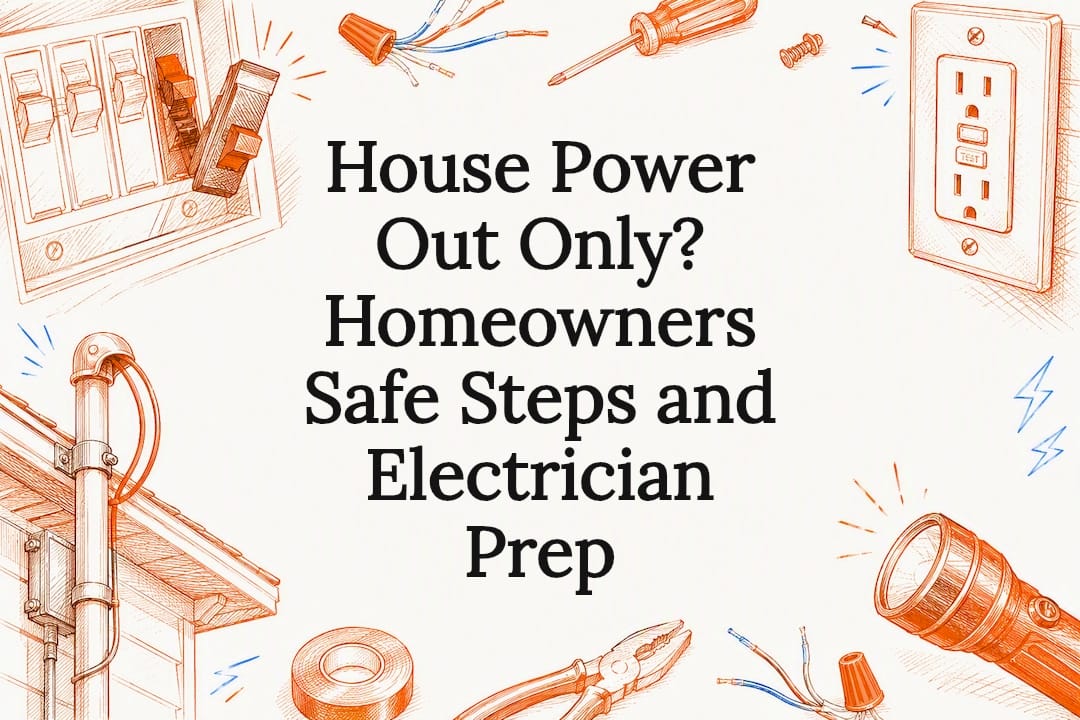

If your house has no power but the neighborhood looks fine, the problem sits inside your electrical system, not with the utility. Start with your main panel: look for a tripped breaker, then check every GFCI outlet, then unplug anything that might be overloading a circuit. If you smell burning, see sparks, or find warm outlets, stop immediately and call a professional.
TL;DR:
- Most power outages affecting only your house are caused by a tripped breaker or a tripped GFCI outlet, not the utility grid itself.
- A GFCI outlet in a bathroom, kitchen, garage, or outdoor area can cut power to multiple outlets downstream, often without obvious signs.
- If breakers and GFCIs reset but power remains absent, damaged wiring or a malfunctioning appliance is likely causing the persistent issue.
- Signs such as burning smells, warm outlets, sparking, or humming sounds indicate electrical hazards requiring immediate professional attention.
- Damage to the meter base, weatherhead, or service entrance cable caused by weather, animals, or age can lead to outages and must be inspected by utility or professionals.
Table of Contents
- Is It Just My House, or Is the Whole Block Out?
- Check Your Main Panel First: Finding and Resetting a Tripped Breaker
- Reset Your GFCI Outlets: The Hidden Reason Half Your House Is Dark
- Rule Out an Overloaded Appliance or Faulty Device
- Warning Signs That Mean Stop and Call a Professional
- Protecting Food, Medicine, and Family While the Power Is Off
- What to Tell the Electrician When Basic Checks Don’t Work
- Test the Panel for Loose Connections or Corrosion
- Inspect the Meter Base and Weatherhead Outside Your Home
- Check the Service Entrance Cable and Utility Connection
- Look for Damaged Wiring or Signs of Rodent Activity
- Think Back on Recent Electrical Work or Changes
- Why We Push Homeowners Toward Early Professional Help
- Get Your Power Back On With Tri-County Services Electric & Plumbing
- Sources
- FAQ
Is It Just My House, or Is the Whole Block Out?
Before you touch a single breaker, figure out whether this is a utility problem or something happening only in your house. Step outside and look at your neighbors’ windows and the streetlights on your block. If everything around you is lit up and your house has no power, the cause is almost certainly inside your home’s wiring or panel, not the grid.
A few basic checks quickly help determine whether the cause is external or internal to your home:
- Look for lit windows or working streetlights nearby.
- Text or call a neighbor if you have cell service.
- Check your utility provider’s outage map for reported issues in your area.
- If neighbors are also dark, report it to the utility and focus on food and medical safety rather than troubleshooting your panel.
- If you spot a downed power line or sparking equipment anywhere outside, keep everyone away and call 911.
Once you’ve confirmed the power outage is only in your house, you can move on to the panel with confidence that you’re solving the right problem.
Check Your Main Panel First: Finding and Resetting a Tripped Breaker
Your electrical panel is the logical next stop when a power outage only affects your house. Open the panel cover and look for a breaker that isn’t fully aligned with the others. A tripped breaker often sits in a position between fully ON and fully OFF, rather than flipped all the way to OFF.
Resetting it safely takes three steps:
- Push the tripped breaker fully to the OFF position first.
- Then flip it firmly back to ON.
- Watch to see if it holds or trips again immediately.
Pay attention to which breaker tripped. If it’s the main breaker at the top of the panel, that can explain why your whole house has no power at once. If it’s a single branch breaker, only the rooms or outlets on that circuit should be affected. A breaker that won’t stay on, or that trips again the moment you reset it, is protecting a persistent fault somewhere in that circuit. Leave it off and call a professional rather than forcing it repeatedly.
Pro Tip: Never remove the panel cover screws or reach inside the panel itself. Resetting breakers from the front is homeowner territory; anything behind that cover is not.
Reset Your GFCI Outlets: The Hidden Reason Half Your House Is Dark
Ground fault circuit interrupter outlets are one of the most overlooked reasons a house has no power in specific rooms while everything else works fine. A single tripped GFCI, often in a bathroom, garage, or kitchen, can cut power to several downstream outlets in completely different rooms.
Check these locations first:
- Bathrooms and half-baths
- Kitchen countertop outlets
- Garage and basement outlets
- Laundry room
- Exterior outlets on porches or patios
Each GFCI outlet has a small RESET button between two indicator lights. Press it firmly. If it clicks and stays in, power should return to that circuit within seconds. If a GFCI won’t reset, unplug everything connected to that circuit first and try again. A GFCI that still refuses to reset after that points to a wiring problem, and systematically resetting every GFCI in the house is a low-risk step that solves a surprising number of partial outages.
Rule Out an Overloaded Appliance or Faulty Device
If resetting breakers and GFCIs didn’t bring power back, or if a breaker trips again right away, an overloaded circuit or a failing appliance is the likely next suspect. Space heaters, window air conditioners, hair dryers, and older refrigerators draw heavy current and are common culprits when a circuit trips repeatedly.
Work through it methodically:
- Unplug everything on the affected circuit before resetting the breaker again.
- Reset the breaker with nothing plugged in and confirm it holds.
- Plug devices back in one at a time, waiting between each, until you find the one that trips the breaker again.
If the breaker trips with little or nothing plugged in at all, stop there. That’s not an overload problem anymore. It points to damaged wiring or a failing breaker, and that’s a job for a professional, not more trial and error.
Warning Signs That Mean Stop and Call a Professional
Some symptoms mean you should stop troubleshooting entirely, no matter how confident you feel about breakers and outlets. These are the moments where continuing on your own increases the risk of fire or shock rather than solving anything.
Watch for:
- Any burning smell near the panel, an outlet, or a switch plate
- Outlets or switch plates that feel warm to the touch
- Visible sparks when plugging something in
- A breaker that trips repeatedly no matter what you unplug
- A buzzing or humming sound coming from the panel
- Power loss to only half the house, which can indicate a lost service leg on a split phase panel
Burning smells, warm outlets, and sparking are classic signs of loose wiring or arcing, and arcing is one of the leading mechanisms behind electrical house fires. If you see a downed line near your property or flooding anywhere near electrical equipment, do not go near it. Call 911 and notify your utility. Everything past this point belongs to a professional.
Protecting Food, Medicine, and Family While the Power Is Off
While you sort out the electrical side, don’t ignore the practical clock running on your refrigerator and freezer. An unopened refrigerator keeps food safe for about 4 hours, and a full freezer holds temperature for an extended period if the door remains closed, with shorter times if it’s half full. A thermometer left inside either appliance tells you for certain. Toss any perishable food that’s been sitting at 40°F or warmer.
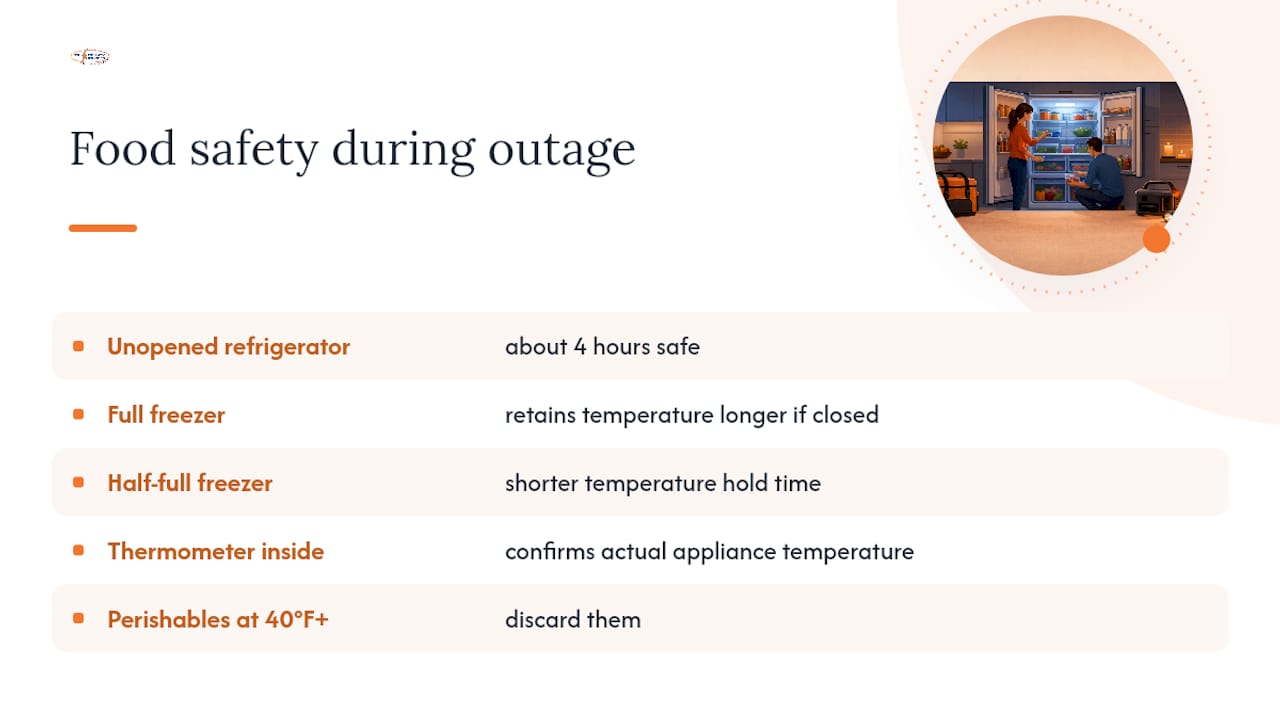
If anyone in the house depends on refrigerated medication like insulin, pack it in a cooler with ice right away and call the pharmacist if the outage stretches on, since people who rely on power for medical needs should always have a backup plan ready.
If you’re using a generator, run it outdoors only, at a safe distance from any window, door, or vent, suitable to prevent CO intrusion, and make sure you have a battery-backed carbon monoxide detector installed. Never run a generator or any gas-powered engine inside a garage, even with the door open.
What to Tell the Electrician When Basic Checks Don’t Work
If you’ve reset breakers, checked every GFCI, and unplugged suspect appliances and your house still has no power, it’s time to call in a professional. What you tell them on the phone can shave real time off the diagnosis, since prepared homeowners who arrive with clear details tend to save on both time and cost.
Before you call, jot down:
- Which rooms or circuits are dead, and whether it’s the whole house or part of it
- Which specific breakers tripped, and whether they reset or tripped again
- Any appliance you were using right before the outage started
- Any burning smell, warmth, sparking, or buzzing you noticed
- Whether neighbors currently have power
Leave any suspect breaker switched off, unplug anything that looked damaged, and leave one lamp on so you’ll notice the instant power comes back. For emergency or diagnostic service, call Tri-County Services Electric & Plumbing at (440) 253-0332. Or look into circuit and panel repair options ahead of time so you know what to expect from the visit.
Test the Panel for Loose Connections or Corrosion
Loose connections inside the panel are one of the most common reasons an outage seems to come and go for no clear reason. Wires that were properly torqued when the panel was installed can loosen over years of heating and cooling cycles as the panel warms under load and cools down repeatedly. Corrosion adds another layer of risk, especially in older homes or in panels near basements and crawl spaces where moisture lingers.
From the outside, you might notice a breaker that feels loose when you flip it, a faint discoloration around certain slots, or a panel cover that’s slightly warm even when nothing seems obviously overloaded. None of these are things to test yourself. Opening the dead front panel cover exposes you to live bus bars, and identifying a loose lug or a corroded connection safely requires meters and training most homeowners don’t have on hand.
This is exactly the kind of check a professional runs during a home electrical inspection: verifying torque on every connection, checking for signs of arcing or heat damage at the lugs, and confirming that corrosion hasn’t compromised a circuit that looks fine from the front. If your outage keeps recurring without an obvious cause like a single faulty appliance, a loose or corroded connection inside the panel is a strong candidate, and it’s not something to leave unaddressed. An older panel that keeps showing these symptoms is often a sign it’s due for a panel upgrade rather than another round of patchwork repairs.
Inspect the Meter Base and Weatherhead Outside Your Home
Not every cause of a house only power outage lives inside your walls. The meter base, the metal box where the utility’s meter attaches to your home, and the weatherhead, the curved fitting at the top of the service mast where overhead wires enter your house, are both exposed to the weather year round and take a beating over time.
Walk outside and look, without touching anything, at the meter base for scorch marks, rust streaks, or a meter that looks like it’s sitting loose or crooked in its socket. Check the weatherhead for cracked insulation on the wires entering it, obvious rust, or a mast that looks bent or pulled away from the house. Ice storms, high winds, and even a tree branch rubbing against the service mast over months can loosen these connections gradually before finally causing a full loss of power.
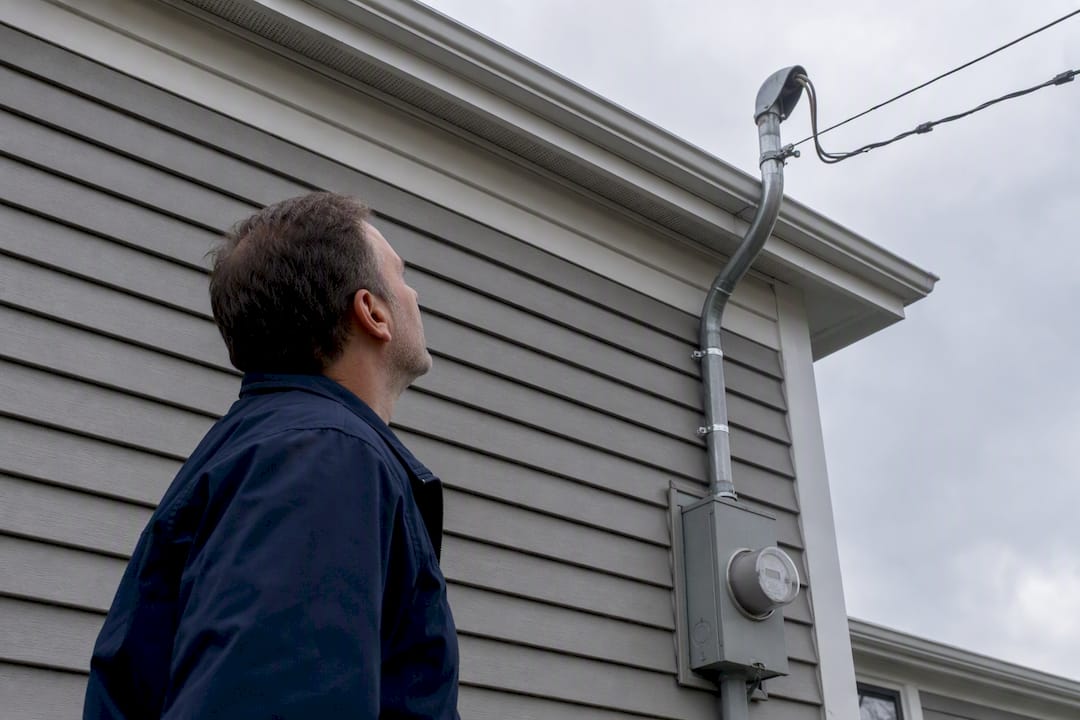
These components sit right at the boundary between your property and the utility’s responsibility, and that boundary itself is confusing for most homeowners. Generally, the utility owns the meter and the wires leading up to it, while everything from the meter base into your house, including the mast and weatherhead, is your responsibility to maintain. That split matters because it determines who you call first. If you see obvious damage at the meter base or weatherhead, don’t touch the equipment. Call your utility to report it, and consider a professional inspection to confirm the connection into your home is sound once power is restored.
Check the Service Entrance Cable and Utility Connection
The service entrance cable is the thick cable running from the weatherhead down the side of your house into the meter base, and from there into your main panel. It’s the single point every bit of power to your home passes through, which makes it a prime suspect when your house has no power but nothing inside the panel looks wrong.
From ground level, look for cable insulation that’s cracked, frayed, or pulling away from the sheathing, especially near the point where it enters the weatherhead or the meter base. Look for obvious sagging where the cable might be rubbing against the roofline or siding. Squirrels, woodpeckers, and even weather exposure over decades can wear through the outer jacket of an aging service cable, and a compromised cable can cause anything from a random intermittent outage to a complete loss of service.
If you spot damage, do not attempt to move, touch, or work near the service entrance cable yourself. This cable is energized at all times unless the utility disconnects it at the transformer or pole, and there’s no way to make it safe without specialized equipment. Contact your utility company directly if the damage looks like it’s on their side of the meter, and call a professional for anything from the meter base inward. If the cable or connection turns out to be original to a decades-old home, it’s often paired with a panel that’s overdue for review anyway.
Look for Damaged Wiring or Signs of Rodent Activity
Rodents are a more common cause of house-only power outages than most homeowners expect. Mice and squirrels chew through wire insulation to wear down their teeth or to build nests, and attics, crawl spaces, and the areas around a home’s wiring runs are exactly the kind of warm, hidden spots they gravitate toward.
You can look for warning signs without opening anything up. Check accessible areas like the attic, basement, and garage for chewed insulation, small piles of shredded material that could be nesting debris, or droppings near wiring runs and junction boxes. A circuit that trips only when a specific appliance runs, or an outage that seems to appear and disappear without a clear pattern, can sometimes trace back to a compromised wire hidden behind drywall or in an attic run.
Visible scorch marks on wiring, exposed copper where insulation has worn away, or wires that look chewed are signs to stop looking and call a professional rather than continuing to inspect further. Damaged insulation creates a real risk of arcing and fire, and locating the exact point of damage inside walls or attic spaces requires equipment and training that go well beyond a flashlight and a step ladder. If you’ve had rodent problems in your attic or basement before, mention that specifically when you call for service, since it gives a professional a head start on where to look.
Think Back on Recent Electrical Work or Changes
Sometimes the explanation for why your power is off traces back to something that happened days or even weeks earlier. Recent electrical work, a newly installed appliance, a DIY project, or even a change made by a previous homeowner can all set the stage for an outage that seems to come out of nowhere.
Ask yourself a few questions before you call for help. Has anyone worked on your panel, wiring, or outlets recently, whether that was a professional or a previous owner’s project you inherited? Did you just install a new major appliance, like an electric range, a window air conditioner, or an EV charger, that could be pulling more current than the circuit was designed to handle? Did you or a contractor recently drill into a wall or ceiling near an outlet or switch, which can nick wiring in ways that don’t fail immediately?
None of these situations mean you did something wrong. Homes settle, connections shift over time, and new loads reveal weaknesses that were always there but never got tested until now. What matters is telling a professional about that history when you call, since it often points directly at the source of the problem instead of leaving them to search the entire house. If a past renovation added new circuits without addressing the panel’s overall capacity, an EV charger installation or similar upgrade may be worth revisiting alongside the current outage.
Why We Push Homeowners Toward Early Professional Help
Homeowners can safely do a lot before calling us: reset a tripped breaker, press RESET on a GFCI, unplug a suspect appliance. What we don’t want is anyone opening a panel cover, poking around a meter base, or working near a service entrance cable that’s still energized. That line exists because we’ve seen what happens when it gets crossed.
The homeowners who get the fastest, cheapest service calls are the ones who’ve already narrowed things down. Telling us which breaker tripped, what smelled off, or which rooms lost power turns a long diagnostic visit into a short one. Tri-County Services Electric & Plumbing has been doing this work in Northeast Ohio since 1975, and that pattern hasn’t changed in fifty years. Preparation on your end saves time and money on ours. If you’re past the safe checks and still in the dark, call (440) 253-0332.
— Lindsay Paramore
Get Your Power Back On With Tri-County Services Electric & Plumbing
You’ve reset the breakers, checked the GFCIs, and ruled out an overloaded appliance, but your house still has no power. That’s the point where guessing costs you more than it saves, and it’s exactly where Tri-County Services Electric & Plumbing steps in. As a family-owned company serving Northeast Ohio since 1975, we send skilled, certified technicians who diagnose the real cause fast, whether that’s a corroded panel connection, damaged service entrance cable, or wiring compromised by rodents, instead of leaving you to keep swapping breakers and hoping.

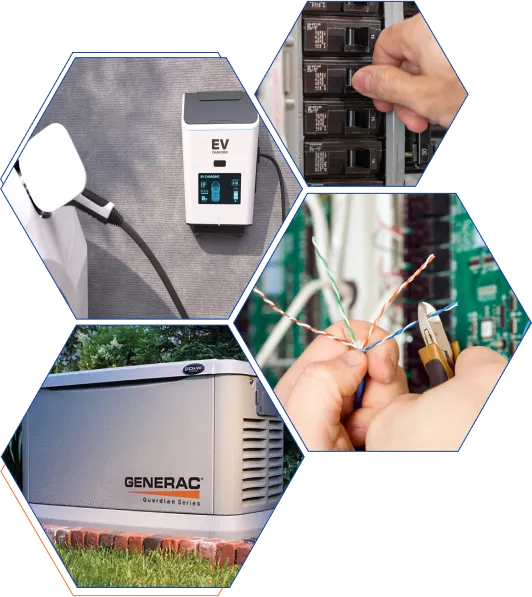
We handle everything from emergency electrical repair and circuit and panel repairs to full inspections, home generator installation, and panel upgrades for houses whose electrical systems have simply outgrown their original setup. If your outage traces back to the utility side of the meter, we’ll tell you that too, rather than billing you for work that isn’t ours to do. When your house has no power and the basic checks haven’t fixed it, call (440) 253-0332 or schedule a diagnostic visit online and let a professional find the answer instead of another guess.
Sources
- Ready
- What to do to protect yourself during a power outage | CDC
- How to protect your health in a power outage | Harvard Health
FAQ
What does it mean if only part of my house loses power?
A partial power outage usually points to a single tripped breaker, a tripped GFCI feeding several outlets, or in split-phase panels, a lost service leg that knocks out half the house while the other half stays on. Anything beyond a simple breaker or GFCI reset should go to a professional.
Why is my power off when everyone else on the block has power?
If your house has no power but the neighborhood is lit up, the cause is inside your home’s electrical system, not the utility grid. Start with your main panel and GFCI outlets before assuming anything more serious is wrong.
How long can food safely sit in the fridge during an outage?
An unopened refrigerator keeps food safe for about 4 hours, while a full freezer holds temperature for up to 48 hours. Use a thermometer to confirm food hasn’t reached 40°F or higher before deciding what to keep.
What should I have on hand in case my house loses power again?
Keep a flashlight, battery-backed carbon monoxide detector, a thermometer for your fridge and freezer, a phone charger with backup battery power, and a written list of your circuit breakers and what they control. Households with critical medical equipment should also have a backup power plan worked out in advance.
Can a single overloaded appliance cause my whole house to lose power?
A single overloaded circuit typically trips only the breaker connected to that specific area, not the whole house. If your entire home has no power at once, the more likely cause is the main breaker or a problem at the panel or service connection itself.