
Electrical project work means any paid repair, installation, upgrade, inspection, or emergency service performed on your home or business by a trained professional, from swapping a breaker to installing a whole-home generator. If you’re facing anything beyond a light bulb change, the safe move is calling a professional before you touch a panel or open a junction box. Tri-County Services Electric & Plumbing handles these jobs across Northeast Ohio; reach the office at (440) 253-0332.
TL;DR:
- Most electrical projects require permits and inspections, especially for panel upgrades, rewiring, and new circuits, to ensure safety and code compliance.
- Properly vetting contractors involves confirming license, insurance, permit handling, detailed scope, load calculations, and comparing multiple bids to avoid hidden costs.
- Project timelines range from a few hours for simple outlet swaps to several days for generator installations, with costs varying based on region, project scope, and existing home infrastructure.
- Energy efficiency upgrades, like LED lighting and modern panels, enhance long-term savings and support smart systems, but should be integrated into planning from the start.
- Local experience and familiarity with regional codes, inspections, and utility coordination are crucial for smooth, compliant, and timely electrical work.
Table of Contents
- What Does Electrical Project Work Actually Include?
- Why Shouldn’t I Just DIY This Myself?
- How Do I Vet and Hire an Electrical Contractor?
- How Long Do Electrical Projects Take and What Do They Cost?
- Why Do Permits and Utility Coordination Matter?
- What Should I Expect on Job Day?
- Which Electrical Codes and Standards Apply to My Project?
- How Do Energy Efficiency Goals Factor Into Electrical Work?
- What Materials and Equipment Show Up on a Typical Job?
- How Should Planning and Design Work Before the Crew Arrives?
- What Troubleshooting Steps Do Electricians Use on the Job?
- How Is Finished Electrical Work Tested and Verified?
- The Local Advantage Nobody Talks About Enough
- Ready to Get Your Electrical Project Done Right?
- Sources
- FAQ
What Does Electrical Project Work Actually Include?
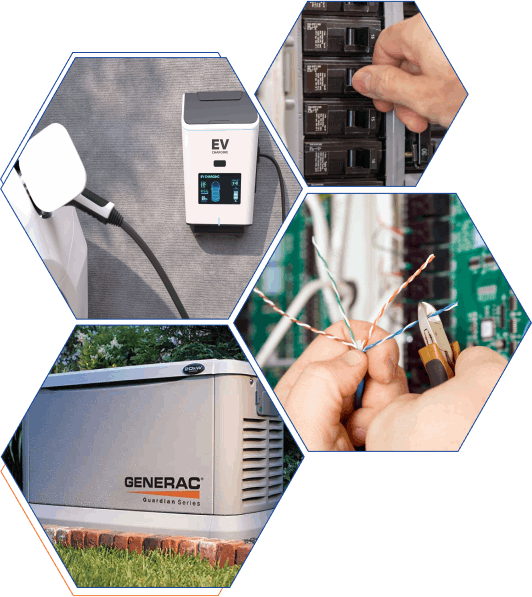
Most projects fall into a handful of categories, and knowing which one you’re dealing with helps you scope the job correctly before you call anyone.
- Panel and service upgrades for homes outgrowing their electrical capacity
- New circuits for kitchens, garages, workshops, or additions
- EV charger installation, often paired with a panel capacity check
- Standby generator hookups, which sometimes involve coordinating a fuel line
- Whole-home surge protection to guard appliances and electronics
- Lighting and control upgrades, from recessed fixtures to smart switches
- Rewiring for older homes with outdated or damaged wiring
- Emergency repairs, like a dead circuit or a tripped main breaker that won’t reset
Small fixture swaps rarely need a permit. Panel work, new circuits, and rewiring almost always do. Some jobs, like a generator that needs a fuel hookup, cross into plumbing territory too. Tri-County Services Electric & Plumbing handles both trades under one roof, which cuts out the back-and-forth of scheduling two separate companies.
Why Shouldn’t I Just DIY This Myself?
Electrical work carries risks that aren’t obvious until something goes wrong: electrocution, house fires from loose connections, improper grounding that damages appliances, and hidden wiring faults that surface months later behind a wall. None of these show up on a quick visual check.
The Electrical Safety Foundation International recommends hiring a qualified electrician for home electrical work rather than attempting it yourself, and its guidance lays out the precautions, GFCI protection, proper PPE, confirming power is fully off, that most DIYers skip entirely. A wrong assumption about which breaker feeds which circuit is a common and dangerous mistake.
Pro Tip: If you smell burning plastic, see scorch marks near an outlet, or notice a breaker that trips more than once in a day, stop using that circuit and call a professional immediately rather than resetting it again.
Watch for these warning signs that mean it’s time to call, not troubleshoot:
- Sparks when plugging in or unplugging a device
- A persistent burning or hot plastic smell near outlets or the panel
- A panel that feels warm to the touch
- Exposed or frayed wiring anywhere in the home
- A breaker that trips repeatedly within the same day
How Do I Vet and Hire an Electrical Contractor?
Hiring the right contractor comes down to a handful of checks most homeowners skip because they’re in a hurry. Slow down here. It’s the part of the process that determines whether the job gets done right the first time.
- Confirm active licensing and business standing. A legitimate contractor should have no problem sharing this, and you can often verify it independently.
- Check insurance coverage. Ask for proof of general liability and workers’ comp. If a worker gets hurt on your property and the contractor isn’t covered, you could be on the hook.
- Ask who pulls the permit. A reputable contractor pulls permits themselves and handles inspection rework at no extra cost if the issue was within their original scope, according to Proven Pros’ hiring guide.
- Request an itemized written scope. This should list equipment models where relevant, a timeline, warranty terms, and a clear payment schedule, not just a single lump-sum number.
- Ask for load calculations on panel work. A contractor sizing a new panel or service should be running NEC 220-style load calculations, not guessing based on square footage.
- Collect at least three written bids and normalize the scope across them before comparing price, since ElectrifyCost’s guide to vetting contractors notes that low quotes often hide missing scope items like disposal fees or permit costs.
Red flags worth walking away from: cash-only payment demands, a contractor who suggests skipping the permit, high-pressure sales tactics, requests for full payment upfront, or a quote that’s a single vague line item. You can also check public permit records in your area to confirm a contractor actually has a job history doing the type of work you need.
How Long Do Electrical Projects Take and What Do They Cost?
Timelines vary more by project type than almost anything else. A single outlet repair or fixture swap usually wraps up in a few hours. Panel upgrades typically take a full day on-site, plus additional time if the utility needs to schedule a disconnect and reconnect. Generator installations run multiple days, since they involve electrical, sometimes gas or fuel line work, and a concrete pad.
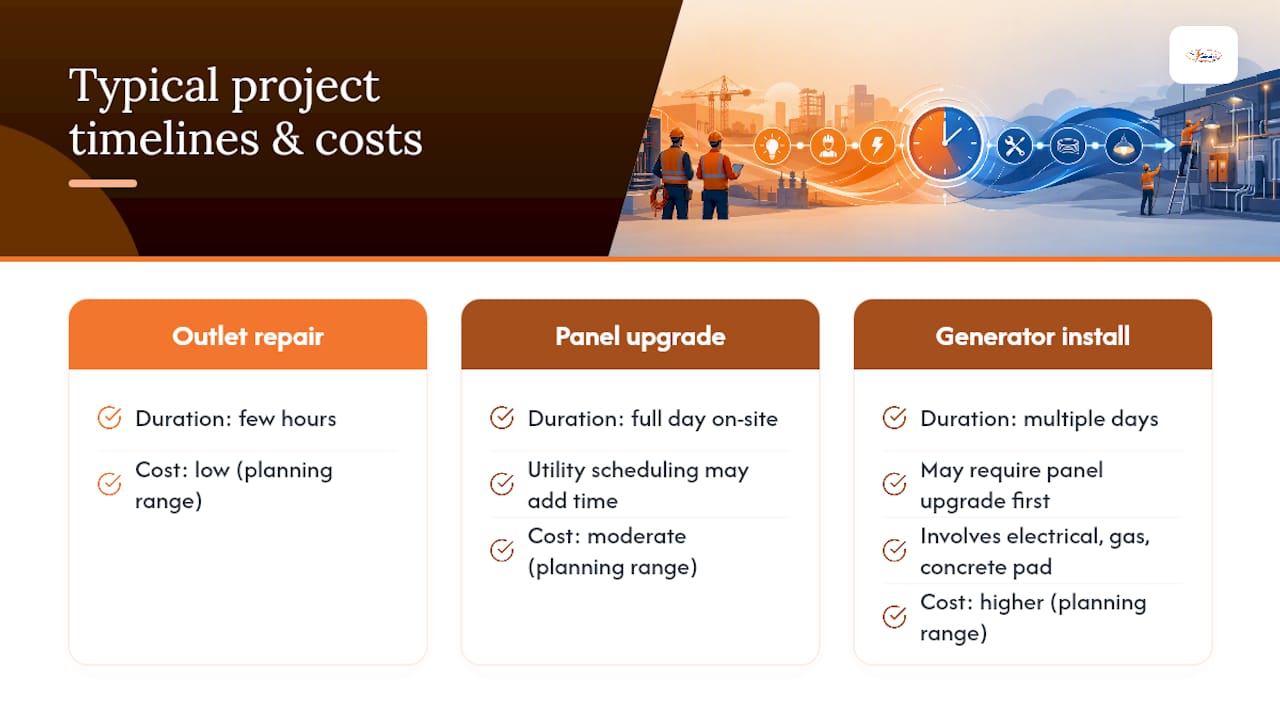
Cost bands vary widely by region, panel size, home age, and site accessibility, so treat any number as a planning range rather than a quote. HireLocal’s comparison of generator and panel projects notes that a panel upgrade is frequently a prerequisite for a generator install, since older panels often lack the capacity to handle a transfer switch safely. That sequencing affects both your timeline and your total spend.
Run a planning estimate before you start collecting bids. It gives you a sanity check against outlier quotes, whether unusually low or suspiciously high, and helps you spot when a bid is missing scope rather than just being a better price.
Why Do Permits and Utility Coordination Matter?
Panel changes, service upgrades, new circuits, and rewiring almost always require a permit and a follow-up inspection in nearly every jurisdiction. Skipping this step isn’t just a paperwork shortcut. It can void your homeowner’s insurance coverage on that work and create real problems if you sell the property later.
A contractor handling the job correctly will:
- Pull the permit before work begins, not after
- Schedule the required inspection once work is complete
- Coordinate with the utility for any disconnect or reconnect needed on service upgrades
- Address any inspector flags at no additional charge if the fix falls within the original scope
Keep copies of permits, inspection sign-offs, and warranty paperwork with your other home records. Buyers and their inspectors ask about permit history on major electrical work, and having it on hand avoids delays during a sale. It also protects you if a manufacturer warranty on equipment like a generator or panel ever needs to be invoked.
What Should I Expect on Job Day?
A well-run crew typically includes a supervising electrician overseeing one or more apprentices or helpers, with a single point of contact for questions. You shouldn’t have to track down different people for updates.
Expect basic site protection: drop cloths in work areas, cords routed to avoid trip hazards, and cleanup before the crew leaves each day. If something changes mid-project, like discovering outdated wiring behind a wall, that should generate a documented change order with a price before the work proceeds, not a surprise on the final invoice.
Ask upfront how to raise a concern if something feels off during the job, and confirm what the warranty covers once the work is signed off. A final walkthrough with inspection paperwork in hand is a normal part of closeout, not an extra step you have to request.
Which Electrical Codes and Standards Apply to My Project?
The National Electrical Code (NEC) sets the baseline safety standard for wiring methods, panel capacity, grounding, and circuit protection across the country, and it gets updated on a three-year cycle. Local jurisdictions in Northeast Ohio adopt a version of the NEC and then layer on their own amendments, so a rule that applies in one township might differ slightly in the next city over.
This matters more than most homeowners realize. A contractor working outside your area might not know your city’s specific amendments around things like arc-fault breaker requirements or outdoor outlet spacing. That’s part of why local experience carries real weight, a contractor who’s pulled permits in your municipality before already knows what the inspector will flag.
Code compliance isn’t optional and it isn’t negotiable on price. An electrician cutting corners to save you money on a bid is setting you up for a failed inspection, a costly rework, or worse, a fire hazard that doesn’t show up until years later. If your home has aluminum wiring, knob-and-tube remnants, or a panel older than 25 years, code compliance work often means bringing multiple systems up to current standard at once rather than patching one issue in isolation. That’s a bigger job than it sounds like on paper, and it’s exactly the kind of work that needs a written scope and a load calculation before anyone starts pulling wire.
Local code corrections are a common and often overlooked part of larger renovation projects, especially in older homes where a previous owner or a past contractor took shortcuts.
How Do Energy Efficiency Goals Factor Into Electrical Work?
Electrical project work increasingly overlaps with energy efficiency goals, and it’s worth thinking about upgrades in that context rather than treating each project as isolated. Switching to LED fixtures during a lighting upgrade, for instance, cuts long-term energy draw compared to older incandescent or fluorescent setups, and it reduces heat output, which matters for HVAC load in the summer.
Panel upgrades open the door to efficiency gains too. A modern panel with adequate capacity supports smart thermostats, EV charging on a dedicated circuit instead of a shared one, and whole-home surge protection that extends the lifespan of efficient appliances by preventing damage from voltage spikes. None of that works well on an undersized or outdated panel.
Timers and occupancy sensors on lighting circuits are a low-cost add during any rewiring or new-circuit project, and they pay for themselves through reduced runtime on lights left on in unused spaces. If you’re already having a contractor open up walls or upgrade a panel, that’s the moment to ask about efficiency add-ons, since retrofitting them later means paying for a second service call and a second round of labor.
Commercial properties see this even more directly. Older commercial buildings often run inefficient lighting and outdated distribution panels that waste energy around the clock, and property managers dealing with commercial electrical systems frequently find that efficiency upgrades pay back faster than expected once you account for the building’s operating hours.
What Materials and Equipment Show Up on a Typical Job?
The materials on an electrical job depend heavily on the project, but a few categories show up again and again. Copper and aluminum wiring, sized to the circuit’s amperage, form the backbone of any installation. THHN and NM-B (Romex) are common conductor types for residential branch circuits, while commercial work more often involves conduit, either EMT or rigid, to protect wiring runs.
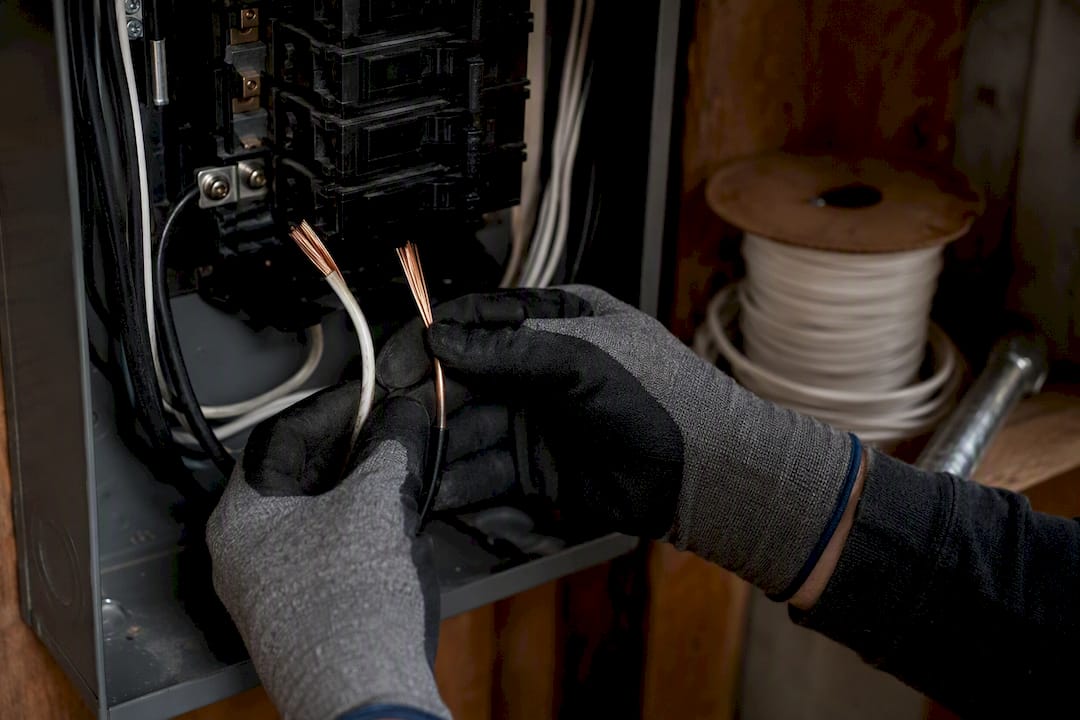
Panels themselves range from 100-amp service for smaller homes to 200-amp or higher for larger properties and homes adding EV charging or a generator. Breakers, whether standard, GFCI, or AFCI depending on the circuit’s use, get sized to match both the wire gauge and the load calculation.
For generator installations, expect a transfer switch, which is the component that safely isolates your home’s circuit from the utility grid during an outage so power doesn’t backfeed into the lines. EV charger installs typically involve a dedicated circuit, often 240-volt, sized to the charger’s amperage draw, plus a disconnect switch depending on local code. Surge protection equipment installs at the panel level to guard the whole home rather than relying on individual power strips.
None of this is a shopping list you hand to a contractor. It’s context that helps you understand why one bid quotes different equipment than another, and why a rock-bottom price sometimes means a rock-bottom breaker box.
How Should Planning and Design Work Before the Crew Arrives?
Good electrical work starts on paper, not with a drill. The planning phase begins with an assessment of your current system: panel capacity, wiring condition, and what the project needs to support, whether that’s a new addition, an EV charger, or a generator.
From there, a contractor should walk through load calculations to confirm the existing panel can handle added demand, or determine that an upgrade comes first. This is the step that gets skipped by less careful contractors and causes problems down the line, like a generator that can’t actually run the circuits it’s supposed to back up.
Design decisions also cover circuit routing, where new outlets or fixtures make sense relative to existing walls and framing, and how to minimize disruption to finished spaces. For a kitchen remodel or a commercial buildout, this planning phase often happens in coordination with other trades, since electrical rough-in usually needs to happen before drywall goes up.
A clear scope document should come out of this phase before any work begins: what’s being installed, where, with what equipment, and on what timeline. Skipping this step is how homeowners end up with change orders and cost overruns midway through a project.
What Troubleshooting Steps Do Electricians Use on the Job?
When something isn’t working right, whether it’s a dead outlet, a tripping breaker, or flickering lights, a professional follows a systematic process rather than guessing. It usually starts with isolating the circuit: confirming which breaker feeds the affected area and checking whether the issue is at the panel, along the wiring run, or at the fixture itself.
A multimeter is the standard tool for checking voltage, continuity, and confirming a circuit is actually dead before anyone touches a wire. For intermittent issues, like a light that flickers only sometimes, technicians look at loose connections at the breaker, the outlet, or wire nuts inside a junction box, since a poor connection generates heat and resistance that shows up as flickering before it becomes a bigger problem.
Repeated breaker trips get diagnosed by checking for overloaded circuits, short circuits, or ground faults, each of which has a different fix. An overloaded circuit might just need load redistribution. A short or ground fault means finding and repairing damaged insulation or a faulty device.
This is exactly the kind of diagnostic work that separates a professional from a well-intentioned homeowner with a screwdriver. A DIYer can often tell something is wrong, but pinpointing where and why usually requires tools and testing knowledge that most households don’t have on hand, and getting it wrong risks masking a real fire hazard instead of fixing it.
How Is Finished Electrical Work Tested and Verified?
Once the work itself wraps up, testing confirms it was done correctly before anyone calls the job finished. This isn’t optional, and it isn’t the same as a quick visual check.
Standard verification steps include:
- Testing every new outlet and switch for proper function and correct polarity
- Checking GFCI and AFCI breakers to confirm they trip correctly when tested
- Verifying voltage at the panel and at new circuits matches the expected values
- Confirming grounding is intact throughout the system
- Running a load test on generator transfer switches to confirm proper operation during a simulated outage
For permitted work, a local inspector performs a separate verification before the job is officially closed out, checking the installation against code requirements independent of the contractor’s own testing. This is the step that gives you, as the homeowner, third-party confirmation that the work meets safety standards rather than just taking the contractor’s word for it.
Once testing and inspection are complete, you should receive documentation: the permit closeout, any warranty paperwork, and ideally a summary of what was installed. Keep this with your other home records. It’s proof the work was done to code, and it matters if you ever sell the property or need warranty service down the road.
The Local Advantage Nobody Talks About Enough
Homeowners fixate on price when comparing bids, but the harder-to-quantify factor is whether a contractor actually knows your area. Tri-County Services Electric & Plumbing has been family-owned in Northeast Ohio since 1975, which means decades of pulled permits, inspector relationships, and utility coordination specific to this region. That history matters when an inspector flags something unusual or a utility disconnect needs scheduling on short notice. Combined electrical and plumbing capability also removes a real friction point on jobs like generator fuel hookups, where coordinating two separate companies often adds delay and confusion neither homeowner asked for.
— Lindsay Paramore
Ready to Get Your Electrical Project Done Right?
You’ve seen what separates a safe, code-compliant job from a shortcut that costs more later, permits, load calculations, itemized scopes, and a contractor who actually knows your municipality’s inspectors. Tri-County Services Electric & Plumbing brings that local track record to every job in Northeast Ohio, backed by decades of experience since 1975.

Whether you need a panel upgrade or circuit repair, EV charger installation, a standby generator, surge protection, or general electrical repair, our technicians pull the permits, run the load calculations, and hand you a written scope before work starts. We also handle plumbing, so a project that touches both trades doesn’t mean juggling two separate companies and two separate schedules. Flexible scheduling means less disruption to your home or business while the work gets done.
Call (440) 253-0332 to talk through your project and get a written estimate, or check out our code correction services if you’re dealing with an older home that needs work brought up to current standards.
Sources
- Do-it-yourself (DIY) electrical safety · ESFI
- How to hire an electrician the safe way · Proven Pros
- How to Vet a Contractor & Compare Bids (2026) · ElectrifyCost
- Generator vs Panel Upgrade: Which Electrical Project Comes First? — Who to call | HireLocal
FAQ
What Counts as Electrical Project Work?
It covers paid residential and commercial electrical jobs, repairs, installations, upgrades, inspections, and emergency service, performed by a professional rather than a DIY attempt.
Do I Need a Permit for a Panel Upgrade?
Yes, panel and service upgrades almost always require a permit and inspection in nearly every jurisdiction, and a contractor who suggests skipping this step is a red flag.
How Many Bids Should I Get Before Hiring an Electrician?
Get at least three written, itemized bids and normalize the scope across them before comparing price, since low quotes often omit items like permits or disposal fees.
Can Tri-County Services Electric & Plumbing Handle Both Electrical and Plumbing Work?
Yes, Tri-County Services Electric & Plumbing offers both trades, which helps on combined jobs like generator fuel hookups that would otherwise require coordinating two separate companies.
How Long Does a Typical Generator Installation Take?
Generator installs generally run multiple days, since they often involve electrical work, fuel or gas line coordination, and sometimes a panel upgrade if existing capacity is insufficient.
Recommended
- 10 Reasons To Hire Professional Electrician Services | Tri-County
- Best Electrical Services For Home Upgrades In 2026
- Electrical Repair Service Licensed Electricians Near You
- Your Backyard Deserves An Upgrade: Outdoor Electrical Improvements That Transform Your Outdoor Living Space | Tri-County Electric Service