

TL;DR:
- A camera inspection is the most critical step before sewer line replacement, often saving significant costs.
- Northeast Ohio homeowners should seek professional evaluations, understand local costs, and demand proper inspection and permits.
If you suspect your sewer lateral needs replacing, the single most important move you can make right now is to call a professional plumbing contractor and schedule a camera inspection before agreeing to any excavation. A video scope typically costs $150-$400 and can be the difference between a $1,500 spot repair and a $12,000 full replacement. Tri-County Services Electric & Plumbing serves homeowners across the Cleveland-Akron area and starts every sewer evaluation with a camera scope, not a shovel.
Typical Northeast Ohio cost ballpark before a site visit:
- Minor spot repair or hydro-jetting: $500–$2,000
- Trenchless CIPP lining or pipe bursting: $4,000–$12,000
- Full open-trench replacement (30–80 ft): $5,500–$15,000+
Your immediate next steps:
- Stop using affected drains if sewage is surfacing or backing up into the home
- Document symptoms with dates, photos, and notes on any recent landscaping or tree work
- Schedule a professional camera scope before accepting any quote for full replacement
- Demand these trust signals in every bid: video camera evidence, a permit pull with municipal inspection before backfill, and a written, itemized estimate that includes restoration costs
Pro Tip: Never accept a replacement quote from a contractor who has not shown you the camera footage. A reputable pro will walk you through the video and explain exactly what they found before recommending a method.
Table of Contents
- What are the signs your sewer lateral is failing?
- What causes sewer lines to fail in Northeast Ohio?
- How do professionals diagnose the problem?
- What does a new sewer line cost in Northeast Ohio?
- Trenchless vs. traditional replacement: which method fits your situation?
- What to expect during installation: a step-by-step timeline
- Which pipe materials last the longest?
- Permits, inspections, and your responsibilities as a homeowner
- How to choose the right contractor for sewer line work
- Why calling a professional first is the right move
- Key Takeaways
- What most homeowners get wrong about sewer line replacement
- Tri-County Services Electric & Plumbing: sewer line help for Northeast Ohio homeowners
- Useful sources and local references
- FAQ
What are the signs your sewer lateral is failing?
A single slow drain in one bathroom is almost always a localized clog. The lateral becomes the suspect when multiple fixtures fail at the same time or in sequence. That distinction matters because the fix is completely different.
Watch for these patterns across your home:
- Backups occurring in two or more fixtures simultaneously (toilet, tub, and floor drain backing up together)
- Slow drains throughout the house, not just in one room
- Sewage odors in the basement, crawl space, or yard
- Soggy, unusually green, or sunken patches of lawn along the path of the buried line
- Gurgling sounds from toilets or floor drains when you run water elsewhere
- Sewage surfacing in the yard or near the foundation cleanout
When symptoms overlap across fixtures, the problem is almost certainly in the main lateral, not a branch line. A single gurgling toilet after a heavy rain is not the same as three drains backing up every time you run the washing machine.
Stop DIY attempts the moment sewage surfaces outside or you smell sewer gas indoors. Repeated professional cleanings that clear the line for only a few weeks before it backs up again are another clear signal that the pipe itself has failed structurally. At that point, calling a professional plumber is the only path forward.
Pro Tip: Before the technician arrives, write down the dates of every backup, any recent tree removal or landscaping work, and whether a neighbor’s line was recently serviced. That timeline helps the technician pinpoint cause faster and can establish whether a third party’s utility work contributed to the damage.
What causes sewer lines to fail in Northeast Ohio?
Northeast Ohio has a specific combination of soil conditions, pipe inventory, and climate that makes sewer lateral failures more common here than in warmer, drier regions. Understanding the local causes helps you anticipate which repair method your contractor is likely to recommend.
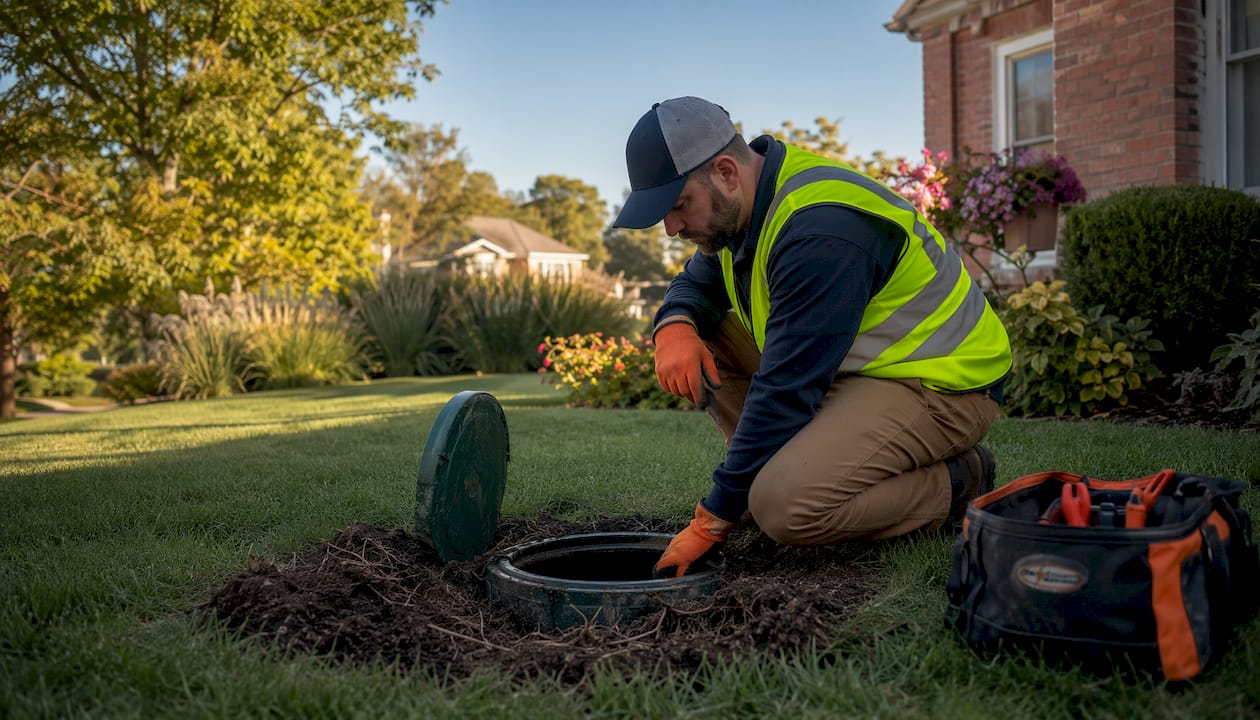
Tree root intrusion is the most common cause across the region. Roots follow moisture and will exploit the smallest crack or imperfect joint in older clay or cast-iron pipe. Once inside, they expand with the pipe’s seasonal temperature changes, trap debris, and eventually block flow entirely. Mature oaks, maples, and willows common in older Cleveland-area neighborhoods are frequent offenders.
Aging pipe materials are the second major factor. Homes built before 1970 in this region commonly have:
- Clay tile pipe: brittle, prone to root intrusion at joints, and susceptible to cracking under soil movement
- Cast-iron pipe: corrodes from the inside out over decades; tuberculation narrows the bore and eventually causes collapse
- Orangeburg pipe: a compressed wood-fiber and tar product installed from the 1940s through the 1960s that absorbs moisture, deforms, and loses structural roundness over time, making it incompatible with trenchless lining methods
Freeze-thaw cycles and frost depth are a Northeast Ohio-specific hazard. In colder climates like ours, sewer lines must be buried deep enough to avoid freeze-thaw damage, and lines installed at insufficient depth or with poor bedding are vulnerable to heaving and offset joints every winter. Soil shifting from repeated freeze-thaw cycles creates bellies (low sags in the pipe) that trap solids and cause chronic backups.
Human activity rounds out the list. Heavy driveways added over an existing lateral, home additions that changed drainage loads, and nearby utility excavations can all crack, offset, or crush a buried pipe without any visible surface sign for years.
How do professionals diagnose the problem?
The diagnostic sequence matters as much as the repair itself. A contractor who skips straight to a replacement quote without camera evidence is not doing their job.
Camera (CCTV) sewer inspection
A video camera inspection pushes a high-definition camera through the lateral from a cleanout or pulled toilet, transmitting live footage of the pipe’s interior. The technician can see cracks, offset joints, root intrusion, bellies, collapsed sections, and grease buildup in real time. That footage determines whether the problem is a localized section (candidate for spot repair or CIPP lining) or a systemic failure requiring full replacement. Camera inspections typically cost $150–$400.
Line locating and depth verification
After scoping, the technician uses an electronic locator to trace the camera’s transmitter signal, marking the lateral’s path and depth on the surface. In Northeast Ohio, knowing the depth is critical for two reasons: frost depth affects minimum burial requirements, and depth determines whether trenchless access pits are feasible or whether a full open trench is necessary.
When hydro-jetting is the right call
Hydro-jetting uses high-pressure water to clear soft blockages, grease accumulation, and early-stage root intrusion from a structurally sound pipe. It is the correct response when the camera shows an intact pipe with a soft obstruction. When the camera reveals cracked pipe walls, offset joints, or a collapsed section, hydro-jetting clears the symptom without addressing the structural failure underneath.
What does a new sewer line cost in Northeast Ohio?
Cost varies significantly based on length, depth, surface type, and method. The per-foot ranges for 2026 give a starting point, but restoration and permit costs are where final project prices diverge most.
Key cost drivers:
- Lateral length and depth (longer and deeper = more labor and material)
- Surface type: lawn restoration is cheapest; driveway or concrete cutting adds $2,000–$8,000
- Pipe material and diameter
- Municipal right-of-way work and any required traffic-control plans
- Permit fees, which commonly range from about $50 to several hundred dollars, plus right-of-way or street-cut bonds that can add $1,000–$3,500 in some urban cases
- Soil conditions (rock, high water table, or unstable fill adds excavation time)
Typical Northeast Ohio scenario ranges:
| Scenario | Typical Range | Notes |
|---|---|---|
| Short lateral, 30–50 ft, lawn-only restoration | $5,500–$15,000+ | Most common; rear or side yard |
| Standard lateral, 50–80 ft, mixed restoration | $7,500–$12,000 | Front yard with sidewalk patch |
| Long run or driveway crossing, 80+ ft | $5,500–$15,000+ | Includes asphalt/concrete cut-and-patch |
| Trenchless CIPP or pipe bursting (30–80 ft) | $4,000–$12,000 | Lower total cost when hardscape is involved |
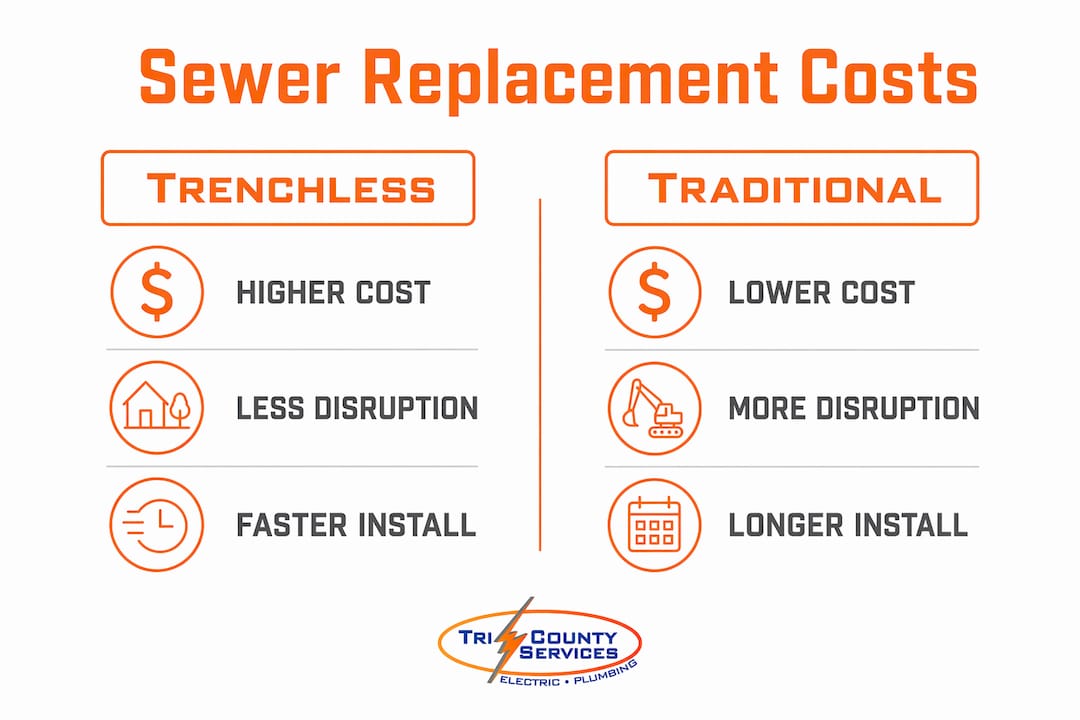
Trenchless methods often cost more per foot than open-trench excavation, but they typically avoid the $2,000–$8,000 in landscaping and hardscape restoration that traditional trenching incurs. On a job with a driveway or patio over the run, trenchless frequently produces a lower total project cost despite the higher per-foot labor rate.
Trenchless vs. traditional replacement: which method fits your situation?
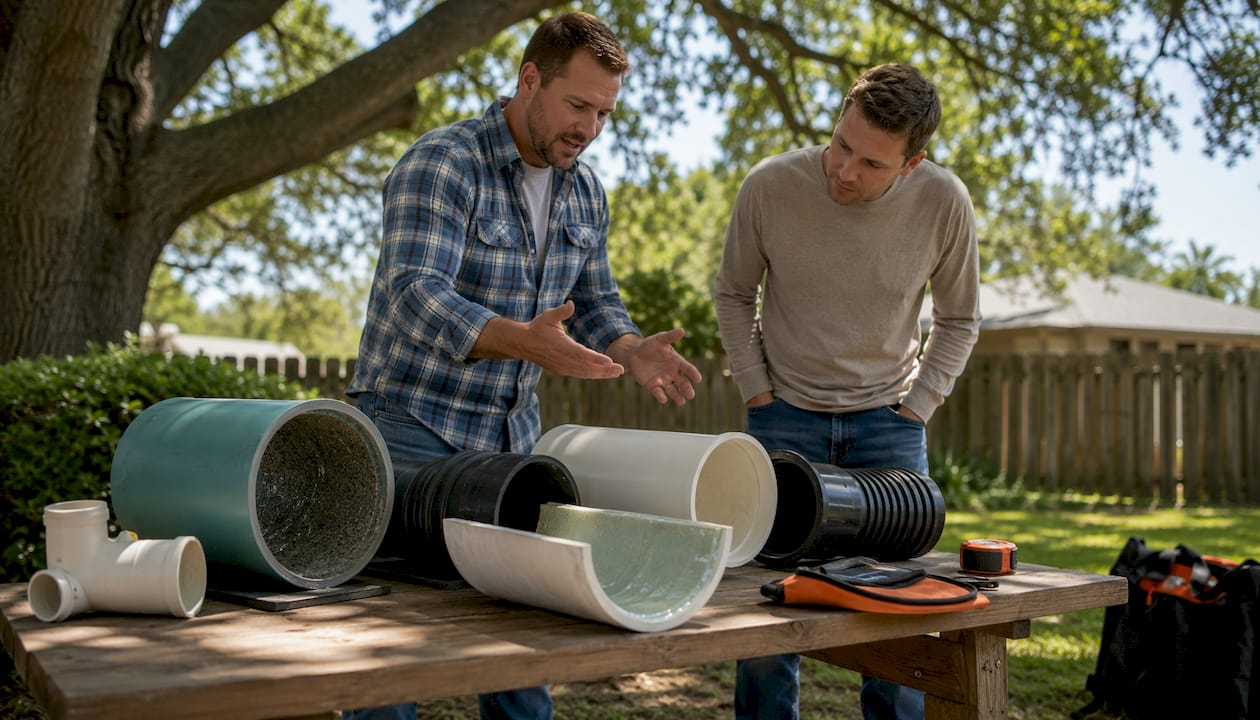
The right method depends entirely on what the camera shows, not on which method the contractor prefers. Here is how the four main options compare.
| Method | Typical cost (low–high) | Property disruption | Timeline | Expected lifespan | Best for |
|---|---|---|---|---|---|
| CIPP lining | — | Minimal: 1–2 small access pits | 1–2 days | 40–50 years | Root intrusion, cracks, minor offsets in structurally intact host pipe |
| Pipe bursting | — | Minimal: pits at each end | 1–2 days | 50–100 years (HDPE) | Collapsed or root-invaded pipe; allows upsizing from 4″ to 6″ |
| Spot repair | $500–$3,000 per section | Small excavation at failure point | Half to 1 day | Matches new pipe material | Isolated crack or offset in otherwise sound lateral |
| Open-trench replacement | — | Full trench along entire run | 2–5 days | 50–100 years (PVC/HDPE) | Fully collapsed lateral, Orangeburg, severe misalignment |
CIPP (cured-in-place pipe) lining pulls a resin-saturated liner into the existing pipe and cures it in place, creating a smooth new pipe within the old one. It requires no major excavation and works well on cracked clay or cast-iron laterals with intact geometry. It cannot be used on Orangeburg that has lost its round shape or on fully collapsed sections.
Pipe bursting pulls a new HDPE pipe through the old line while simultaneously fracturing the host pipe outward. It can upsize from 4″ to 6″ in a single pull and handles collapsed or root-invaded pipe that CIPP cannot line. Two small access pits at each end are all the excavation required.
Spot repair makes sense when the camera identifies one discrete failure in an otherwise sound lateral. Excavating only the damaged section keeps cost and disruption low.
Open-trench replacement remains the only option when the host pipe is fully collapsed, severely misaligned, or made of Orangeburg that has deformed beyond round. It gives the contractor direct access for bedding verification and slope correction, which matters on older installations where the original grade was never right.
What to expect during installation: a step-by-step timeline
Knowing the sequence prevents surprises and helps you prepare your property.
The installation process, from first call to final walkthrough:
- Site visit and camera scope — the technician scopes the line, locates it, and documents findings on video before any quote is issued
- Permit pull and OUPS 811 locate — the contractor files for the required municipal permit and submits an 811 ticket at least 48 hours before breaking ground; no reputable contractor digs without a clear locate
- Method selection and written quote — based on camera findings, the contractor recommends CIPP, pipe bursting, spot repair, or open-trench and provides a written, itemized estimate
- Excavation or trenchless mobilization — for open-trench work, the route is marked and trenched to the required depth; for trenchless, access pits are dug at each end
- Bedding and pipe installation — new pipe is bedded in compacted sand or pea gravel graded at 1/4 inch per linear foot for gravity flow; slope is verified with a laser level before pipe is laid
- Pressure or air test — the new line is tested for leaks and documented in writing for the inspector
- Camera verification before backfill — a full-length camera walk of the new lateral confirms slope, joint integrity, and absence of debris; footage is delivered to the homeowner
- Municipal inspection — the inspector signs off on the open trench before backfill; most jurisdictions require an on-site visit
- Backfill, compaction, and restoration — backfill in 12-inch compacted lifts; lawn, concrete, or asphalt restored per the contract scope
- Final walkthrough and documentation — homeowner receives permit sign-off, camera footage, and written workmanship/material warranty
Realistic timelines: A trenchless CIPP or pipe-bursting job on a straightforward 40–60 ft lateral typically runs 1–2 days on site. Open-trench replacement of the same run takes 2–5 days. Add 3–7 business days of lead time for the permit and 811 locate before any crew arrives.
A properly bedded pipe graded at 1/4 inch per foot will drain reliably for decades. A bellied pipe caused by poor bedding will back up regardless of pipe material and costs more to rework than the original install.
Which pipe materials last the longest?
Modern sewer pipe materials have dramatically longer service lives than the clay, cast iron, and Orangeburg they replace.
PVC (SDR-26 and SDR-35) is the standard for residential lateral replacement in Ohio. SDR-26 is the heavier-wall variant used for deeper trenches and driveway crossings; SDR-35 is standard wall for routine residential installs. Both meet Ohio Plumbing Code requirements, use rubber-gasket or glued joints that resist root intrusion, and carry a design life of 50–100 years. The Uni-Bell PVC Pipe Association’s installation guide specifies ASTM D3034 as the governing standard for all diameters from 3″ through 60″.
HDPE is the material of choice for pipe bursting and horizontal directional drilling. Its butt-fusion or electrofusion joints create a seamless, monolithic connection stronger than the pipe wall itself, making it completely impervious to root intrusion. Design life is also 50–100 years.
CIPP epoxy liner creates a new pipe within the old host pipe. Typical service life is 40–50 years, somewhat shorter than a full PVC or HDPE replacement but often sufficient given the lower disruption and cost.
What to request in your warranty:
- PVC or HDPE replacement: ask for a minimum 1-year workmanship warranty and confirm the pipe material meets ASTM D3034
- CIPP lining: ask for the liner manufacturer’s warranty (typically 10 years on materials) plus the contractor’s workmanship warranty
- Any method: require that the warranty explicitly covers defects in slope and bedding, not just pipe material
Permits, inspections, and your responsibilities as a homeowner
Homeowners are generally responsible for the sewer lateral from their building to the municipal connection point, and work must be permitted and inspected before backfill to avoid forced uncovering later. That last part is worth emphasizing: if a contractor backfills without a municipal inspection sign-off, the city can require the trench to be reopened at the homeowner’s expense.
Documents and approvals to collect and keep:
- Permit receipt showing the permit number and issuing municipality
- Municipal inspection sign-off before backfill (written or stamped)
- Camera footage of the completed lateral before backfill
- Itemized invoice showing method, materials, per-foot costs, and restoration scope
- Written workmanship and material warranty from the contractor
- Any right-of-way encroachment permit if the work extends to the street
Unpermitted sewer work creates two long-term problems. First, your homeowner’s insurance may deny a related claim if the work was not inspected. Second, unpermitted work surfaces during a home sale inspection and can delay or kill a transaction. The permit fee is a small cost relative to those risks.
If the lateral crosses the public right-of-way or ties into the city main in the street, the contractor must also obtain an encroachment permit from the municipality. In some Northeast Ohio cities, street-cut bonds and traffic-control plans add to the project cost, which is why those line items should appear explicitly in any written estimate.
How to choose the right contractor for sewer line work
The cheapest bid is almost never the right bid on a sewer lateral job. A contractor who skips the camera scope, excludes restoration from the quote, or cannot produce a written warranty is passing those costs and risks to you.
Must-ask questions before signing anything:
- Is a camera inspection included, and will you show me the footage before recommending a method?
- Does the written quote itemize method, materials, per-foot cost, restoration, and permit fees separately?
- Do you pull the permit and coordinate the municipal inspection, or is that on me?
- What is your written warranty on workmanship and materials, and does it cover slope and bedding?
- How long have you operated in Northeast Ohio, and can you provide local references?
Red flags to walk away from:
- Contractor refuses to show camera footage or quotes replacement without scoping first
- Large deposit demanded before any diagnostic work is done
- Quote excludes restoration or permits (“we’ll figure that out later”)
- No written warranty offered
- Bid is dramatically lower than others without a clear explanation of what is excluded
Comparing quotes fairly: Normalize every bid to total cost including restoration and permits. A $6,000 trenchless quote that includes driveway restoration is often cheaper than a $4,500 open-trench quote that excludes it. Ask each contractor to confirm in writing what the restoration scope covers.
Pro Tip: When you call for quotes, ask specifically: “Will you pull the permit and coordinate the municipal inspection before backfill?” A contractor who hesitates or says permits are optional is a contractor to avoid.
Why calling a professional first is the right move
Sewer lateral work looks deceptively straightforward from the surface. It is not. Slope, material specification (PVC SDR-26/SDR-35), and proper inspections are technical requirements where mistakes are hidden underground for years before causing structural damage. A DIY attempt that gets the slope wrong by even a fraction of an inch per foot will belly the pipe, trap solids, and produce the same chronic backups the homeowner was trying to fix, plus a rework bill that exceeds the original job.
Tri-County Services Electric & Plumbing approaches every sewer call with a camera-first diagnostic workflow. The technician scopes the line, locates it, documents the footage, and then explains the findings before any method is recommended. That sequence protects homeowners from unnecessary excavation and ensures the repair matches the actual failure mode.
For homeowners in the Cleveland-Akron area, Tri-County Services Electric & Plumbing handles permit coordination, municipal inspection scheduling, and restoration planning as part of the project scope. Before-and-after camera footage, documented slope verification, and a written warranty are standard at closeout. You can learn more about the camera-first diagnostic approach or reach out directly to schedule a scope.
Key Takeaways
A camera inspection before any excavation is the single most important step Northeast Ohio homeowners can take when a sewer lateral problem is suspected, and it typically costs $150–$400.
| Point | Details |
|---|---|
| Camera inspection first | A $150–$400 video scope determines whether spot repair, trenchless lining, or full replacement is needed. |
| Trenchless saves on restoration | CIPP and pipe bursting avoid $2,000–$8,000 in hardscape restoration, often lowering total project cost despite higher per-foot rates. |
| Know the local cost bands | Northeast Ohio full replacement runs $5,500–$15,000+; restoration, permits, and depth are the biggest price variables. |
| Require permits and inspection | Municipal inspection before backfill is non-negotiable; unpermitted work risks insurance denial and resale complications. |
| Tri-County Services Electric & Plumbing | Serves Cleveland-Akron homeowners with camera-first diagnostics, permit coordination, and written warranties on every sewer lateral job. |
What most homeowners get wrong about sewer line replacement
The conventional wisdom on sewer line replacement tends to frame the decision as a simple cost comparison between trenchless and open-trench. That framing misses the more important question: does the camera footage actually support the method being quoted?
Plenty of homeowners in Northeast Ohio have paid for CIPP lining on a lateral that turned out to be Orangeburg, only to discover the liner could not bond to a host pipe that had already lost its round shape. Others have paid for full open-trench replacement on a lateral where a pipe-bursting job would have cost less and finished in a day. The method mismatch almost always traces back to a contractor who skipped or rushed the camera scope.
The other thing homeowners consistently underestimate is the restoration cost. A $7,000 open-trench quote that excludes the driveway patch is not a $7,000 job. The concrete or asphalt work alone can add $3,000–$5,000, and that number rarely appears in the initial bid unless you ask for it explicitly. Trenchless methods look expensive per foot right up until you add the restoration line item to the open-trench alternative.
Northeast Ohio’s specific pipe inventory (clay, cast iron, and Orangeburg are all common in pre-1970 homes) means the diagnostic step is not a formality. It is the decision point. Get the camera footage, understand what it shows, and then evaluate methods. That sequence produces better outcomes than any rule of thumb about which method is “usually” cheaper.
Tri-County Services Electric & Plumbing: sewer line help for Northeast Ohio homeowners
When your sewer lateral needs attention, you want a contractor who starts with a camera, not a backhoe. Tri-County Services Electric & Plumbing has served Northeast Ohio homeowners since 1975, and the sewer and drain services the team provides cover the full range: camera inspections, hydro-jetting, trenchless method coordination, full open-trench replacement, permit handling, municipal inspection coordination, and restoration management. You get one point of contact from the first scope to the final walkthrough.

Every job includes a written, itemized estimate before work begins, camera footage at closeout, and a documented warranty on workmanship and materials. Scheduling is flexible and designed to minimize disruption to your property and daily routine. Call (440) 325-0136 or book online at tricountyelectricservice.com to schedule your camera inspection or request a quote. The sooner the line is scoped, the sooner you know exactly what you are dealing with and what it will cost.
Useful sources and local references
- Northeast Ohio municipal sewer permit contacts: Check your city or township’s building department for permit applications; most Northeast Ohio municipalities require a permit before any work outside the building foundation. Cleveland, Akron, and Canton all have online permit portals.
- Ohio 811 (OUPS): Call 811 or visit ohio811.org at least 48 hours before any digging to have underground utilities marked.
- Union Sanitary District homeowner brochure: Practical guidance on sewer lateral repair and replacement, contractor selection, and permit requirements.
- Uni-Bell PVC Pipe Association installation guide: Technical reference for PVC SDR-26/SDR-35 installation standards (ASTM D3034).
- JMJ Plumbing: slope for drain: Explains the 1/4-inch-per-foot gravity slope standard for residential laterals.
- Tri-County Services Electric & Plumbing sewer and drain services: Schedule a camera inspection or request a quote for Northeast Ohio sewer lateral work.
- Tri-County Services Electric & Plumbing local plumbing page: Company profile and service area information for Cleveland-Akron homeowners.
This article is general information for homeowners and is not a substitute for professional advice specific to your property. Permit requirements, inspection procedures, and cost ranges vary by municipality. Confirm current requirements with your local building department or a qualified plumbing professional before beginning any work.
FAQ
When should you replace a sewer line instead of repairing it?
Replace when the camera shows structural failure across most of the lateral: collapsed sections, severe offsets, or Orangeburg pipe that has lost its round shape. Spot repair or CIPP lining works for isolated damage in an otherwise sound pipe.
How deep are sewer lines buried in Ohio?
Depth varies by municipality and site conditions, but Northeast Ohio laterals are typically buried deep enough to stay below the frost line. A professional locating service will confirm the exact depth at your property.
Is a 3-inch sewer line adequate for a residential home?
Most residential laterals are 4 inches in diameter, which is the standard for connecting a single-family home to the city main. A 3-inch line may be undersized depending on fixture count; a camera scope and a professional assessment will confirm whether upsizing is needed.
Where does Cleveland sewage go after it leaves your home?
Wastewater from Cleveland-area homes flows through the lateral to the city main, then to the Northeast Ohio Regional Sewer District (NEORSD) collection system, and ultimately to one of the district’s treatment plants for processing before discharge.
How long does a new sewer line installation take?
A trenchless CIPP or pipe-bursting job on a typical 40–60 ft residential lateral takes 1–2 days on site. Open-trench replacement of the same run takes 2–5 days, plus 3–7 business days of lead time for the permit and 811 locate before work begins.