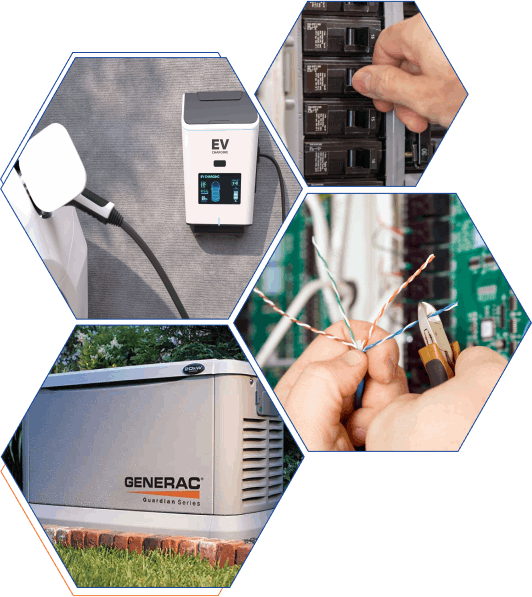

EV charger installation is the process of adding a dedicated 240V circuit and a Level 2 charging unit to your home electrical system, giving you fast, reliable overnight charging without depending on public stations. For homeowners across the Cleveland-Akron area, this upgrade is quickly becoming as standard as a garage door opener. The National Electrical Code governs every step, from load calculations under NEC 220.82 to circuit protection under NEC 625.41. Getting it right means working with a professional electrician, pulling the proper permits, and choosing hardware that matches your panel. Tri-County Services Electric & Plumbing has handled this work in Northeast Ohio since 1975. Ready to enjoy faster, more convenient charging at home? Call (440) 253-0332 today to schedule your EV charger installation consultation and make powering your vehicle easier than ever.
What electrical system requirements do you need for a Level 2 EV charger?
Your electrical panel is the starting point for any home EV charger installation. Before anything else, a load calculation under NEC 220.82 determines whether your existing panel can handle the added demand. Most 200A panels have enough capacity. Some 100A panels may require an upgrade depending on what else is already running.
The wiring and breaker size depend directly on the charger’s amperage rating. Per NEC 625.41, the breaker must be rated at 125% of the charger’s continuous load. That math works out like this:
-
32A charger: 40A double-pole breaker, 8 AWG copper wire
-
48A charger: 60A double-pole breaker, 6 AWG copper wire
-
GFCI protection: Required by code for all EV charger circuits
-
Dedicated circuit: The charger must have its own circuit, not shared with other appliances
You also need to decide between a NEMA 14-50 outlet and a hardwired connection. A NEMA 14-50 outlet lets you plug in and unplug the charger, which appeals to renters or homeowners who may move. The trade-off is a 40A continuous current ceiling and a physical outlet that can loosen over time. Hardwired installations skip the outlet entirely and connect directly to the panel, supporting higher amperage and eliminating that potential failure point.
Pro Tip: Before calling an electrician, count the open breaker slots in your panel and note your panel’s total amperage rating. That 30-second check gives you a clearer picture of what to expect before the first quote arrives.
How do you choose the right EV charger hardware for your home?
Charger hardware choice comes down to three factors: how long you plan to stay in the home, how much range you need per night, and what your panel can support. A 40A charger adds roughly 30 miles of range per hour, which covers the daily driving needs of most Cleveland-area commuters with hours to spare.

Plug-in chargers using a NEMA 14-50 outlet work well for renters or anyone who wants to take the unit when they move. The setup is straightforward, and the charger can be unplugged and reinstalled elsewhere. The downside is the 40A ceiling and the risk of outlet wear under repeated heavy use. Some lower-quality outlets have documented overheating problems under sustained load.
Hardwired chargers are the better choice for homeowners who plan to stay put. They support 48A and above, remove the outlet as a potential failure point, and align more cleanly with code requirements. The installation is permanent, but so is the benefit.
Smart chargers and load-shedding devices offer a third path worth knowing about. These devices share an existing 240V circuit with another appliance, such as a dryer, and alternate power delivery based on demand. This approach can avoid a panel upgrade entirely in homes where capacity is tight.
-
Plug-in (NEMA 14-50): Portable, easier to install, capped at 40A continuous
-
Hardwired: Permanent, supports 48A+, safer under heavy daily use
-
Smart/load-shedding: Shares existing circuits, avoids panel upgrades in some cases
Pro Tip: If you own your home and plan to charge every night, hardwire the unit. The cost difference over a plug-in setup is small, and the long-term reliability gain is significant.
What does the professional EV charger installation process look like?
The installation process follows a clear sequence, and knowing each step helps you set realistic expectations. The physical electrical work is often the fastest part. Permit cycles and inspections are what stretch the timeline to 1–3 weeks in most cases.
-
Panel assessment: The electrician performs a load calculation per NEC 220.82 to confirm available capacity and identify open breaker slots.
-
Permit application: A 240V circuit permit is filed with the local municipality. Permit fees typically run $75–$200 depending on the jurisdiction.
-
Electrical rough-in: The electrician installs a dedicated double-pole breaker, runs wire (Romex or conduit depending on the route), and mounts the charger unit.
-
Charger configuration: The charger’s internal current limit is set to match the breaker rating, a step that protects both the unit and the circuit.
-
Municipal inspection: An inspector verifies the work meets local code before the circuit is energized.
-
Final sign-off: The homeowner receives documentation confirming the installation passed inspection.
Permits are mandatory for 240V circuit installations in nearly all US jurisdictions. Unpermitted work can result in insurance denial and create serious problems when you sell your home. The permit is not a formality. It is legal protection for you as a homeowner.
The on-site labor typically runs 2–6 hours depending on how far the wire must travel and whether it passes through finished walls. A garage adjacent to the main panel is the easiest scenario. A detached garage or a charger mounted on an exterior wall far from the panel adds time and cost. Tri-County Services Electric & Plumbing handles permit filing and inspection coordination as part of the installation process, which removes the most common source of project delays for Cleveland-area homeowners.
What does EV charger installation cost in 2026?
Total cost depends on four variables: the charger hardware, labor, permits, and whether your panel needs an upgrade. A professional Level 2 installation without a panel upgrade runs $1,200–$3,500. If the panel needs upgrading, that total can reach $7,000.
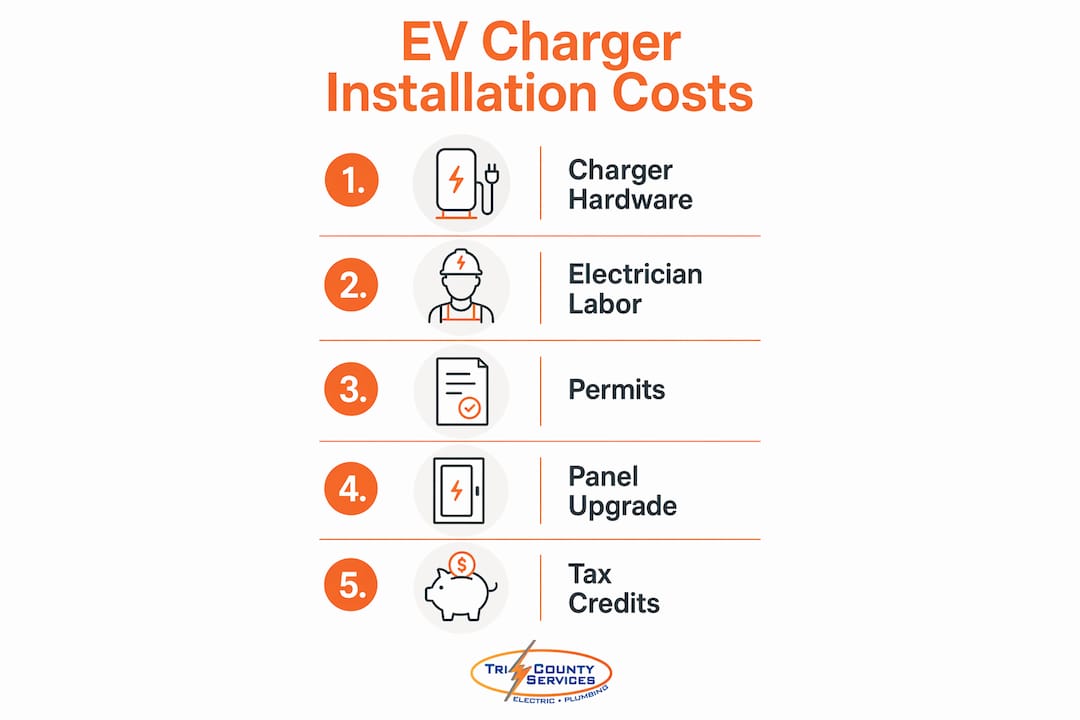
| Cost Component | Typical Range |
|---|---|
| Charger hardware | $400–$800 |
| Electrician labor | $800–$2,500 |
| Permit fees | $75–$200 |
| Panel upgrade (if needed) | $1,500–$3,500 additional |
Wire run distance is the biggest variable inside the labor figure. A short run from a panel to a garage wall takes far less time than routing conduit through a finished basement or across a long exterior wall. Getting two or three quotes from local electricians gives you a realistic range for your specific home layout.
The federal 30C tax credit offers 30% back on installation costs, up to $1,000, for units placed in service by june 30, 2026. Eligibility depends on census tract location. Roughly one-third of US addresses qualify. The Argonne National Laboratory census tract tool lets you check your address before you commit to a timeline.
Pro Tip: Ask each electrician to show you the load calculation before they quote a panel upgrade. Many homes with 200A panels do not need one. A quote that skips the calculation and jumps straight to an upgrade recommendation deserves a second opinion.
Key Takeaways
A successful home EV charger installation requires the right panel capacity, proper permits, and hardware matched to your long-term plans.
| Point | Details |
|---|---|
| Panel capacity first | Run an NEC 220.82 load calculation before assuming you need a panel upgrade. |
| Match breaker to charger | A 32A charger needs a 40A breaker; a 48A charger needs a 60A breaker with 6 AWG wire. |
| Hardwire for long-term use | Hardwired units support higher amperage and remove outlet failure risk for permanent installs. |
| Permits protect you | Unpermitted 240V work can void insurance and create home sale complications. |
| Tax credit deadline matters | The 30C federal credit covers 30% up to $1,000 for installs completed by june 30, 2026. |
What I’ve learned from years of EV charger installations in Northeast Ohio
By Lindsay Paramore
The question I hear most often is whether a homeowner really needs a panel upgrade. The honest answer is: less often than you might think. A proper NEC 220.82 load calculation almost always tells a different story than a quick visual inspection. I have seen too many homeowners pay for upgrades they did not need because no one ran the numbers first. Ask for the calculation in writing before you approve any additional scope.
Permits are the other area where I see homeowners try to cut corners. The logic is understandable. Permits add time and a small fee. But an unpermitted installation can void your homeowner’s insurance coverage for any fire or electrical incident, and it will surface during a home inspection when you sell. The permit is not bureaucracy. It is the paper trail that proves the work was done correctly.
My consistent recommendation for Cleveland-area homeowners who own their homes is to hardwire the charger. The cost difference over a plug-in setup is modest, and the reliability over years of daily charging is meaningfully better. If you are planning to stay in your home for five or more years, the hardwired option pays for itself in peace of mind alone. Tri-County Services Electric & Plumbing handles the full process, from load calculation through final inspection, so you are not managing permit paperwork on your own.
— Lindsay Paramore
Tri-County Services Electric & Plumbing handles your EV charger installation
Tri-County Services Electric & Plumbing has served Northeast Ohio homeowners since 1975, and EV charger installation is one of the most requested services the team handles today. Every project starts with a proper load calculation, not a guess, so you know exactly what your panel can support before any work begins.
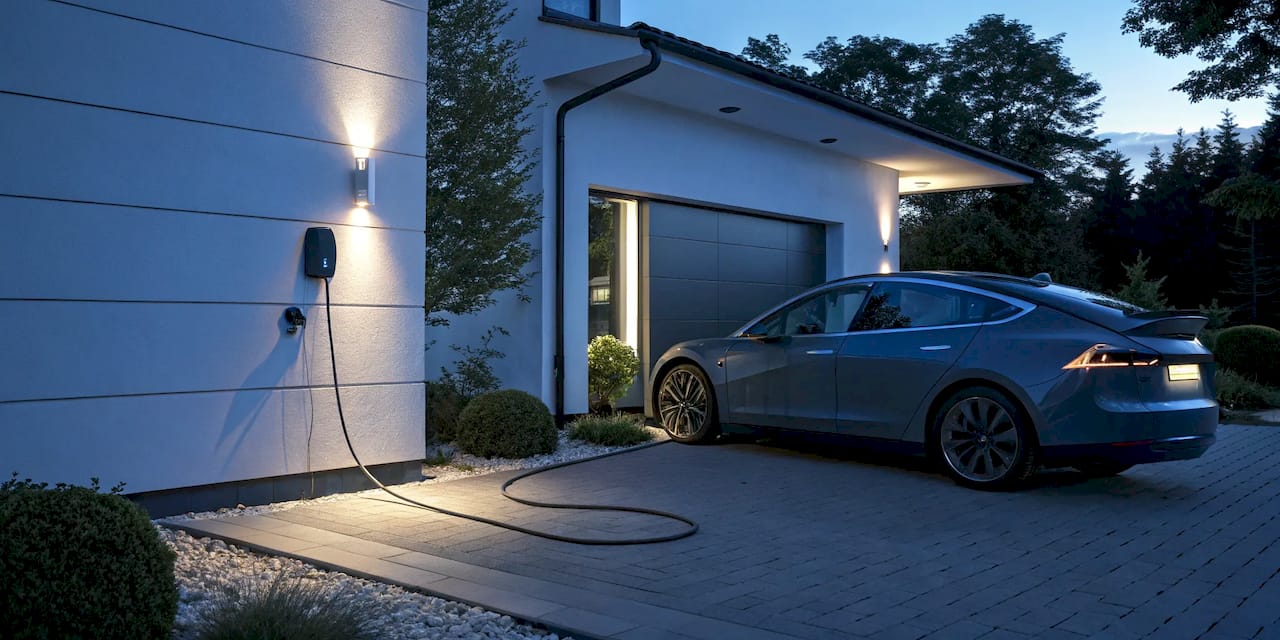
The team manages permit filing, electrical rough-in, charger mounting, and final inspection coordination from start to finish. That means no chasing down inspectors or wondering where your project stands. Tri-County serves the Cleveland, Akron, and Canton areas with a flexible schedule built around your availability. If your home needs a panel upgrade before the charger goes in, that work is handled by the same crew under one project. Call (440) 325-0136 or visit tricountyelectricservice.com to schedule your consultation.
FAQ
What is a Level 2 EV charger installation?
Level 2 EV charger installation is the process of adding a dedicated 240V circuit and a wall-mounted charging unit to your home, enabling significantly faster charging than a standard 120V outlet. A 40A Level 2 charger delivers roughly 30 miles of range per hour.
Do I need a permit for home EV charger installation?
Yes. Permits are required for 240V circuit installations in nearly all US jurisdictions. Skipping the permit can void your homeowner’s insurance and create problems when you sell your home.
How long does EV charger installation take?
The physical electrical work typically takes 2–6 hours on-site. The full project, including permit approval and final inspection, usually runs 1–3 weeks.
Should I choose a hardwired or plug-in EV charger?
Hardwired chargers are the better choice for homeowners planning to stay long-term. They support higher amperage, eliminate outlet wear, and align more cleanly with electrical code requirements than plug-in NEMA 14-50 setups.
What does home EV charger installation cost?
Without a panel upgrade, professional installation runs $1,200–$3,500, covering hardware, labor, and permits. If a panel upgrade is required, total costs can reach $7,000. The federal 30C tax credit may offset up to $1,000 for eligible installations completed by june 30, 2026.